Exercise may slightly calm the aging immune system, but the evidence is weak
How the immune system worksPart of a story we are following · 3 articles · See every update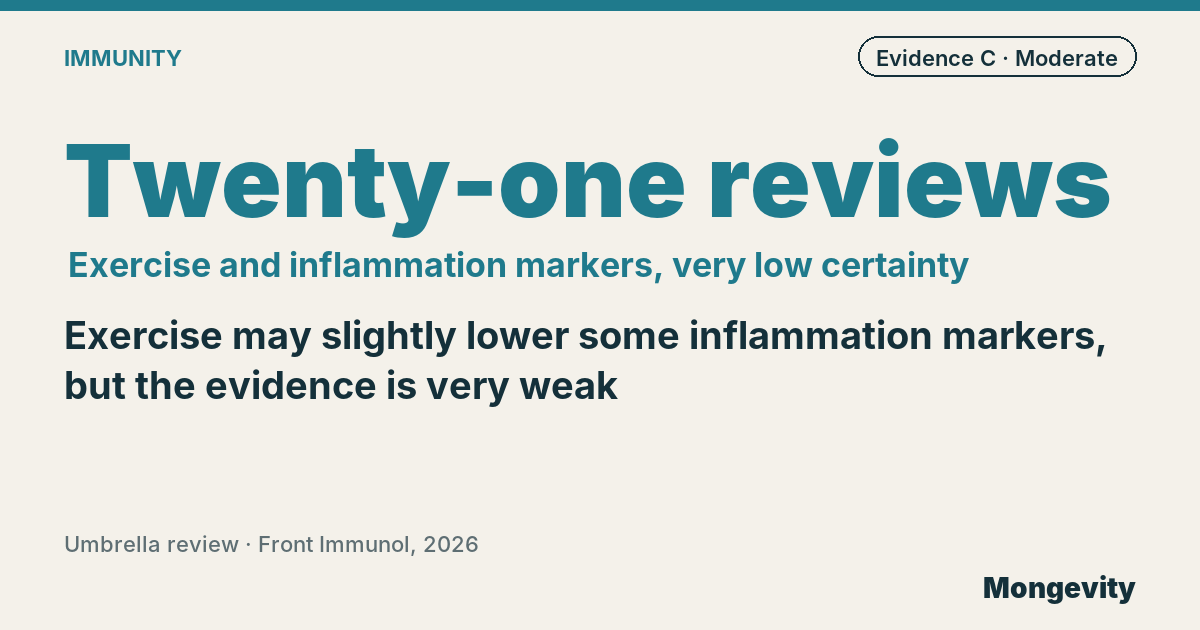
Exercise may produce small reductions in the inflammation markers TNF-alpha and CRP in older adults and people with chronic disease, while effects on IL-6 were inconsistent, according to an umbrella review of twenty-one reviews published Sept. 29, 2026, in Frontiers in Immunology. The evidence on how exercise shapes the aging immune system is very weak.
As we age, the immune system tends to stay in a state of mild, constant inflammation, sometimes called inflammaging, and its defenses become less sharp, a process called immunosenescence. Both are linked to many chronic diseases. Exercise is often said to calm this inflammation.
What did the study look at?
This was an umbrella review: instead of pooling individual trials, it gathered and appraised existing systematic reviews and meta-analyses. Researchers searched six databases up to March 2026 for reviews on exercise or physical activity and blood markers of inflammation or immune aging in older adults and adults with chronic diseases. They rated the quality of each review and the certainty of the evidence.
What did the study find about the immune system?
- Twenty-one reviews were included, 14 of them in the main synthesis.
- Exercise was linked to small reductions in TNF-alpha (estimates from −1.42 to −0.05) and CRP (−0.65 to −0.47), two common inflammation markers.
- Effects on IL-6, another key marker, were inconsistent (−0.81 to +0.09).
- Differences between studies were often high, up to 94%.
- Review quality was critically low in 11 reviews, and certainty was very low for every marker.
- There was almost no evidence on immune aging or cell aging markers.
Why does this matter?
Claims that exercise “reduces inflammation” are everywhere. This review shows that, at the level of blood markers, the signal is small and the evidence is weak. That doesn’t mean exercise isn’t good for you: its benefits for the heart, muscles, brain, mood and lifespan are well established through other outcomes.
How solid is this evidence?
It’s limited. Mongevity rates it C on our A-to-E scale: a careful, pre-registered umbrella review, but the reviews it summarizes were mostly of low quality and the certainty was very low. The authors note that excluding the weakest reviews weakened the apparent effect.
What are the open questions?
Well-designed trials measuring immune aging markers, and linking marker changes to health outcomes, are needed.
What does this mean for you?
Keep moving for the many proven benefits of exercise, not to change a lab number. A mix of aerobic activity, strength training and balance work, adapted to your health, is a good goal at any age.
How do I explain this at dinner?
People often say exercise lowers inflammation. Researchers pooled twenty-one reviews and found that it may lower a couple of inflammation markers a little, but the studies were weak. Exercise is still great for you, for many other reasons. A good question for the table: what keeps you moving even when you don’t feel like it?
In one sentence: exercise may produce small reductions in TNF-alpha and CRP in older adults and people with chronic diseases, but effects on IL-6 are inconsistent and certainty is very low.
Questions and answers
- What is inflammaging?
- A mild, chronic inflammation that tends to increase with age.
- Does exercise lower inflammation markers?
- It may slightly lower TNF-alpha and CRP; effects on IL-6 were inconsistent.
- How strong is the evidence?
- Very low certainty; most reviews were of low or critically low quality.
- Should I still exercise?
- Yes. Its benefits for health and lifespan are established through other outcomes.