Moving enough, sitting less and sleeping well together were linked to fewer heart events
Preventing heart diseasePart of a story we are following · 3 articles · See every update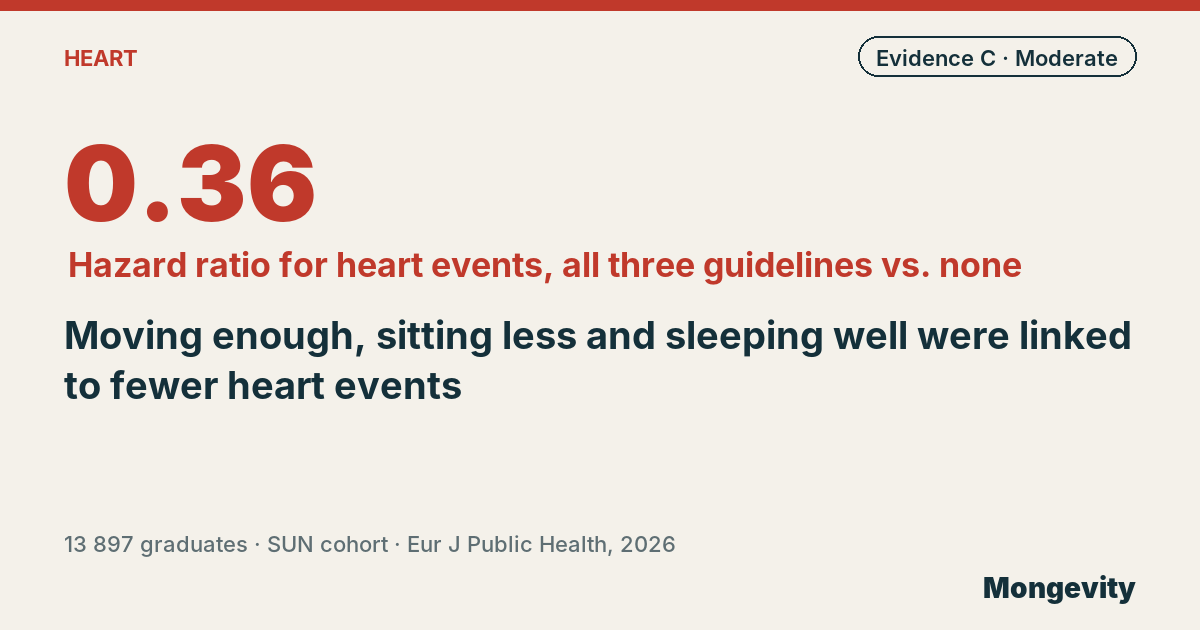
Meeting at least two of three daily movement guidelines, for activity, sitting and sleep, was linked to fewer cardiovascular events in a cohort of 13 897 Spanish university graduates followed for a mean 14.48 years, published Oct. 9, 2026, in European Journal of Public Health. The finding adds a simple, everyday angle to heart disease prevention.
The 24-hour movement guidelines look at the whole day, not just exercise: how active you are, how long you sit and how long you sleep.
What did the study do?
Researchers followed 13 897 Spanish university graduates in the SUN cohort, which began in 1999 with questionnaires every two years. They used the Canadian 24-hour movement guidelines:
- At least 150 minutes a week of moderate to vigorous physical activity.
- No more than 8 hours a day sitting.
- 7 to 9 hours of sleep a night, or 7 to 8 hours at 65 or older.
Each person got a score from 0 to 3. The main outcome was a heart attack, stroke or cardiovascular death.
What did the study find about heart disease prevention?
46.68% of participants met all three guidelines, and only 0.96% met none. Over a mean follow-up of 14.48 years, 148 cardiovascular events occurred.
| Guidelines met vs. none | Hazard ratio for cardiovascular events |
|---|---|
| Two | 0.37 |
| Three | 0.36 |
Why does this matter?
The results support thinking about health across the whole day: moving more, breaking up sitting and protecting sleep may work together for the heart. Meeting at least two seemed to make a meaningful difference.
How solid is this evidence?
It’s moderate. Mongevity rates it C on our A-to-E scale: a long-running prospective cohort with careful adjustment. Limits: participants were highly educated and fairly healthy, events were few, especially in the very small group meeting no guidelines, which makes the estimates imprecise, and behaviors were self-reported.
What are the open questions?
Studies in more diverse populations and with objective measures, such as activity trackers, are needed, as well as trials testing whole-day changes.
What does this mean for you?
Check your day against the three targets. If you sit for long periods, stand up and move regularly. Aim for 150 minutes of brisk walking or similar activity a week, and protect a regular 7 to 9 hours of sleep.
How do I explain this at dinner?
In a long study of Spanish graduates, people who got enough exercise, didn’t sit too much and slept 7 to 9 hours had far fewer heart attacks and strokes than those who met none of these. Meeting just two of the three already helped. A good question for the table: which of the three is hardest for you?
In one sentence: meeting at least two of the 24-hour movement guidelines, for activity, sitting and sleep, was linked to fewer cardiovascular events in a long-running Spanish cohort.
Questions and answers
- What are the 24-hour movement guidelines?
- Targets for activity (150 minutes a week), sitting (8 hours a day or less) and sleep (7 to 9 hours).
- Were they linked to fewer heart events?
- Meeting two (hazard ratio 0.37) or three (0.36) guidelines was linked to fewer events than meeting none.
- How many people met all three?
- 46.68% of participants.