For frail older adults, a high-dose flu shot may offer more protection
FrailtyPart of a story we are following · 3 articles · See every update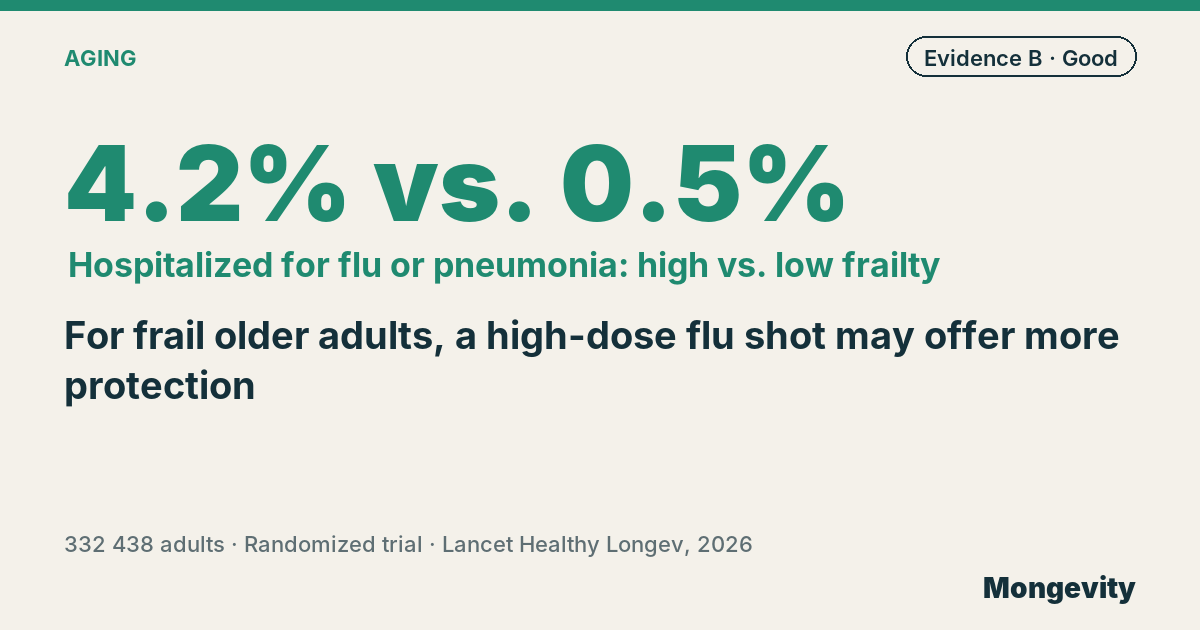
The advantage of a high-dose flu vaccine over a standard dose seemed to grow with frailty in an analysis of the Danish DANFLU-2 trial of 332 438 adults 65 and older, published in September 2026 in The Lancet Healthy Longevity, though estimates were uncertain. Frailty may help decide who benefits most.
Frail older adults are more likely to get seriously ill from the flu, and their immune systems may respond less to vaccines. High-dose flu vaccines were developed to give older people a stronger response.
What did the study do?
The DANFLU-2 trial in Denmark randomly assigned 332 438 adults aged 65 or older, over three flu seasons from 2022-23 to 2024-25, to a high-dose or standard-dose flu vaccine. Frailty risk was measured with a score based on past hospital diagnoses and grouped as low, intermediate or high. The main outcome was hospitalization for flu or pneumonia.
What did the study find about frailty?
Hospitalization for flu or pneumonia rose sharply with frailty:
| Frailty risk | Hospitalized | Advantage of high dose (relative effectiveness) |
|---|---|---|
| Low | 0.5% | 0.2% |
| Intermediate | 1.5% | 13.1% |
| High | 4.2% | 19.9% |
When frailty was treated as a continuous score, the advantage of the high-dose vaccine grew significantly with frailty. But in the prespecified frailty groups, the difference wasn’t statistically significant, and each group’s estimate was imprecise. Serious adverse events rose with frailty but were similar for both vaccines.
Why does this matter?
Frail older adults are at the highest risk from flu. If high-dose vaccines protect them more, prioritizing these vaccines for frail people could prevent hospital stays.
How solid is this evidence?
It’s good, with caveats. Mongevity rates it B on our A-to-E scale: a prespecified analysis of a very large randomized trial. But the authors call the results exploratory: confidence intervals crossed no effect in each group, frailty was measured from hospital records, and the trial was open-label and funded by a vaccine maker.
What are the open questions?
More studies are needed to confirm whether frail people gain more from high-dose vaccines and to identify who benefits most.
What does this mean for you?
If you’re 65 or older, get a flu vaccine every season. If you or an older relative are frail, ask your doctor or pharmacist whether a high-dose or enhanced flu vaccine is available and recommended.
How do I explain this at dinner?
In a huge Danish trial, frail older adults were much more likely to be hospitalized with flu or pneumonia, and a stronger flu shot seemed to help them a bit more than a standard one. A good question for the table: who in your family should get the stronger flu shot?
In one sentence: the advantage of a high-dose flu vaccine over a standard dose seemed to grow with frailty in older adults, an exploratory finding that supports considering high-dose vaccines for frail people.
Questions and answers
- What is a high-dose flu vaccine?
- A flu vaccine with more antigen, designed to give older adults a stronger immune response.
- Did frailty change its effect?
- Its advantage grew with frailty as a continuous score, but subgroup estimates were imprecise.
- How much more were frail people hospitalized?
- 4.2% with high frailty risk vs. 0.5% with low frailty risk.