A shorter pill schedule for advanced colon cancer worked as well, with fewer side effects
Colorectal cancerPart of a story we are following · 6 articles · See every update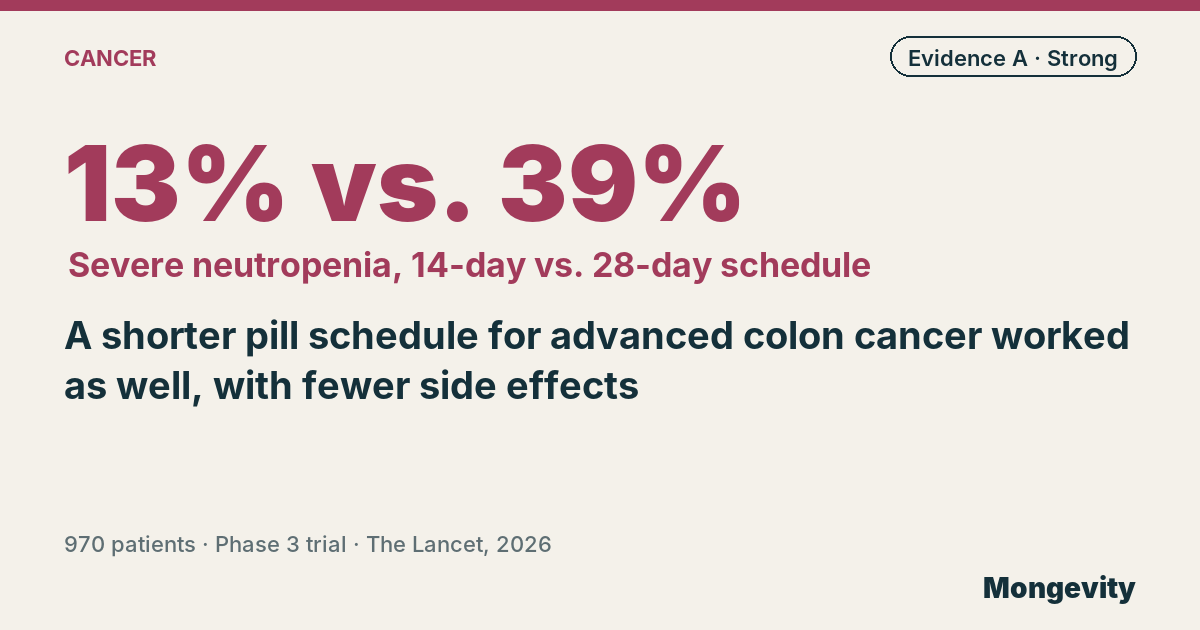
A 14-day schedule of trifluridine-tipiracil plus bevacizumab was as good for survival as the standard 28-day one in advanced colorectal cancer, with far less severe neutropenia (13% vs. 39%), in the PRABITAS trial in Japan published Oct. 24, 2026, in The Lancet. A gentler schedule may make treatment easier.
When metastatic colorectal cancer keeps growing after standard treatments, a common next step is trifluridine-tipiracil, a chemotherapy pill, plus bevacizumab, a drug given by IV. The usual 28-day schedule often lowers white blood cells and causes stomach problems.
What did the trial test?
At 178 hospitals in Japan, 970 people with refractory metastatic colorectal cancer were assigned by chance to the conventional 28-day schedule (pills on days 1-5 and 8-12, IV on days 1 and 15) or a 14-day schedule (pills on days 1-5, IV on day 1). The trial was pragmatic: it used broad eligibility and routine practice. The question was whether the shorter schedule was not worse for survival.
What did the study find about colorectal cancer?
| Severe neutropenia, 14-day | 13% |
|---|---|
| Severe neutropenia, 28-day | 39% |
| Loss of appetite, 14-day | 15% |
| Loss of appetite, 28-day | 26% |
The hazard ratio was 0.93, which met the non-inferiority goal. Two treatment-related deaths occurred in the 14-day group and none in the 28-day group.
Why does this matter?
At this stage of the disease, quality of time counts as much as length. A schedule that keeps survival the same while sharply cutting side effects is a real gain, and the authors propose it as the new standard.
What questions remain?
Doctors will want to see mature overall survival data, longer follow-up on side effects and results in more diverse populations. They will also want to know how this option fits with other new treatments, and which patients benefit most, before it changes routine care everywhere.
How solid is this evidence?
It’s strong. Mongevity rates it A on our A-to-E scale: a large randomized phase 3 trial in routine practice. Limits: it was open-label, done only in Japan, and the 14-day group had two treatment-related deaths.
What does this mean for you?
If you or someone close to you is receiving trifluridine-tipiracil with bevacizumab, ask the oncologist about the 14-day schedule. Colon cancer screening from the recommended age remains the best way to catch it early.
How do I explain this at dinner?
For advanced colon cancer, doctors in Japan tried giving the same pills for fewer days each month. People lived just as long and had far fewer side effects. A good question for the table: why isn’t more medicine always better?
In one sentence: a 14-day schedule of trifluridine-tipiracil plus bevacizumab was as good for survival as the 28-day one in advanced colorectal cancer, with fewer side effects.
Questions and answers
- What is trifluridine-tipiracil?
- A chemotherapy pill used for metastatic colorectal cancer that keeps growing after standard treatments.
- Is the shorter schedule as effective?
- Yes: median survival was 11.3 vs. 10.3 months, meeting the non-inferiority goal.
- Does it cause fewer side effects?
- Severe neutropenia fell from 39% to 13%.