More people with rectal cancer are skipping surgery to ‘watch and wait’
Colorectal cancerPart of a story we are following · 6 articles · See every update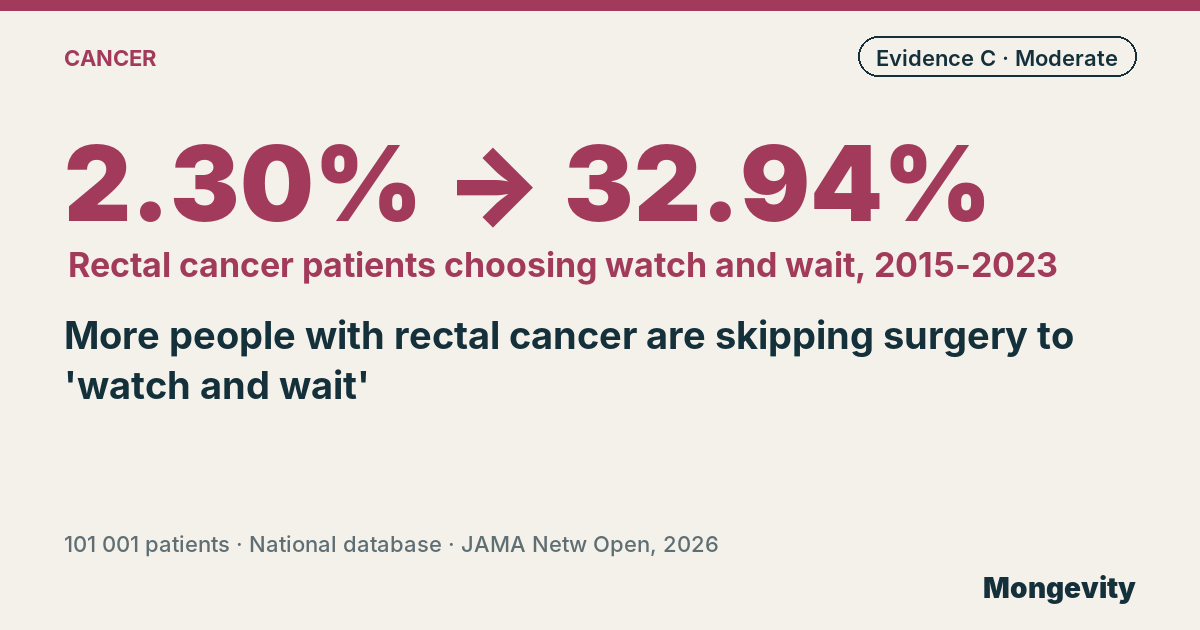
Skipping surgery to ‘watch and wait’ after a strong response to treatment rose from 2.30% of US rectal cancer patients in 2015 to 32.94% in 2023, in a national study published Oct. 1, 2026, in JAMA Network Open. Organ preservation is reshaping colorectal cancer care.
For stage II to III rectal cancer, standard care has long been chemotherapy and radiation followed by surgery to remove the rectum, which can mean a permanent colostomy bag. But some tumors disappear completely with treatment. In those cases, a strategy called “watch and wait” skips surgery and instead monitors closely, keeping the rectum.
What did the study do?
Researchers used the National Cancer Database, which covers hospitals accredited by the Commission on Cancer, to study 101 001 people diagnosed with stage II to III rectal cancer between 2006 and 2023 who received chemotherapy and radiation first. They estimated how many didn’t have surgery beyond what would be expected for other reasons, such as poor health.
What did the study find about colorectal cancer?
- Watch and wait rose from 2.30% of patients in 2015 to 32.94% in 2023.
- The pace sped up: about 9.83% more each year from 2015 to 2018, and 21.71% more each year from 2019 to 2023.
- Older patients adopted it earlier: people 80 or older passed a 10-point excess by 2017, while people under 50 did so only by 2021.
- Diagnosis in 2023 vs. 2006 (odds ratio 6.23) and age 80 or older vs. under 50 (4.25) were each linked to not having surgery.
Why does this matter?
Avoiding surgery can preserve bowel function and quality of life. The sharp rise after 2019 matches growing evidence and guidelines supporting watch and wait for well-selected patients.
How solid is this evidence?
It’s moderate. Mongevity rates it C on our A-to-E scale: a very large national database, but it estimates watch and wait indirectly, from patients who didn’t have surgery, and it doesn’t report cancer outcomes such as regrowth or survival.
Why does monitoring matter so much?
In some people the tumor grows back. Watch and wait only works with strict, regular checks, including exams, endoscopy and imaging, so that any regrowth is caught early and treated.
What does this mean for you?
If you or someone close to you has rectal cancer that responded very well to treatment, ask whether watch and wait is an option, what monitoring it requires and what the risk of regrowth is. Start colon and rectal cancer screening at the recommended age.
How do I explain this at dinner?
For some people with rectal cancer, the tumor vanishes with chemo and radiation. More and more of them now skip surgery and get checked closely instead, keeping their bowel working normally. A good question for the table: when is less treatment the better choice?
In one sentence: in the US, watch and wait for rectal cancer rose from 2.30% of patients in 2015 to 32.94% in 2023, making careful selection and monitoring essential.
Questions and answers
- What is watch and wait?
- Skipping rectal surgery after a complete response to chemotherapy and radiation, with close monitoring instead.
- How common is it now?
- In this US database, it rose from 2.30% of patients in 2015 to 32.94% in 2023.
- Is it safe?
- It can be for well-selected patients, with strict follow-up to catch any regrowth early.