Keyhole surgery for colon cancer in the liver had fewer complications and equal survival
Colorectal cancerPart of a story we are following · 6 articles · See every update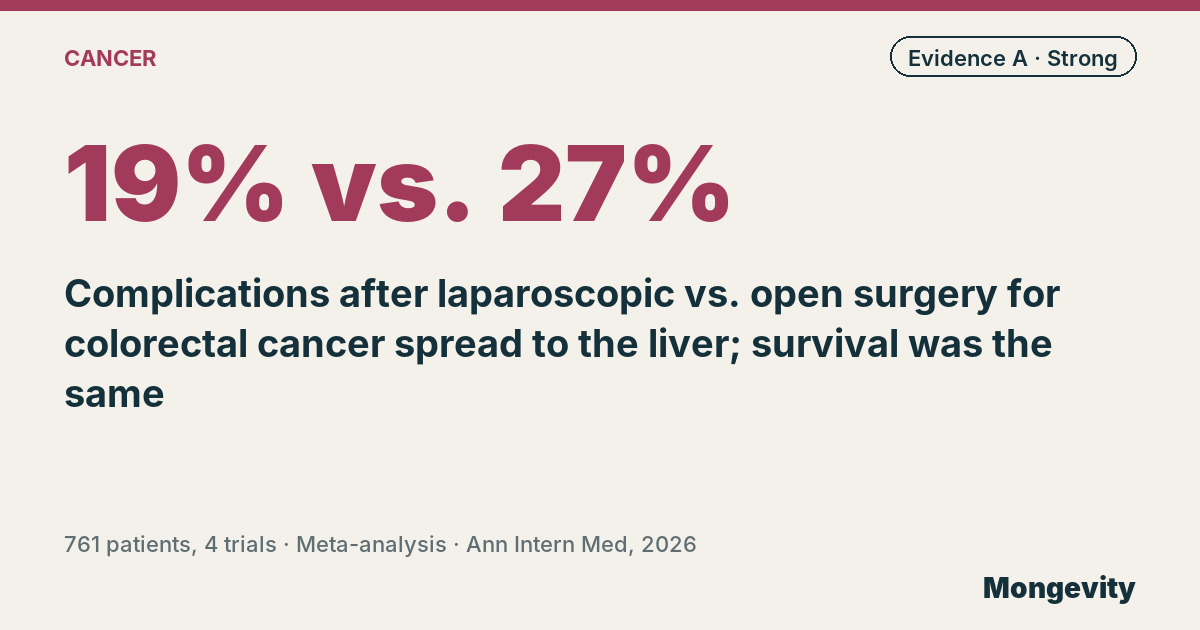
Laparoscopic surgery for colorectal cancer that spread to the liver had fewer complications than open surgery, 19% vs. 27%, with similar long-term survival, in a meta-analysis of every randomized trial published Oct. 27, 2026, in Annals of Internal Medicine. Keyhole surgery is a solid option for these patients.
Colorectal cancer often spreads to the liver, and surgery to remove those metastases can be curative. Surgeons can operate through a large open incision or with laparoscopic, keyhole surgery.
Laparoscopic surgery led to fewer complications, with the same long-term survival.
What did the study include?
761 patients from 4 randomized trials: 384 assigned to laparoscopic surgery and 377 to open surgery. The researchers obtained each patient’s data, including unpublished data, and followed outcomes for a median of 93 months.
What did the study find about colorectal cancer?
| Laparoscopic | Open | |
|---|---|---|
| Complications after surgery | 19% | 27% |
| Complications, after chemotherapy before surgery | 25% | 24% |
| Death within ninety days | 1.8% | 0.8% |
| Long-term overall and disease-free survival | no difference | no difference |
The advantage in complications disappeared in patients who had received chemotherapy or other systemic therapy before surgery. Early deaths were rare in both groups; the slightly higher figure after laparoscopic surgery was small and based on few events, so it should be interpreted with caution.
Why does this matter?
Fewer complications usually mean shorter hospital stays, less pain and a faster return to daily life. Knowing that the cancer outcomes are the same helps patients and surgeons choose the less invasive approach when it’s feasible. Because the analysis used each patient’s data from every published trial, it gives the clearest answer available so far to a question surgeons have debated for years.
How solid is this evidence?
It’s strong. Mongevity rates it A on our A-to-E scale: an individual participant data meta-analysis of every published randomized trial, with long follow-up. Limits: the analysis was restricted to variables available in all trials, and laparoscopic liver surgery requires experienced centers.
What does this mean for you?
If you or someone close to you needs surgery for colorectal cancer that spread to the liver, ask whether a laparoscopic approach is possible in your case and how much experience the team has with it. The best choice depends on the number and location of the metastases.
How do I explain this at dinner?
Surgeons can remove cancer spots from the liver through a big cut or through small holes with a camera. The small-holes method caused fewer problems after surgery, and people lived just as long. A good question for the table: why can doing something through a smaller door be better?
In one sentence: laparoscopic surgery for colorectal cancer that spread to the liver caused fewer complications than open surgery, with the same long-term survival.
Questions and answers
- Is laparoscopic liver surgery as good as open surgery for colorectal metastases?
- For long-term survival, yes: overall and disease-free survival didn't differ in this meta-analysis of 4 trials.
- Does it cause fewer complications?
- Yes: 19% vs. 27%, though not in patients who received systemic therapy before surgery.
- Was there any downside?
- Death within ninety days was 1.8% after laparoscopic and 0.8% after open surgery.