Blocking a tumor ‘shield’ protein may boost immunotherapy before bladder surgery
Bladder cancerPart of a story we are following · 2 articles · See every update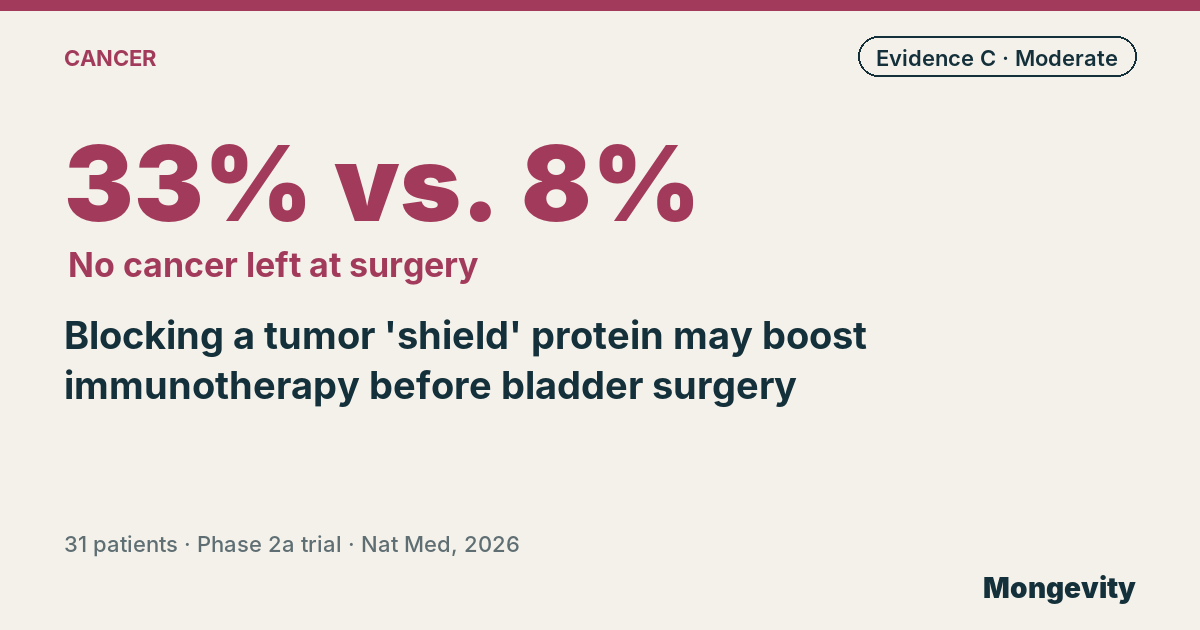
Adding visugromab, which blocks the protein GDF-15, to nivolumab before bladder surgery led to no remaining cancer in 33% of patients vs. 8% with nivolumab alone, in a small phase 2a trial published Oct. 24, 2026, in Nature Medicine. It is an early lead against bladder cancer.
Muscle-invasive bladder cancer is usually treated with surgery to remove the bladder, often after chemotherapy with cisplatin. But many patients can’t receive cisplatin. Immunotherapy before surgery is an option, yet tumors often resist it. One reason may be GDF-15, a protein made in large amounts by these tumors that seems to keep immune cells out.
What did the trial test?
Thirty-one patients with newly diagnosed muscle-invasive bladder cancer who couldn’t or wouldn’t receive cisplatin got three cycles of nivolumab, an immunotherapy, plus either visugromab, an antibody that neutralizes GDF-15 (16 patients), or a placebo (15 patients), before surgery. Patients were allocated in sequence, not at random, and only patients didn’t know which they received.
What did the study find about bladder cancer?
| Nivolumab + visugromab | Nivolumab + placebo | |
|---|---|---|
| No cancer left at surgery | 33% | 8% |
| Major response in the tissue | 60% | 23% |
| Tumor shrinkage on scans | 60% | 15% |
| Serious treatment side effects | 13% | 20% |
No one had to stop treatment or delay surgery because of side effects. Responses to the combination were linked to more active killer T cells in the tumor at the start.
Why does this matter?
If GDF-15 helps tumors resist immunotherapy, blocking it could make treatments work for more people. These early results are encouraging enough for larger trials.
How solid is this evidence?
It’s moderate. Mongevity rates it C on our A-to-E scale: a placebo-controlled trial, but very small, not randomized and only single-blinded. The wide uncertainty means the true difference could be much smaller.
What are the open questions?
A larger randomized trial is needed to confirm the benefit, test long-term survival and identify which patients are most likely to respond.
What does this mean for you?
If you or someone close to you has muscle-invasive bladder cancer and can’t receive cisplatin, ask whether immunotherapy before surgery or clinical trials are options. Seeing blood in the urine, even once, is a reason to see a doctor.
How do I explain this at dinner?
Some bladder tumors make a protein that acts like a shield against the immune system. In a small trial, blocking that shield before surgery helped an immune drug wipe out the cancer in more people. A good question for the table: why might cancers develop shields at all?
In one sentence: in a small trial, adding visugromab to nivolumab before bladder surgery left no remaining cancer in more patients, a signal that needs larger trials.
Questions and answers
- What is GDF-15?
- A protein that bladder tumors make in large amounts and that may help them resist immunotherapy.
- What did visugromab do?
- Combined with nivolumab, it left no cancer at surgery in 33% of patients vs. 8% with nivolumab alone.
- Is it available?
- No: it's experimental and needs larger randomized trials.