Mailing colon cancer test kits raised screening at first, but the gain faded by year 3
Colorectal cancerPart of a story we are following · 6 articles · See every update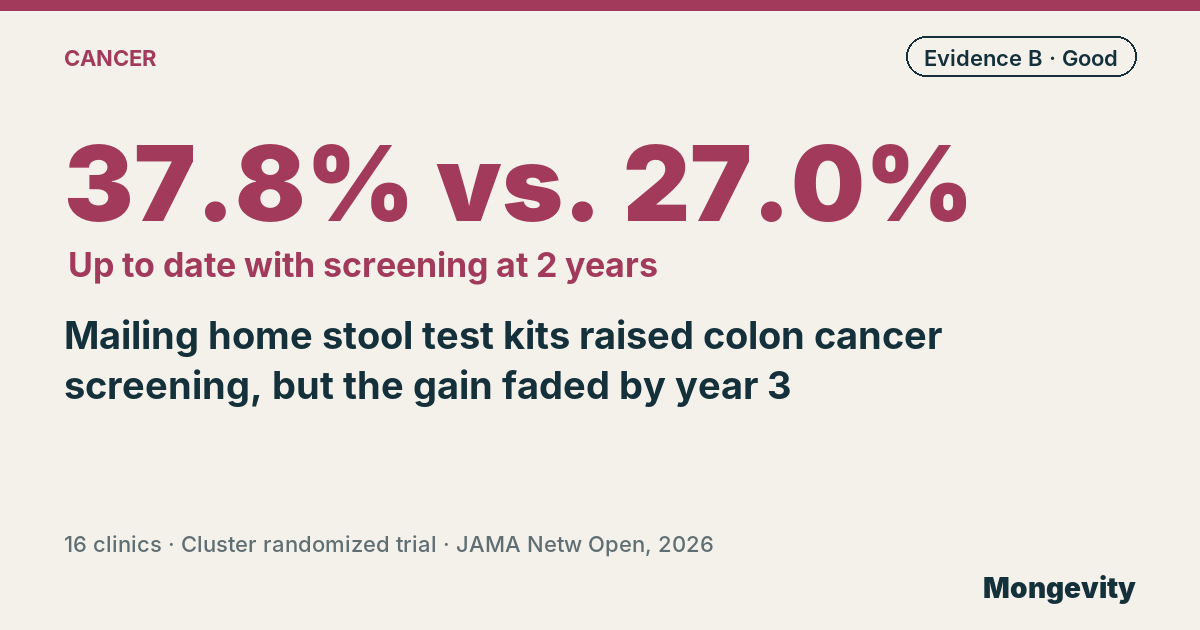
Mailed stool test kits raised colon cancer screening at 2 years, 37.8% vs. 27.0%, but the difference at 3 years was not significant, in a trial in Southern California community health centers published Oct. 1, 2026, in JAMA Network Open. Keeping colorectal cancer screening up takes more than one mailing.
Colorectal cancer is one of the cancers that screening can actually prevent, because doctors can find and remove growths before they turn dangerous. Yet many people never get screened, especially in underserved communities. One simple idea is to mail people a stool test kit at home.
What is a FIT kit?
FIT stands for fecal immunochemical test. It detects tiny amounts of blood in a stool sample, which can be a sign of polyps or cancer. You take the sample at home and mail it back. A positive result leads to a colonoscopy.
What did the trial test?
The trial ran between June 1, 2021, and May 31, 2024, at 16 clinics from 2 federally qualified health centers in Southern California. These centers serve many low-income patients. Clinics, not individuals, were assigned by chance to mailed FIT outreach or usual care for patients aged 50 to 75 years who were not up to date with screening. The outreach included an educational primer, the FIT kit and telephone reminders, sent once a year.
What did the study find about colorectal cancer?
| Up to date with screening | Mailed FIT clinics | Usual care clinics |
|---|---|---|
| At 2 years | 37.8% | 27.0% |
| At 3 years | 39.4% | 36.5% |
At 2 years the difference was 10.8 percentage points. At 3 years it was 2.9 percentage points, which was not statistically significant.
Why did the gain fade?
The researchers point to a change in the plan: because of limited resources, mailings started earlier in year 3, so some people who had done the test in year 2 weren’t due again yet. They also note that keeping the program running as designed, with ongoing support, is needed for a steady effect.
How solid is this evidence?
It’s good. Mongevity rates it B on our A-to-E scale: a randomized trial in real clinics, but randomized by clinic, with fewer clinics in the intervention group and a protocol change that complicates the final result. It measured screening, not cancer deaths.
What does this mean for you?
If you’re in the age range your country recommends, ask whether you’re up to date with colon cancer screening. If your clinic offers a home stool test, it’s an easy option; if it comes back positive, the follow-up colonoscopy is the step that counts.
How do I explain this at dinner?
Clinics mailed people a simple at-home test for colon cancer. In the second year, many more people got screened. By the third year the gap had narrowed, partly because of how the mailings were timed. A good question for the table: when did you last get screened?
In one sentence: mailing stool test kits raised colon cancer screening in community clinics at 2 years, but keeping the gain needs steady support.
Questions and answers
- What is a FIT test?
- A home stool test that detects hidden blood, a possible sign of polyps or colorectal cancer.
- Did mailing kits work?
- At 2 years screening was 37.8% vs. 27.0%; at 3 years the difference was not statistically significant.
- What happens if the test is positive?
- A colonoscopy is needed to find the cause and remove any polyps.