For healthy aging, exercise plus an active social life added years free of memory problems
Who gets to age wellPart of a story we are following · 4 articles · See every update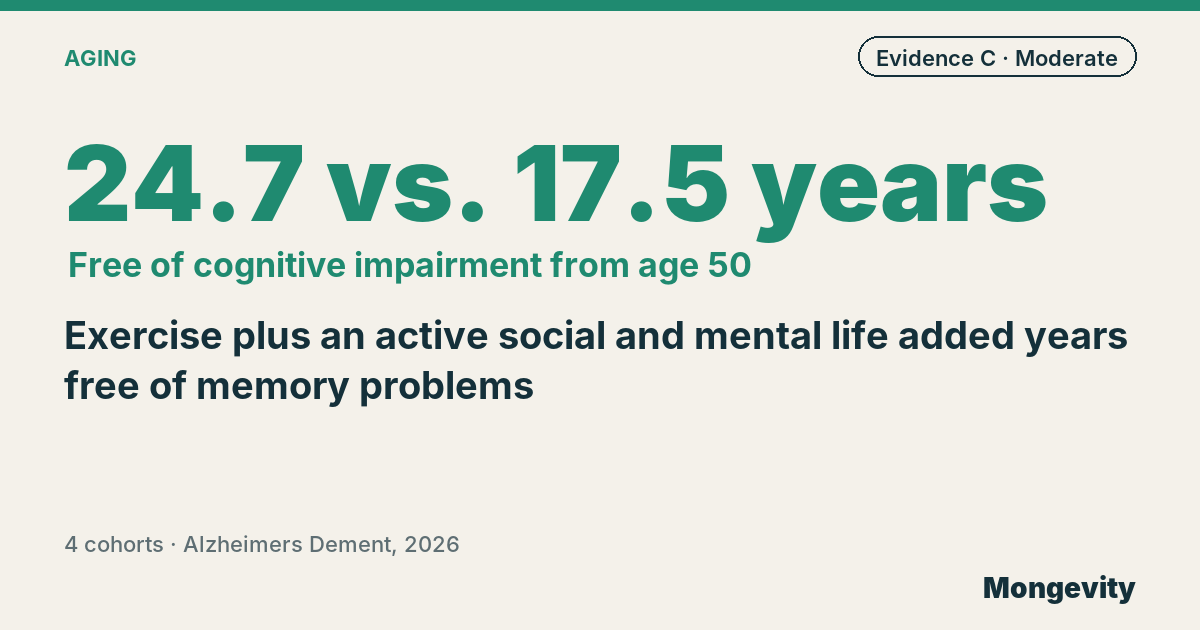
People high in both exercise and social-mental engagement could expect 24.7 years free of cognitive impairment from age 50, vs. 17.5 for those low in both, in a study of four aging cohorts across Asia, North America and Europe published in October 2026 in Alzheimer’s & Dementia. Healthy aging seems to build on several habits at once.
Staying physically active and staying mentally and socially engaged, through reading, hobbies, volunteering or seeing friends, are both linked to healthier brain aging. But can one make up for the other? If you don’t exercise, can an active social life compensate?
What did the study do?
Researchers combined repeated data from four large aging cohorts in Asia, North America and Europe. At each wave, they classified people into four groups: low exercise and low engagement, high exercise and low engagement, low exercise and high engagement, or high in both. They then estimated how many years people could expect to live without cognitive impairment, starting at age 50.
What did the study find about healthy aging?
The authors conclude that structured exercise and cognitive-social engagement have combined benefits that aren’t interchangeable: one doesn’t fully replace the other.
Why does this matter?
The gap between the lowest and highest groups is large. It suggests that dementia prevention works best as a package, moving the body and keeping the mind and social life busy, rather than picking just one habit.
How solid is this evidence?
It’s moderate. Mongevity rates it C on our A-to-E scale: a large multinational analysis with repeated measures and an intuitive outcome. But it’s observational: people who exercise and socialize may be healthier and better off in other ways, and people with early memory problems may already be withdrawing from both. The abstract gives few details on how activities were measured.
What are the open questions?
Trials that combine exercise with social and cognitive activities, like some multidomain prevention programs, are needed to show how many years can really be gained, and how much of each activity is enough.
What does this mean for you?
Think in pairs: combine regular physical activity, such as brisk walking, dancing, cycling or strength training, with activities that challenge your mind and connect you with others, such as clubs, classes, volunteering or games with friends. A walking group does both at once.
How do I explain this at dinner?
People who both exercised and kept busy with friends and hobbies could expect several more years without memory problems after 50 than people who did neither. Doing just one helped less. A good question for the table: what activity could you do that moves your body and your mind together?
In one sentence: exercise and an active social and mental life were each linked to more years free of cognitive impairment, and together the gain was largest.
Questions and answers
- Can social activities replace exercise for the brain?
- Not fully: the benefits were combined and not interchangeable.
- How big was the difference?
- From age 50, 24.7 years free of cognitive impairment for high exercise and engagement vs. 17.5 for low in both.
- What counts as engagement?
- Cognitive and social activities such as hobbies, learning, volunteering and time with others.