With aging, memory problems plus frailty were tied to heart, kidney and metabolic disease
Who gets to age wellPart of a story we are following · 4 articles · See every update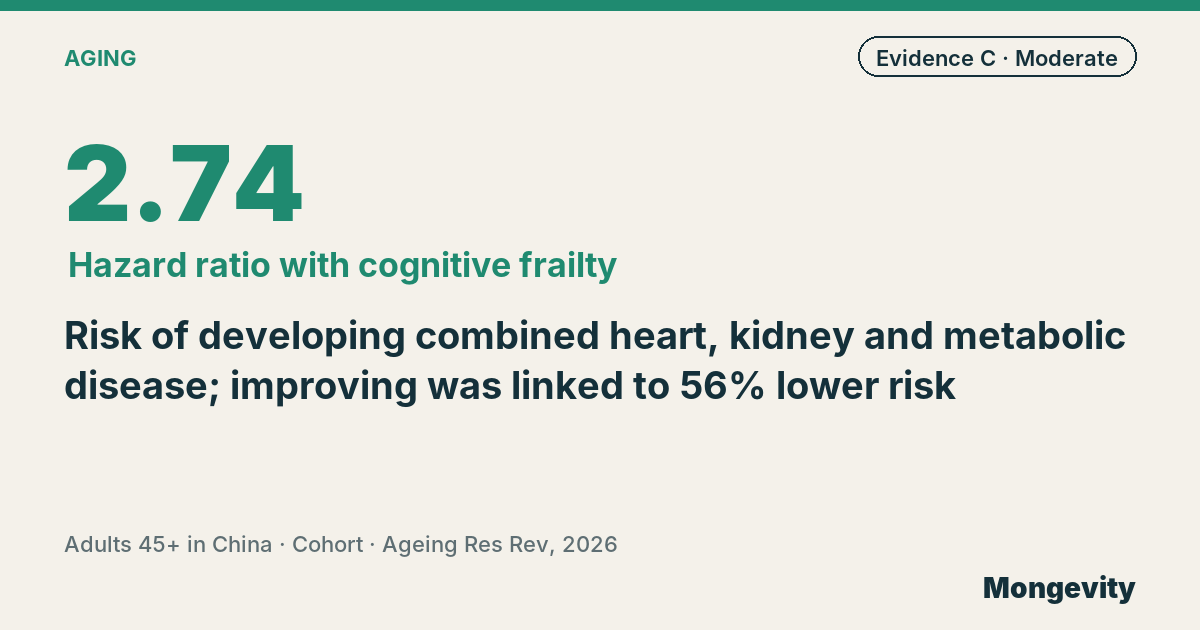
Middle-aged and older adults in China with cognitive frailty had a 2.74 hazard ratio for developing combined heart, kidney and metabolic disease, in a national cohort published Oct. 30, 2026, in Ageing Research Reviews. Improving to robust health was linked to a 56% lower risk, a hopeful message for healthy aging.
Cognitive frailty is when physical frailty and memory or thinking problems happen together.
People with cognitive frailty were much more likely to develop this cluster, and those who improved had a lower risk.
What did the study look at?
Researchers used the China Health and Retirement Longitudinal Study (CHARLS), following adults aged 45 and older from 2011 to 2018. Out of 9,816 participants, 3,836 were included in the main analysis and 1,891 in the analysis of changes over time. People were classified as robust, with reversible cognitive frailty, or with potentially reversible cognitive frailty.
What did the study find about healthy aging?
| Group | Risk of CKM multimorbidity (hazard ratio) |
|---|---|
| Reversible cognitive frailty | 2.74 |
| Potentially reversible cognitive frailty | 2.51 |
| Improving from reversible frailty to robust | 0.44 |
Improving from reversible cognitive frailty to robust health was linked to a 56% lower risk, while getting worse was linked to a much higher risk. The bigger the change in cognition, the bigger the change in risk. Cognitive status added information beyond physical frailty alone.
Why does this matter?
Brain health and heart, kidney and metabolic health are often managed separately. This study suggests they’re connected, and that checking memory and thinking could help identify people at higher risk.
How solid is this evidence?
It’s moderate. Mongevity rates it C on our A-to-E scale. It’s a large national cohort, but observational: it can’t show that improving cognition lowers disease risk. Many participants were excluded from each analysis, and the findings come from China.
What does this mean for you?
Staying physically active, socially engaged and mentally stimulated supports both brain and body. If you or an older relative notice memory problems along with weakness or slowing down, mention both at the next medical visit. Keeping blood pressure, blood sugar and cholesterol under control protects the heart and kidneys, and is also good for the brain.
How do I explain this at dinner?
Scientists found that older people who were both physically weak and forgetful were more likely to develop problems with their heart, kidneys and sugar levels. Those who got better had less risk. A good question for the table: what keeps both your body and your mind strong?
In one sentence: cognitive frailty was linked to a higher risk of combined heart, kidney and metabolic disease, and improving it was linked to a lower risk.
Questions and answers
- What is cognitive frailty?
- When physical frailty and problems with memory or thinking occur together.
- How is it linked to heart, kidney and metabolic disease?
- In this study, cognitive frailty was linked to a 2.74 hazard ratio for developing at least two of these conditions.
- Can improving help?
- Improving from reversible cognitive frailty to robust health was linked to a 56% lower risk, though the study can't prove cause.