A scan-guided plan let some women with HER2+ breast cancer skip chemotherapy
Breast, ovarian and uterine cancerPart of a story we are following · 8 articles · See every update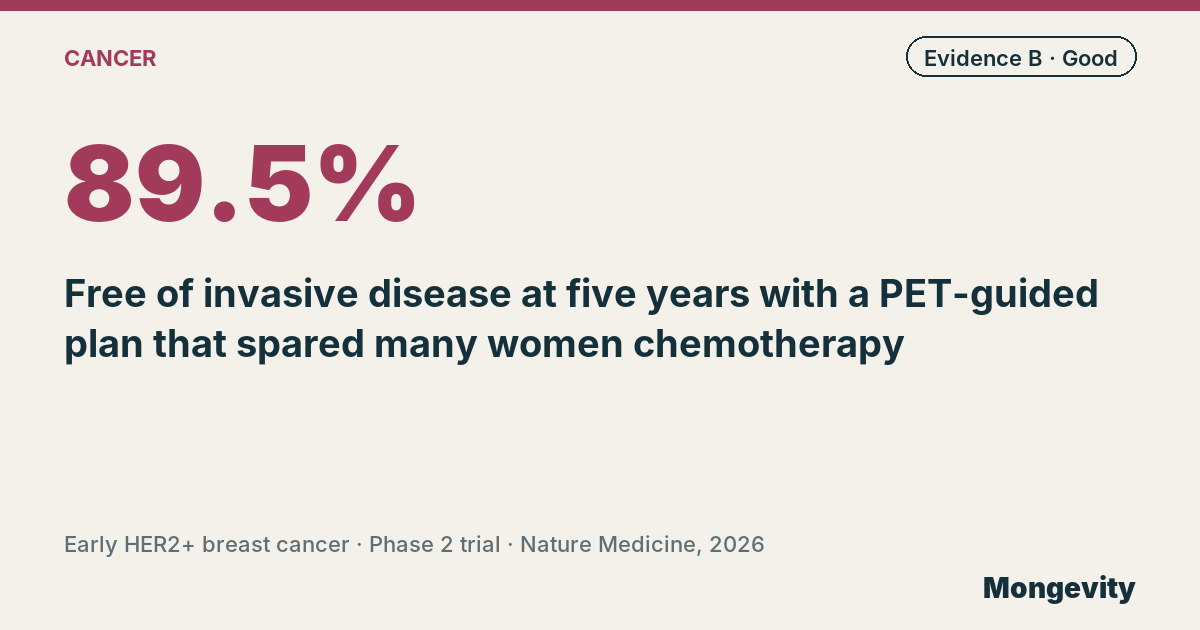
Five years into the PHERGain trial, 89.5% of women with HER2-positive breast cancer on a PET-guided plan were free of invasive disease, and so were 92.4% of those who responded well without chemotherapy, according to results published Oct. 29, 2026, in Nature Medicine. Some women with this cancer may safely skip chemotherapy.
Women with HER2-positive breast cancer usually get chemotherapy together with drugs that block HER2. Those drugs work so well that researchers have asked a simple question: could some women skip chemotherapy without losing the benefit?
On a plan guided by a PET scan, 89.5% of women were alive without invasive disease at five years.
What is HER2-positive breast cancer?
HER2 is a protein on the surface of some breast cancer cells that pushes them to grow. Trastuzumab and pertuzumab are antibodies that block it. Combined with chemotherapy, they are the standard treatment before surgery for many women with early HER2-positive cancer.
What did the trial test?
Women with early, operable HER2-positive breast cancer were assigned by chance to two groups. Group A got the usual chemotherapy plus trastuzumab and pertuzumab. Group B started with trastuzumab and pertuzumab alone, with hormone therapy if the tumor needed it. After two cycles, a PET scan checked whether the tumor was responding. Women whose tumor responded kept going without chemotherapy; the rest got chemotherapy. After surgery, women who still had cancer in the tissue also got chemotherapy.
What did the study find about women’s cancers?
| After a median of 5.6 years | Result |
|---|---|
| Group B, women free of invasive disease at five years | 89.5% |
| Women who responded on PET and had no cancer left at surgery, without chemotherapy | 92.4% |
| Distant recurrences in that subgroup | one |
The researchers also measured circulating tumor DNA, tiny pieces of tumor DNA in the blood. Women with detectable tumor DNA did worse, while those in whom it disappeared were more likely to have no cancer left at surgery and did better over time.
Why does this matter?
Chemotherapy brings side effects that can last: fatigue, hair loss, nerve damage and, in some women, heart problems. A way to pick out women who don’t need it, using a scan early in treatment, could spare many of them. Tumor DNA in the blood may one day help refine that choice.
How solid is this evidence?
It’s good but not final. Mongevity rates it B on our A-to-E scale. PHERGain was a randomized phase 2 trial that didn’t directly compare the two groups, and the 92.4% figure comes from a subgroup chosen after randomization, so the authors say it describes outcomes rather than proving that skipping chemotherapy is safe. The tumor DNA findings are exploratory.
What does this mean for you?
If you or someone close to you has early HER2-positive breast cancer, standard treatment still includes chemotherapy for most women. It’s reasonable to ask the oncologist whether treatment can be adapted to how the tumor responds, or whether a clinical trial testing this approach is available.
How do I explain this at dinner?
Doctors gave the targeted medicines first and took a picture of the tumor to see if it was shrinking. If it was, some women could skip the hardest part of treatment. A good question for the table: when does checking how things are going let you change the plan?
In one sentence: a PET-guided plan let a group of women with early HER2-positive breast cancer avoid chemotherapy with good results at five years, though the evidence isn’t final.
Questions and answers
- Can women with HER2-positive breast cancer skip chemotherapy?
- Standard care still includes chemotherapy for most. In PHERGain, women who responded well on a PET scan and had no cancer left at surgery did well without it, but this needs confirmation.
- What does the PET scan do in this plan?
- It checks after two cycles of targeted drugs whether the tumor is responding. Responders continued without chemotherapy; non-responders got it.
- What is circulating tumor DNA?
- Small pieces of tumor DNA in the blood. In PHERGain, detectable tumor DNA was linked to worse outcomes, and its disappearance to better ones.
- Is this ready for routine care?
- Not yet. It's a phase 2 result that supports the approach, not proof that it's as safe as standard chemotherapy.