A TROP2-targeted drug helped women with hard-to-treat endometrial cancer live longer
Breast, ovarian and uterine cancerPart of a story we are following · 8 articles · See every update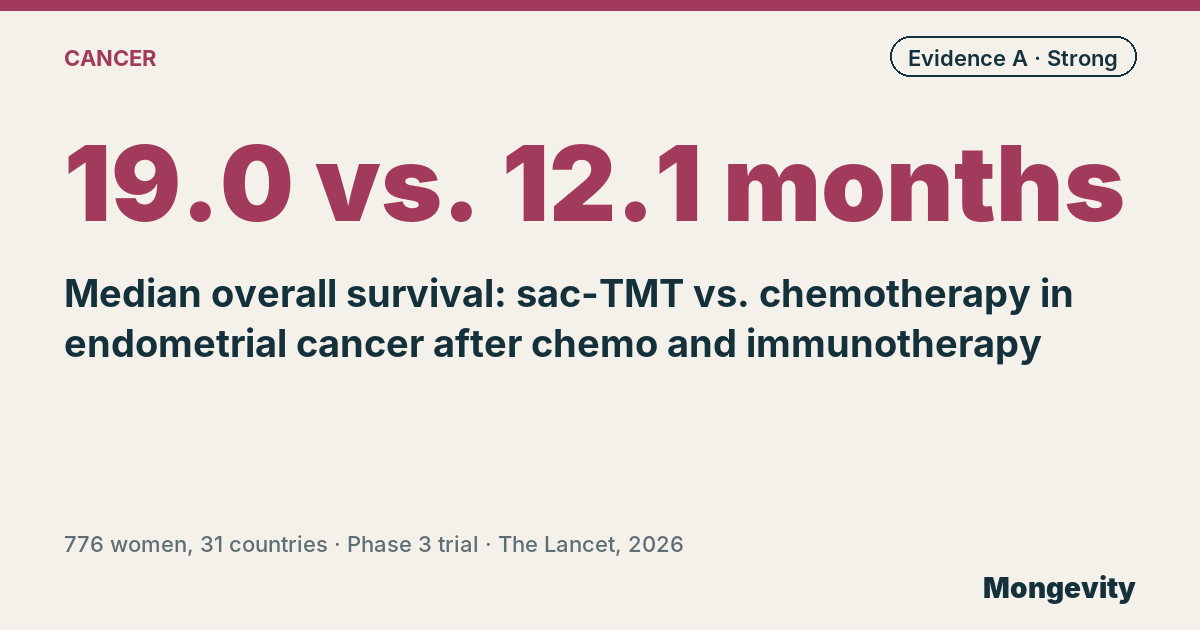
Women with endometrial cancer that progressed after chemotherapy and immunotherapy lived a median 19.0 months on sacituzumab tirumotecan, vs. 12.1 months on the doctor’s choice of chemotherapy, in a phase 3 trial published Oct. 26, 2026, in The Lancet. It is a new option for a uterine cancer with few choices.
For women with advanced endometrial cancer that keeps growing after both chemotherapy and immunotherapy, options are few and the outlook is poor.
Sac-TMT kept the cancer in check longer and helped women live longer than standard chemotherapy: a median of 19.0 months vs. 12.1 months.
What is sac-TMT?
It’s an antibody-drug conjugate: an antibody that binds TROP2 on tumor cells carries a potent chemotherapy payload directly to them.
What did the trial test?
At 242 centers across 31 countries and regions, 776 women whose endometrial cancer had progressed after platinum chemotherapy and immunotherapy were assigned by chance to sac-TMT or to the doctor’s choice of doxorubicin or paclitaxel. Radiologists who didn’t know the treatment judged progression.
What did the study find about women’s cancers?
| Sac-TMT | Doctor’s choice | |
|---|---|---|
| Median time without the cancer growing | 7.2 months | 3.9 months |
| Median overall survival | 19.0 months | 12.1 months |
| Grade 3+ side effects | 69% | 57% |
| Serious side effects | 35% | 32% |
The hazard ratio for death was 0.68. Deaths related to treatment were rare and equal in both groups (three each).
Why does this matter?
Endometrial cancer is becoming more common in many countries, and women whose disease returns after both chemotherapy and immunotherapy have had very few good options. Showing that a treatment helps people live longer, not just delays growth on a scan, is the strongest kind of result a cancer trial can deliver. It also adds to the growing list of cancers in which antibody-drug conjugates are changing what doctors can offer.
How solid is this evidence?
It’s strong. Mongevity rates it A on our A-to-E scale: a large international randomized phase 3 trial that improved overall survival, the hardest outcome. Limits: it was open-label, funded by Merck Sharp & Dohme, and side effects were somewhat more frequent with sac-TMT.
What does this mean for you?
If you or someone close to you has endometrial cancer that progressed after chemotherapy and immunotherapy, ask the oncologist about antibody-drug conjugates such as sac-TMT and about clinical trials. The authors suggest it could become a new standard of care.
How do I explain this at dinner?
When regular treatments stopped working for some women with uterine cancer, doctors tried a medicine that finds a specific mark on cancer cells and delivers chemo right there. It helped them live longer. A good question for the table: why do scientists keep trying when the first options run out?
In one sentence: an antibody-drug conjugate aimed at TROP2 helped women with previously treated endometrial cancer live longer than standard chemotherapy.
Questions and answers
- What is sac-TMT?
- Sacituzumab tirumotecan, an antibody-drug conjugate that targets TROP2 and delivers chemotherapy to tumor cells.
- Does it help women live longer?
- Yes, in this trial: median overall survival was 19.0 months vs. 12.1 months with standard chemotherapy.
- Is it harder to tolerate?
- Grade 3 or higher side effects were more frequent (69% vs. 57%), while serious side effects were similar (35% vs. 32%).