Immunotherapy alone beat chemo as first treatment for one type of advanced uterine cancer
Breast, ovarian and uterine cancerPart of a story we are following · 8 articles · See every update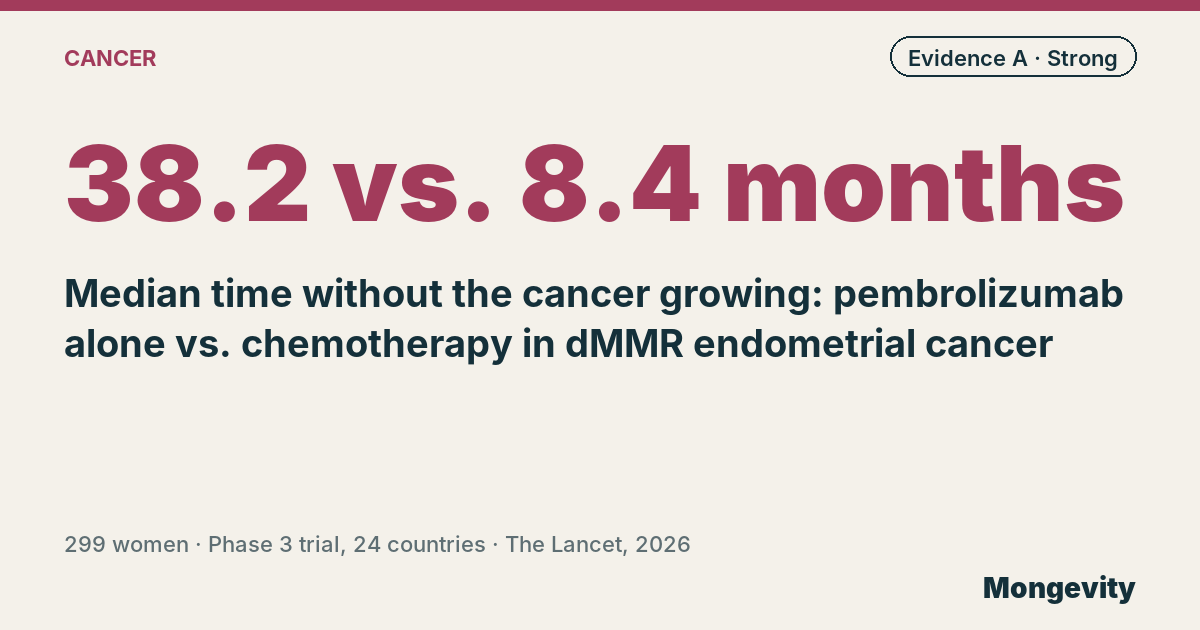
Women with advanced mismatch repair-deficient endometrial cancer went a median 38.2 months without progression on pembrolizumab alone, vs. 8.4 months on chemotherapy, with fewer serious side effects, in a phase 3 trial at centers in Asia and Europe published Oct. 26, 2026, in The Lancet. It could change the first treatment for this subtype of uterine cancer.
Endometrial cancer starts in the lining of the uterus. In some cases, the tumor has a flaw in its DNA repair system called mismatch repair deficiency, or dMMR. These tumors carry many mutations, which makes them easier for the immune system to spot.
Pembrolizumab kept the cancer in check for a median of 38.2 months, vs. 8.4 months with chemotherapy.
What did the trial test?
At 122 centers in 24 countries, 299 women with advanced or recurrent dMMR endometrial cancer were assigned by chance to pembrolizumab, an immunotherapy given by IV every six weeks, or to carboplatin plus paclitaxel, the standard chemotherapy.
What did the study find about women’s cancers?
| Serious side effects, pembrolizumab | 18% |
|---|---|
| Serious side effects, chemotherapy | 51% |
| Hair loss, pembrolizumab | 2% |
| Hair loss, chemotherapy | 50% |
At six months both groups looked alike (75% vs. 76% without progression), but from there the curves separated. Overall survival hadn’t yet shown a clear difference at this interim analysis (hazard ratio 0.77, not significant).
Why does this matter?
Chemotherapy has been the usual first treatment for advanced endometrial cancer for a long time, with side effects many women know well: hair loss, nausea, fatigue and nerve damage in the hands and feet. A treatment that controls the cancer longer while avoiding much of that is a real change in daily life. The result also shows why testing the tumor matters: the benefit here was found in a group defined by a lab test on the tumor, not by how the cancer looked or where it spread.
How solid is this evidence?
It’s strong: a large, international, randomized phase 3 trial with progression judged by blinded reviewers. Mongevity rates it A. Limits: it was open-label and funded by Merck, which makes pembrolizumab. And it didn’t compare pembrolizumab alone with today’s usual first treatment for many of these patients, immunotherapy plus chemotherapy.
What does this mean for you?
If you or someone close to you has advanced endometrial cancer, ask whether the tumor was tested for mismatch repair (dMMR or MSI-high). The result changes which treatments make sense. Whether immunotherapy alone or with chemotherapy is better for a given person is a decision for the oncology team.
How do I explain this at dinner?
Some tumors are so full of mistakes that the body’s defenses can spot them, like a car covered in dents in a parking lot. Immunotherapy helps those defenses do their job. A good question for the table: what makes something easy to spot in a crowd?
In one sentence: for advanced uterine cancer with a DNA repair flaw, immunotherapy alone controlled the disease far longer than chemotherapy and with fewer serious side effects.
Questions and answers
- What is dMMR endometrial cancer?
- It's uterine cancer whose cells can't fix certain DNA copying errors. These tumors carry many mutations and tend to respond to immunotherapy.
- Can pembrolizumab replace chemotherapy?
- In this trial, as a first treatment for advanced dMMR endometrial cancer, pembrolizumab alone controlled the cancer longer than chemotherapy. It wasn't compared with immunotherapy plus chemotherapy.
- Does it help women live longer?
- Not proven yet. At this interim analysis the survival difference was not statistically significant.