In midlife women, regular exercise went with faster thinking, especially strength training
Exercise and the brainPart of a story we are following · 3 articles · See every update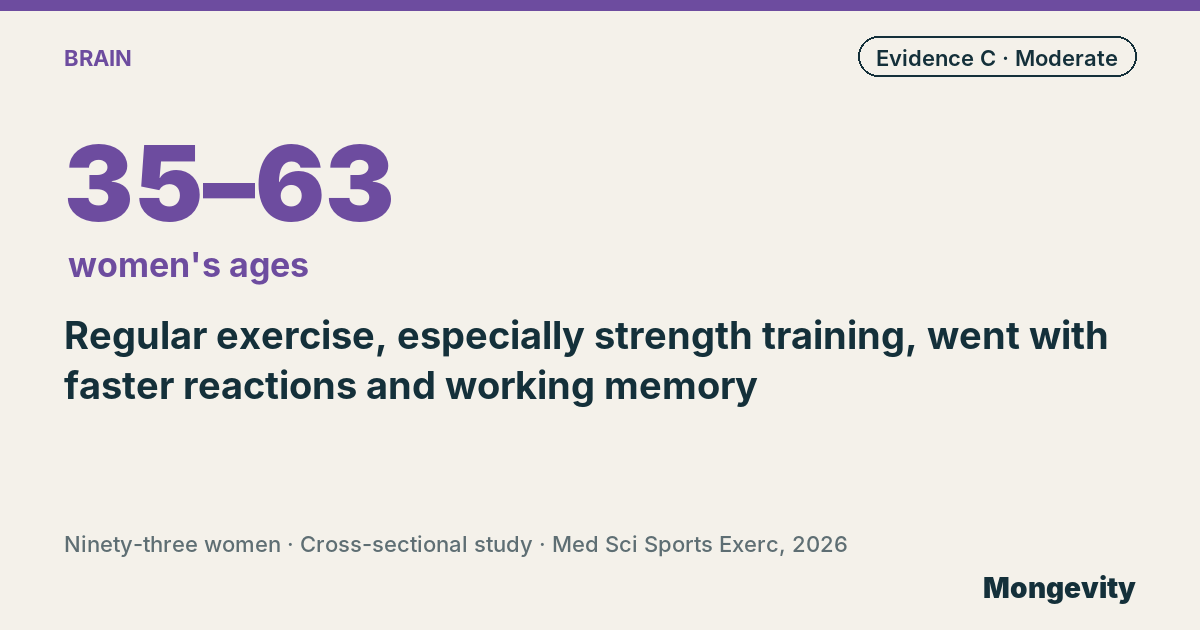
Women aged 35 to 63 who exercised regularly showed less age-related slowing in reaction time and working memory, and strength trainers had the fastest reactions, in a study of ninety-three women published Oct. 27, 2026, in Medicine & Science in Sports & Exercise. It adds to the evidence on exercise and the brain in midlife.
Midlife is a time of big changes for women, including menopause, and many notice their thinking feels slower.
What did the study look at?
Ninety-three women aged 35-63 did tests of simple reaction time, working memory (holding and using information for a short time) and planning. They were grouped by whether they exercised regularly and by the main type: aerobic, resistance (strength) training or other.
What did the study find about exercise and the brain?
- Reaction time: regular exercise lessened the slowing that comes with age. Women who did strength training reacted faster than non-exercisers and those doing aerobic or other exercise.
- Working memory: the benefit of exercise on response speed grew as the task got harder, mostly in older participants. Here, the type of exercise didn’t matter.
- Planning: performance was linked to age, but not to exercise.
Why does this matter?
It suggests midlife may be a key window for using exercise to protect thinking speed, and that strength training deserves a place alongside aerobic activity, something many women don’t include in their routines. Strength training also helps keep muscle and bone as estrogen falls, so it may pay off in more than one way.
How solid is this evidence?
It’s moderate at best. Mongevity rates it C on our A-to-E scale. It’s a small cross-sectional study: it compares women at one point in time, so it can’t show that exercise causes the differences. Women who exercise may differ in other ways, such as sleep, health or education.
What does this mean for you?
If you’re in midlife, aim to combine aerobic activity with strength training at least twice a week, using weights, bands or your own body weight. It’s good for muscles, bones and heart, and this study hints it may help thinking speed too. Start light, focus on good form and increase gradually; a trainer or physical therapist can help if you’re new to it.
How do I explain this at dinner?
Scientists tested midlife women on how fast they could react and remember. Those who exercised regularly, especially with weights, were quicker. A good question for the table: what kind of exercise could we try together this week?
In one sentence: in midlife women, regular exercise, and strength training in particular, was linked to faster thinking, though the study can’t prove cause.
Questions and answers
- Does exercise help thinking in midlife women?
- In this study, regular exercisers showed less age-related slowing in reaction time and working memory.
- Which type of exercise helped most?
- Strength training was linked to the fastest reaction times; for working memory, the type didn't matter.
- Does this prove exercise protects the brain?
- No. It's a cross-sectional study that shows associations, not cause.