Getting up at night to urinate, which breaks sleep, was linked to depressive symptoms
Sleep healthPart of a story we are following · 13 articles · See every update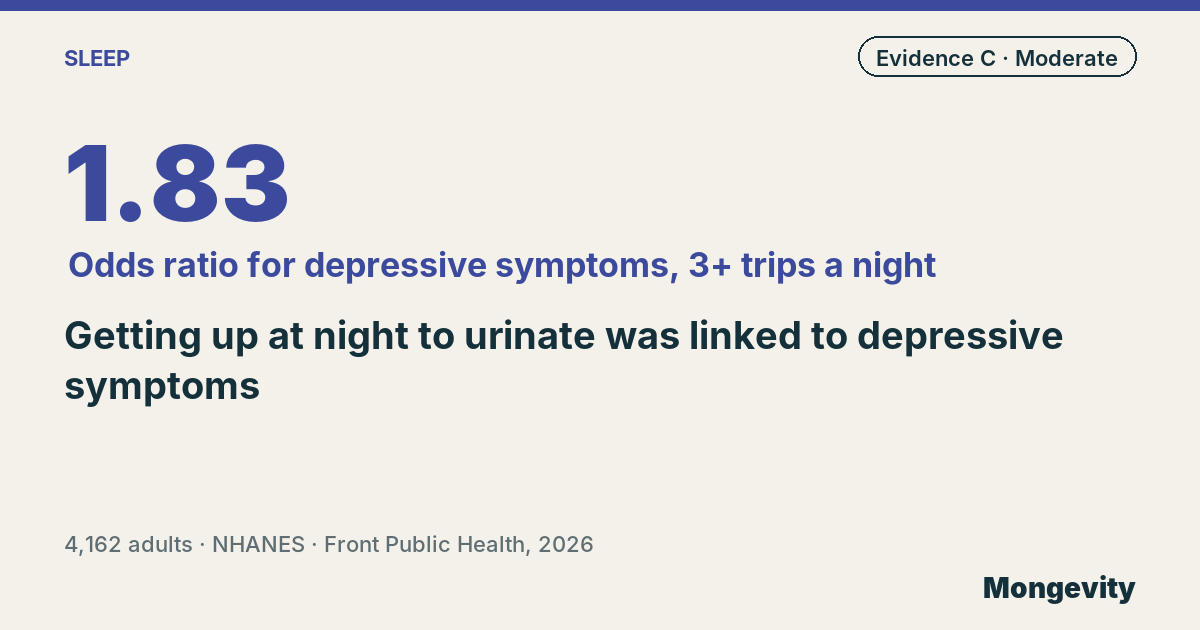
Waking three or more times a night to urinate was linked to higher odds of depressive symptoms (odds ratio 1.83) in 4,162 US adults, possibly through poorer sleep, in a study published Oct. 7, 2026, in Frontiers in Public Health. Treating night-time urination could protect sleep and mood.
Nocturia means waking up at night to urinate. It becomes common with age, and it breaks up sleep. Depression is also common, and poor sleep is both a symptom and a risk factor.
What did the study do?
Researchers analyzed 4,162 adults from the US National Health and Nutrition Examination Survey (NHANES) 2021-2023. They grouped people by how many times a night they got up to urinate: 0, 1, 2, or 3 or more. Clinically relevant depressive symptoms were defined as a score of 10 or more on a standard questionnaire, the PHQ-9. They also used a smaller Chinese cohort of 255 patients to explore whether sleep quality might explain the link.
What did the study find about sleep?
| Times up at night to urinate | Odds of depressive symptoms vs. none |
|---|---|
| 2 times | 1.42 |
| 3 or more times | 1.83 |
The more often people got up, the higher the odds. In the Chinese cohort, part of the link seemed to pass through poorer sleep quality, and it remained, though smaller, after removing the sleep question about bathroom trips.
Why does this matter?
Nocturia is often seen as just a bladder or prostate issue. These findings suggest it’s also linked to mental health, probably partly through fragmented sleep. Treating it could help sleep and mood, and doctors may want to ask about mood when patients report nocturia.
How solid is this evidence?
It’s moderate. Mongevity rates it C on our A-to-E scale: a large, nationally representative survey with careful statistics, but a snapshot in time. Depression could also cause nocturia, for example through poor sleep or medicines, and the Chinese analysis was small and exploratory.
What are the open questions?
Long-term studies and treatment trials are needed to show whether reducing nocturia improves mood, and in whom.
What does this mean for you?
If you get up two or more times a night to urinate, tell your doctor: causes include prostate enlargement, an overactive bladder, diabetes, heart failure, sleep apnea and drinking late in the day, and many are treatable. Cutting fluids, alcohol and caffeine in the evening can help. If you feel down most days, mention that too.
How do I explain this at dinner?
People who get up three or more times a night to pee were more likely to have symptoms of depression, perhaps because their sleep is constantly interrupted. A good question for the table: how many times do you wake up at night?
In one sentence: frequent nighttime urination was linked to depressive symptoms in US adults, possibly through poorer sleep, a link worth raising with a doctor.
Questions and answers
- What is nocturia?
- Waking up at night to urinate.
- Is it linked to depression?
- Waking three or more times a night was linked to higher odds of depressive symptoms (odds ratio 1.83).
- Can nocturia be treated?
- Often yes: causes such as prostate enlargement, overactive bladder, diabetes or sleep apnea can be addressed.