Sleep apnea was linked to shifts in Alzheimer’s proteins in blood and spinal fluid
How the brain cleans itself during sleepPart of a story we are following · 3 articles · See every update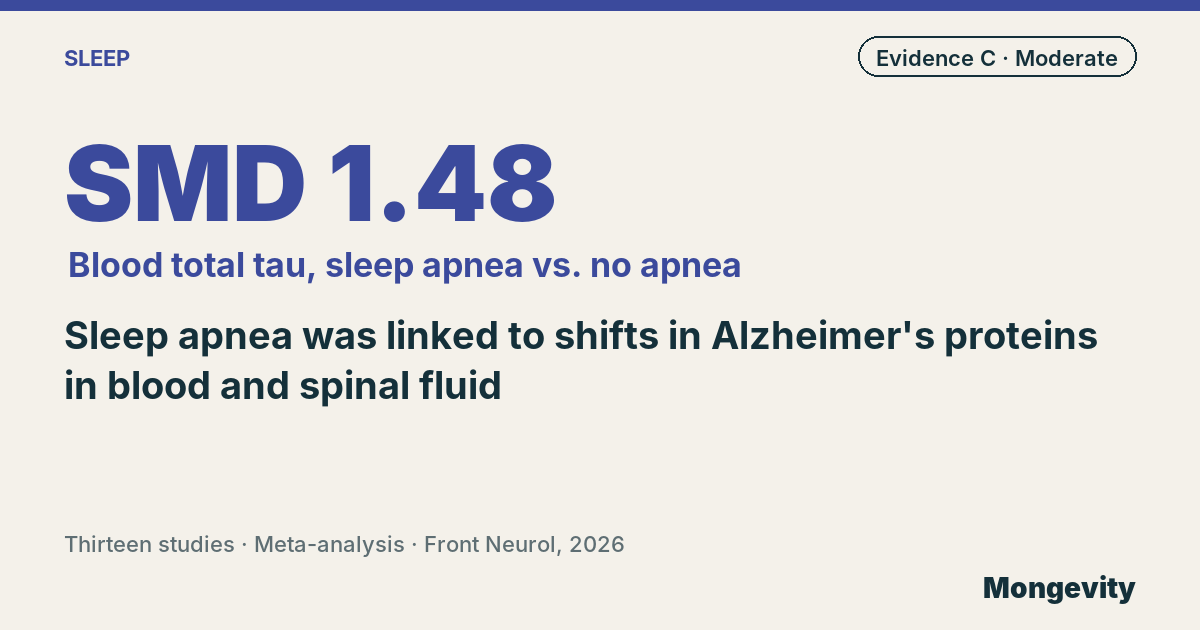
People with obstructive sleep apnea had higher total amyloid and tau in blood (standardized mean differences 0.66 and 1.48) and lower amyloid in spinal fluid, according to a meta-analysis of thirteen studies published Sept. 21, 2026, in Frontiers in Neurology. The pattern didn’t match established Alzheimer’s, so the link between sleep and the brain remains uncertain.
During deep sleep, the brain clears waste, including amyloid-β and tau, the proteins that build up in Alzheimer’s disease. Obstructive sleep apnea, in which breathing stops repeatedly during sleep, fragments sleep and lowers oxygen. Could it interfere with this cleaning?
What did the study look at?
Researchers searched four databases through December 2024 for studies comparing amyloid and tau levels in blood or cerebrospinal fluid, the fluid around the brain and spinal cord, between people with and without sleep apnea. Thirteen studies qualified: seven measured blood and six measured spinal fluid.
What did the study find about sleep and the brain?
- In blood, people with sleep apnea had higher total amyloid (standardized mean difference 0.66) and higher total tau (1.48).
- Blood amyloid subtypes and phosphorylated tau didn’t differ.
- In spinal fluid, people with sleep apnea had lower amyloid-β40 (−1.13) and amyloid-β42 (−1.23).
- The amyloid ratio and tau in spinal fluid didn’t differ.
- Certainty was low to very low for most outcomes, and heterogeneity was often high.
Why does this matter?
Sleep apnea is common and treatable, and many people don’t know they have it. These findings suggest it may affect how the brain handles Alzheimer’s proteins. But the pattern didn’t match the typical signature of Alzheimer’s, so it may reflect reversible effects of low oxygen and broken sleep rather than the disease itself.
How solid is this evidence?
It’s limited. Mongevity rates it C on our A-to-E scale: a systematic review and meta-analysis, but of mostly cross-sectional studies, with high heterogeneity, low to very low certainty and a registration done after the fact. The authors call the findings hypothesis-generating.
What are the open questions?
Large studies following people over time are needed to see whether these changes predict dementia, and whether treating sleep apnea, for example with CPAP, normalizes them.
What does this mean for you?
If you snore loudly, stop breathing during sleep according to a bed partner, wake up unrefreshed or feel very sleepy during the day, ask your doctor about a sleep study. Treating sleep apnea improves energy, blood pressure and quality of life, whatever its effect on the brain.
How do I explain this at dinner?
The brain cleans itself during deep sleep. In people whose breathing keeps stopping at night, researchers found different levels of the proteins linked to Alzheimer’s in blood and spinal fluid, but the studies were weak and the pattern wasn’t the classic Alzheimer’s one. A good question for the table: does anyone here snore loudly enough to wake others?
In one sentence: obstructive sleep apnea was associated with compartment-specific changes in amyloid and tau in blood and cerebrospinal fluid, but the evidence was low certainty and hypothesis-generating.
Questions and answers
- What is obstructive sleep apnea?
- A condition in which breathing stops repeatedly during sleep, fragmenting sleep and lowering oxygen.
- What did the review find in blood?
- Higher total amyloid (SMD 0.66) and total tau (SMD 1.48) in people with sleep apnea.
- And in spinal fluid?
- Lower amyloid-β40 and amyloid-β42, without changes in tau.
- Does sleep apnea cause Alzheimer's?
- Not shown; the pattern didn't match established Alzheimer's.