Starting classes later helped night-owl students sleep more and score like early birds
Sleep healthPart of a story we are following · 13 articles · See every update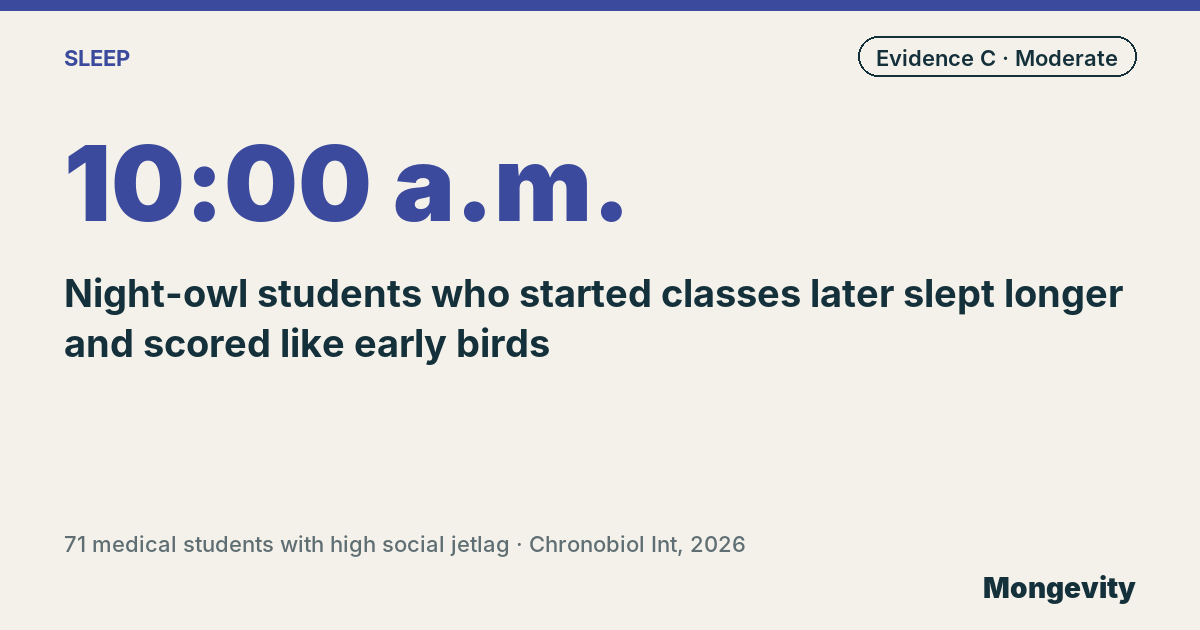
First-year medical students with strong social jetlag who had classes starting at 10:00 a.m. slept longer, had steadier daily rhythms and scored on exams like naturally early students, in a university study published Oct. 29, 2026, in Chronobiology International. School schedules can work with sleep, not against it.
Some people are natural night owls: their body clock runs late, so early schedules force them to wake up while their brain still thinks it’s night. The gap between the body’s clock and the social clock is called social jetlag.
Night-owl students who started classes at 10:00 a.m. slept longer, had steadier daily rhythms and performed on exams as well as early-bird students.
What did the study test?
220 incoming first-year medical students filled out a chronotype questionnaire. The 71 with high social jetlag were assigned by chance to a later schedule, with classes starting at 10:00 a.m. or later (30 students), or the standard 8:00 a.m. schedule (41 students). Wrist devices tracked sleep, activity and light, and body temperature rhythms showed each student’s internal clock.
What did the study find about sleep?
Among students on the early schedule, those with a late internal clock scored lower on exams than those with an early clock. Students with a late clock on the later schedule scored about the same as early-clock students. They also had more stable rest-activity patterns, steadier blue-light exposure and longer sleep. Across students, a later internal clock predicted lower exam scores, most clearly on the early schedule.
Why does this matter?
It suggests that some of the poorer performance of night owls isn’t about effort or ability but about timing. Matching schedules to body clocks could help students sleep better and learn more.
How solid is this evidence?
It’s moderate. Mongevity rates it C on our A-to-E scale. Part of the study used random assignment, which is a strength, but groups were small, it took place in one medical school, and some comparisons were based on groups formed after the fact by measured body clock.
What does this mean for you?
If you or a teenager in your family struggles with early mornings, it may be biology, not laziness. Getting bright light in the morning, keeping regular sleep times on weekends too, and dimming screens at night can help shift the clock earlier.
How do I explain this at dinner?
Some people’s inner clock runs later, like a watch set an hour behind. When students with a late clock started class later, they slept more and did as well on tests as early risers. A good question for the table: are you a morning person or a night person?
In one sentence: letting night-owl medical students start classes later improved their sleep and erased their exam disadvantage in a small study.
Questions and answers
- What is social jetlag?
- The gap between your internal body clock and the schedule society sets for you, such as early classes or work.
- Do later class times help night owls?
- In this study, night-owl students with 10:00 a.m. classes slept longer and scored like early-bird students.
- Can I shift my body clock?
- Morning light, regular sleep times and less screen light at night can help shift it earlier.