Good vitamin C levels went with faster walking and, in women, stronger grip
Muscle strength with agePart of a story we are following · 3 articles · See every update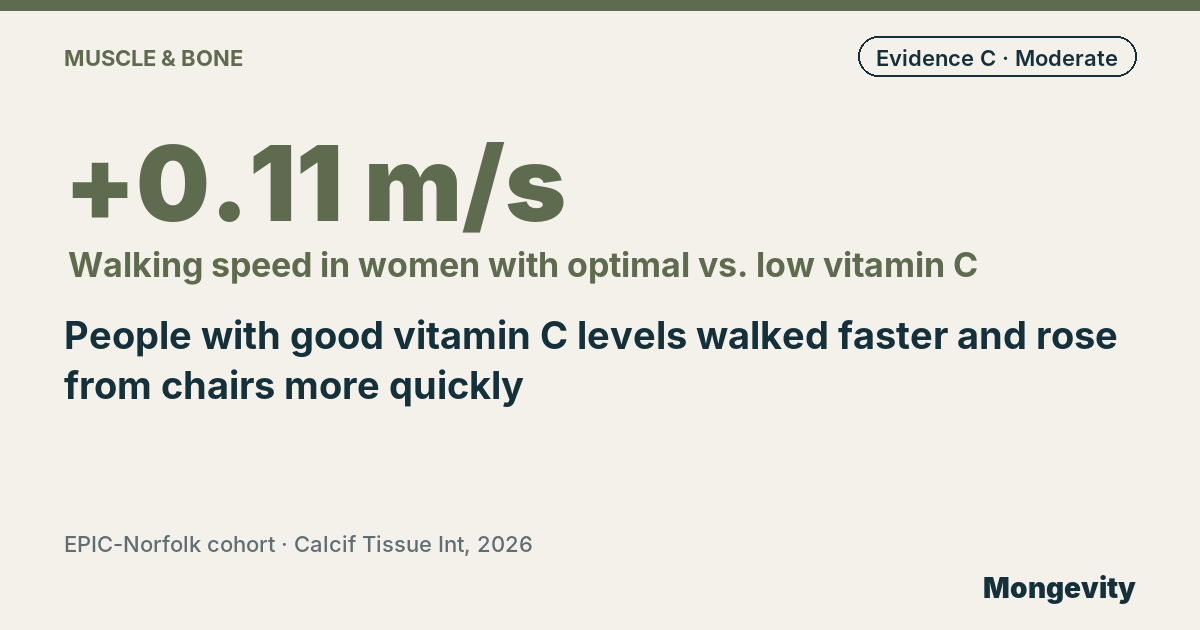
Optimal blood vitamin C was linked to faster walking and chair rises, and in women to a stronger grip, in over 5000 adults aged 48 to 92 in the EPIC-Norfolk cohort in England, in a study published Oct. 24, 2026, in Calcified Tissue International. Diet may support muscle strength with age.
As we age, muscles lose strength and mass, a process that can lead to sarcopenia, frailty and falls. Vitamin C, found in fruits and vegetables, helps make collagen and protects cells from damage, and it may matter for muscles too.
What did the study do?
Researchers analyzed data from over 5000 participants aged 48 to 92 in the EPIC-Norfolk cohort in England. They grouped people by blood vitamin C, low (below 25 μmol/L), suboptimal (25 to below 50) or optimal (50 or above), and by dietary intake. They measured handgrip strength, walking speed and the time to stand up from a chair five times, adjusting for lifestyle, health and diet.
What did the study find about muscle strength?
| Optimal vs. low blood vitamin C | Women | Men |
|---|---|---|
| Handgrip strength, adjusted for height | +0.54 kg/m² | No clear difference |
| Walking speed | +0.11 m/s | +0.05 m/s |
| Time for five chair rises | 1.03 s faster | 0.71 s faster |
In women, higher dietary vitamin C was also linked to faster walking and chair rises. In men, dietary intake wasn’t linked to performance.
Why does this matter?
Walking speed and chair rise time are strong signals of independence and future health in older adults. If vitamin C status helps maintain them, eating enough fruits and vegetables could be a simple contribution to healthy aging.
How solid is this evidence?
It’s moderate. Mongevity rates it C on our A-to-E scale: a large, well-characterized cohort with blood measurements, but a cross-sectional snapshot. It can’t show whether vitamin C improves performance, or whether healthier, more active people simply eat better.
What are the open questions?
Long-term and intervention studies are needed to see whether raising vitamin C, through diet or supplements, actually helps muscle function.
What does this mean for you?
Aim for plenty of fruits and vegetables every day, such as citrus, kiwi, berries, peppers and broccoli, which are rich in vitamin C. Combine a good diet with regular strength and balance exercises, which have the strongest evidence for keeping muscles working.
How do I explain this at dinner?
Middle-aged and older people with good vitamin C levels in their blood walked a bit faster and got up from chairs more quickly than those with low levels. Fruits and vegetables may help muscles too, though the study can’t prove it. A good question for the table: what’s your favorite vitamin C food?
In one sentence: optimal blood vitamin C was linked to better physical performance in middle-aged and older adults, a link that needs longer studies to confirm.
Questions and answers
- Is vitamin C linked to muscle function?
- Optimal blood levels were linked to faster walking and chair rises, and in women to stronger grip.
- What counts as optimal?
- In this study, a blood level of 50 μmol/L or above.
- Should I take supplements?
- The study didn't test them; a diet rich in fruits and vegetables is a sensible first step.