Tai Chi combined with other training may boost strength and function in frail older adults
Muscle strength with agePart of a story we are following · 3 articles · See every update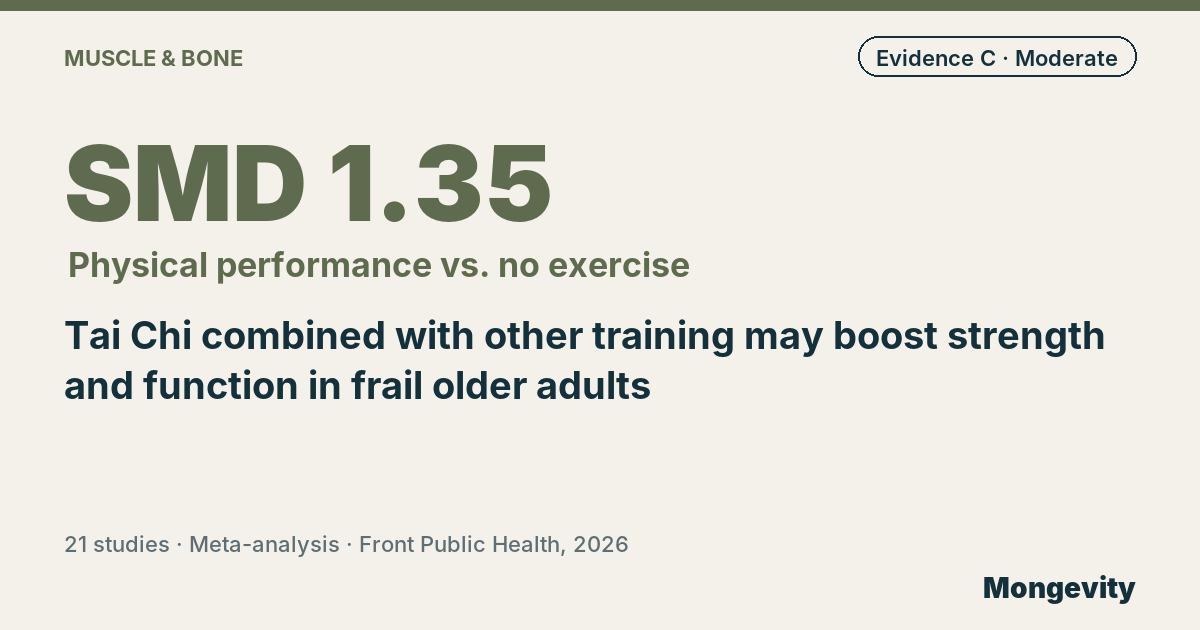
Tai Chi combined with other training improved muscle function (standardized mean difference 1.00) and physical performance (1.35) compared with no exercise in older adults with sarcopenia or frailty, according to a meta-analysis of 21 studies published in August 2026 in Frontiers in Public Health. Certainty was low, but muscle strength can still be built late in life.
Sarcopenia, the loss of muscle strength and mass with age, and frailty make older adults more likely to fall, lose independence and be hospitalized. Tai Chi, a slow, flowing Chinese mind-body exercise, improves balance, but may not be enough on its own to build muscle. Programs that combine it with resistance training, nutrition or other approaches have emerged.
What did the study look at?
Researchers searched ten databases up to May 2026 for randomized trials comparing Tai Chi-based combined programs with no exercise, other exercise or Tai Chi alone, in older adults with sarcopenia, frailty or risk of functional decline. 21 studies were included, 16 of them in the pooled analysis. They rated certainty with the GRADE system.
What did the study find about muscle strength?
- Compared with no exercise, combined programs improved muscle function (standardized mean difference 1.00) and frailty and overall physical performance (1.35).
- Compared with other active exercise, they may improve physical performance (0.63), while effects on muscle function and mass were uncertain.
- Muscle mass and quality didn’t improve consistently.
- Of 14 bodies of evidence, 2 were low and 12 very low certainty; none was moderate or high.
Why does this matter?
Older adults need exercise that is safe, enjoyable and sustainable. Tai Chi is popular and accessible, and adding strength or other components could make it more effective for muscle and function. But the evidence doesn’t yet show which combination works best or whether it beats other exercise.
How solid is this evidence?
It’s limited. Mongevity rates it C on our A-to-E scale: a pre-registered meta-analysis of randomized trials, but based on few, varied studies with low or very low certainty.
What are the open questions?
Larger, better-designed trials are needed to define the best combination, dose and duration, and whether combined programs beat Tai Chi alone or standard strength training.
What does this mean for you?
If you or an older relative enjoy Tai Chi, keep it up for balance and add some strength exercises, such as standing up from a chair, wall push-ups or resistance bands. Enough protein and regular activity help preserve muscle. Adapt exercises to your health and ask for guidance if you’re frail.
How do I explain this at dinner?
Researchers pooled trials where frail older adults did Tai Chi plus other training like strength work. They got stronger and moved better than people who didn’t exercise, but the studies were few and weak. A good question for the table: what exercise could you see yourself doing in old age?
In one sentence: Tai Chi-based combined interventions may improve muscle function and physical performance in older adults with sarcopenia or frailty, but the evidence is of low or very low certainty.
Questions and answers
- What is sarcopenia?
- The loss of muscle strength and mass that comes with age.
- Did combined Tai Chi programs help?
- Compared with no exercise, they improved muscle function and physical performance.
- Are they better than other exercise?
- Possibly for physical performance, but the evidence is uncertain.
- Did they build muscle mass?
- Muscle mass and quality didn't improve consistently.