A road marathon tired the legs more and took longer to recover from than a trail run
Exercise and recoveryPart of a story we are following · 3 articles · See every update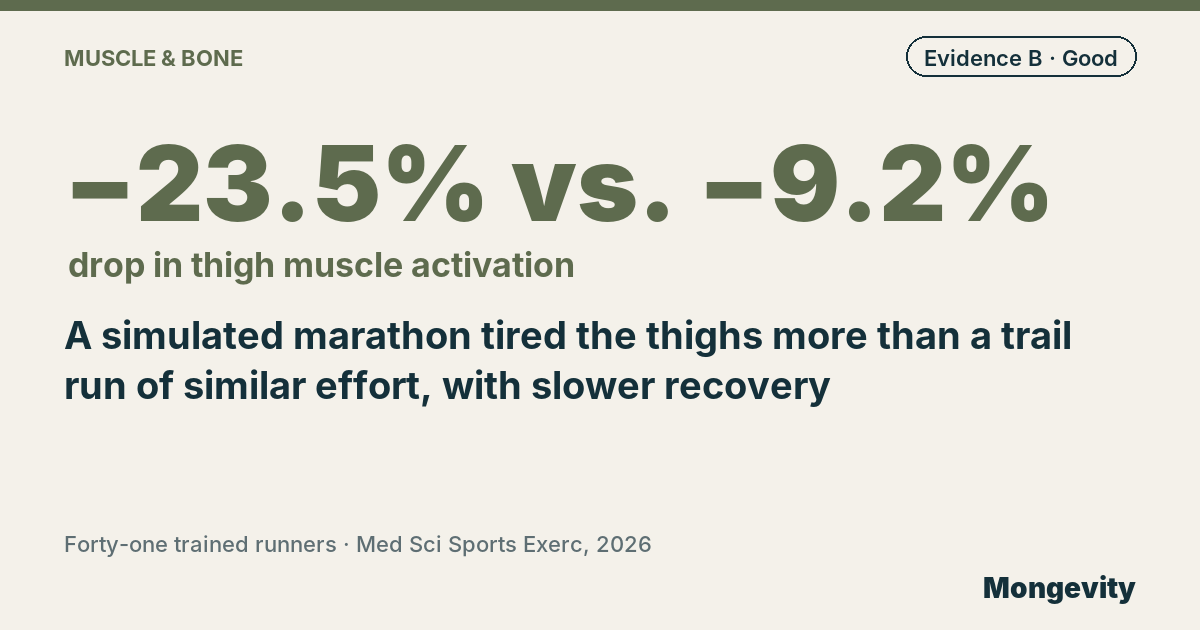
A simulated road marathon caused bigger drops in thigh muscle activation and jump height, more muscle damage and slower recovery than trail runs of similar effort, in a study of forty-one trained runners published Oct. 23, 2026, in Medicine & Science in Sports & Exercise. For exercise recovery, terrain matters.
Road marathons and trail runs are both long efforts, but they stress the body differently: the road is flat and repetitive, while trails mix climbs, descents and uneven ground.
What did the study test?
Forty-one trained runners, specialized in road or trail running, did either a simulated treadmill marathon, a simulated treadmill trail run, or a real trail run of equivalent effort (29 km with about 1,400 m of climbing). Researchers measured muscle strength and activation, blood markers of muscle damage, jump height and muscle soreness before, right after, and up to seven days after.
What did the study find about exercise recovery?
| Measure | Marathon | Treadmill trail | Real trail |
|---|---|---|---|
| Drop in thigh muscle activation | -23.5% | -9.2% | -13.0% |
| Change in squat jump height | -11.7% | +11.4% | +5.9% |
Blood markers of muscle damage rose much more after the marathon the next day. Thigh muscle activation and jump height took longer to return to normal after the marathon, and soreness also lasted longer. There were no differences in calf muscle fatigue or in peak strength.
Why does this matter?
Recovery plans are often the same for any long run. This study suggests a road marathon may need more recovery time for the thigh muscles than a trail run of similar effort, which matters for training schedules and injury prevention.
How solid is this evidence?
It’s good for sports science. Mongevity rates it B on our A-to-E scale. The measurements were detailed and repeated over a week. Limits: runners weren’t randomly assigned (each did the run matching their specialty), the groups were small, and two of the runs were simulated on a treadmill.
What does this mean for you?
If you run long distances, plan more easy days after a road marathon than after a trail run of similar effort, and pay attention to lingering thigh soreness. Strength work for the thighs may help your legs handle long road races.
How do I explain this at dinner?
Scientists compared runners who did a long road race with runners who did a long trail run. The road runners’ thigh muscles were more tired and took longer to bounce back. A good question for the table: why might running on varied ground be easier on the legs?
In one sentence: a road marathon caused more thigh muscle fatigue and slower recovery than trail runs of similar effort in trained runners.
Questions and answers
- Is a marathon harder on the body than a trail run?
- In this study, a simulated road marathon caused more thigh muscle fatigue and muscle damage than trail runs of similar effort.
- Does recovery take longer?
- Yes: thigh muscle activation, jump height and soreness took longer to return to normal after the marathon.
- What should runners do?
- Plan more recovery after road marathons and consider strength work for the thighs.