A daily GLP-1 pill cut body weight by up to 8.7% in a phase 3 trial in Japan
GLP-1 drugs (Ozempic, Wegovy, Mounjaro)Part of a story we are following · 4 articles · See every update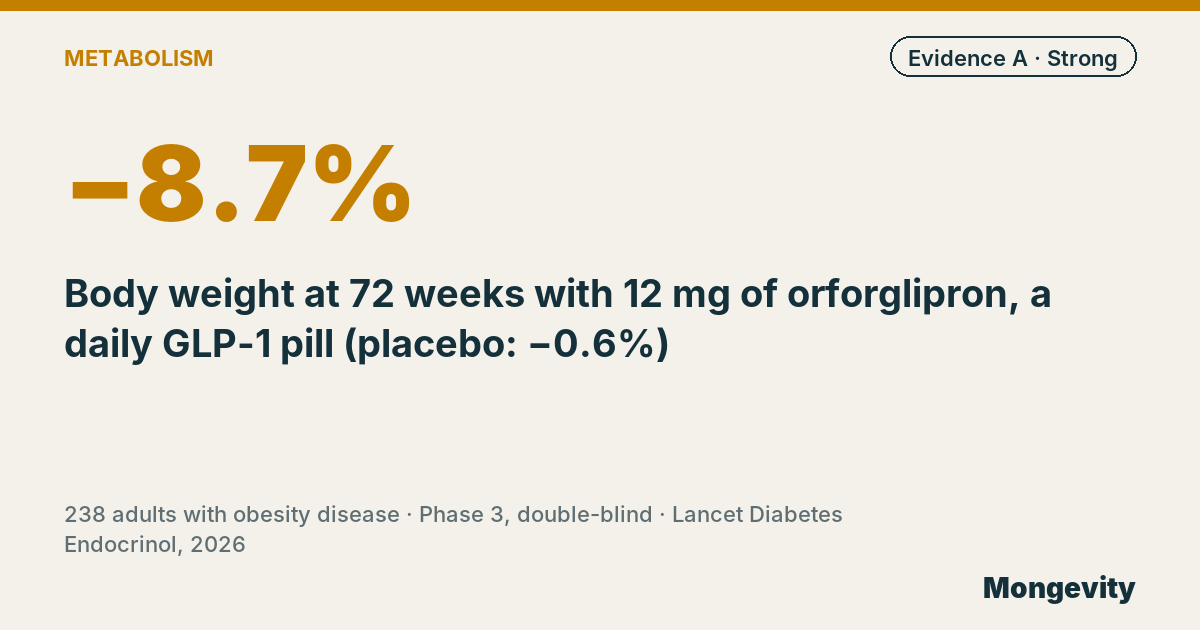
Japanese adults with obesity who took orforglipron, a once-daily GLP-1 pill, lost 5.9% to 8.7% of their body weight at 72 weeks, vs. 0.6% on placebo, in a phase 3 trial in Japan published Oct. 30, 2026, in The Lancet Diabetes & Endocrinology. A pill may widen access to GLP-1 drugs.
Drugs like semaglutide and tirzepatide have changed obesity treatment, but most are weekly injections. Orforglipron is different: it’s a small-molecule GLP-1 drug taken as a pill once a day.
After 72 weeks, people on orforglipron lost between 5.9% and 8.7% of their body weight, depending on the dose, compared with 0.6% on placebo.
What is orforglipron?
GLP-1 is a gut hormone that slows digestion and makes you feel full sooner. Most GLP-1 drugs are proteins that must be injected. Orforglipron isn’t a protein, so it can be swallowed as a pill, with no need to take it on an empty stomach with special rules.
What did the trial test?
At 16 centers in Japan, 238 adults with obesity-related health problems such as high blood pressure, high cholesterol or type 2 diabetes were assigned by chance to orforglipron at 6, 12 or 36 mg a day, or to a placebo, for 72 weeks. Neither participants nor researchers knew who got what. Everyone had already tried dieting without success.
What did the study find about GLP-1 drugs?
Side effects were mostly mild to moderate stomach problems. Nausea was the most common reason to stop the drug, more often at the highest dose.
Why does this matter?
A pill is easier to make, store and take than an injection, which could make GLP-1 treatment reach many more people. Japan also defines obesity disease at a lower body mass index than Western countries, so this trial shows how the drug works in people who are less heavy than in most earlier studies.
How solid is this evidence?
It’s strong. Mongevity rates it A on our A-to-E scale: a double-blind, randomized, placebo-controlled phase 3 trial with 90% of participants finishing. Limits: it was funded by Eli Lilly, the maker, it included only Japanese adults, and weight loss was smaller than with the strongest injectable drugs in other trials, so results shouldn’t be copied directly to other populations.
What does this mean for you?
If you live with obesity and related health problems, oral GLP-1 drugs may become an option. Availability and approval depend on where you live. Weight-loss medicines should be prescribed and followed by a doctor; avoid products sold online or on social media.
How do I explain this at dinner?
Some medicines that help people lose weight copy a hormone your gut makes after eating, the one that says you’re full. Most of them are shots, but scientists made one you can swallow as a pill. A good question for the table: how does your body tell you it’s had enough to eat?
In one sentence: a once-a-day GLP-1 pill helped Japanese adults with obesity disease lose up to 8.7% of their weight in 72 weeks, with mostly mild stomach side effects.
Questions and answers
- What is orforglipron?
- A GLP-1 drug that isn't a protein, so it can be taken as a pill once a day instead of an injection.
- How much weight did people lose?
- At 72 weeks, 5.9% with 6 mg, 8.7% with 12 mg and 7.9% with 36 mg, compared with 0.6% on placebo.
- What were the side effects?
- Mostly mild to moderate stomach problems. Nausea was the most frequent reason to stop, more often at the highest dose.
- Is orforglipron approved?
- Approval depends on each country. Ask your doctor what's available where you live.