Feeling good in the morning mattered more for mental health than sleep timing
Sleep healthPart of a story we are following · 13 articles · See every update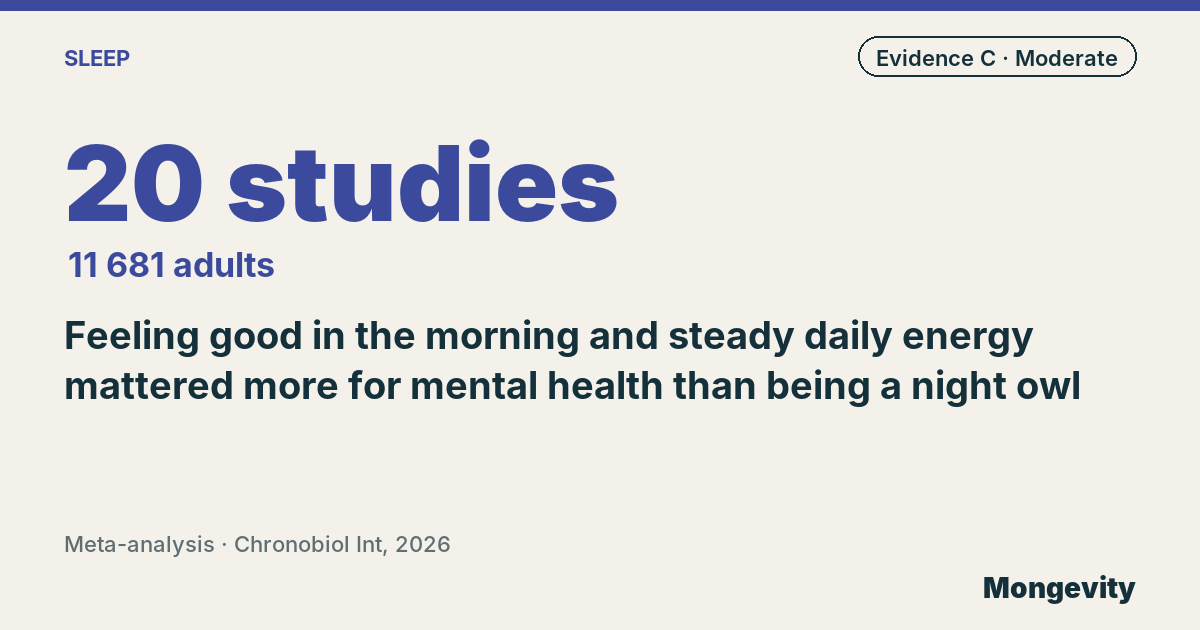
Morning affect, feeling good soon after waking, was linked to better mental health, while being a night owl showed weaker links, in a meta-analysis of 20 studies with 11 681 adults published Oct. 27, 2026, in Chronobiology International. How you feel in the morning may matter more than when you sleep.
Chronotype is usually described as a single line from morning lark to night owl. But researchers increasingly see it as having several parts.
The biggest links weren’t with being a night owl, but with how good you feel in the morning and how much your alertness swings during the day.
What are the three dimensions?
The researchers used studies with the Morningness-Eveningness-Stability Scale improved (MESSi), which measures:
- Morning affect: how fresh and good you feel after waking.
- Eveningness: how much your peak energy falls late in the day.
- Distinctness: how much your energy and alertness swing across the day.
What did the review include?
From 151 screened records, 20 studies with 11 681 adults met the criteria. The authors combined correlations between each dimension and measures of well-being and ill-being, such as anxiety or depressive symptoms.
What did the study find about sleep?
- Morning affect was linked to lower ill-being and higher well-being.
- Distinctness showed the opposite pattern: bigger daily swings went with worse mental health.
- Eveningness had weaker and less consistent links.
Why does this matter?
Night owls are often told their schedule is bad for their mental health. This review suggests the picture is more nuanced: how you feel in the morning and how stable your energy is during the day may be more telling than when you prefer to go to bed.
How solid is this evidence?
It’s moderate. Mongevity rates it C on our A-to-E scale. A meta-analysis pools many studies, but these were correlational, so they don’t show cause and effect. All used the same questionnaire, and the outcomes measured varied across studies.
What does this mean for you?
Pay attention to how you feel when you wake up and whether your energy crashes during the day. Regular sleep times, morning light and avoiding late caffeine can help both. If low mood or anxiety persist, seek professional help.
How do I explain this at dinner?
Some people wake up happy and some wake up grumpy. Scientists found that how you feel in the morning, and how much your energy goes up and down, mattered more for mood than whether you like staying up late. A good question for the table: how do you feel when you first wake up?
In one sentence: feeling good in the morning and having steady energy during the day were more closely linked to mental health than being a night owl.
Questions and answers
- Is being a night owl bad for mental health?
- In this meta-analysis, eveningness had weaker and less consistent links with mental health than morning affect or daily swings in alertness.
- What is morning affect?
- How fresh and good you feel after waking up; higher morning affect was linked to better well-being.
- What is distinctness?
- How much your energy and alertness swing during the day; bigger swings were linked to worse mental health.