A glucose sensor lowered A1c in type 2 diabetes even without insulin
Tools for living with diabetesPart of a story we are following · 3 articles · See every update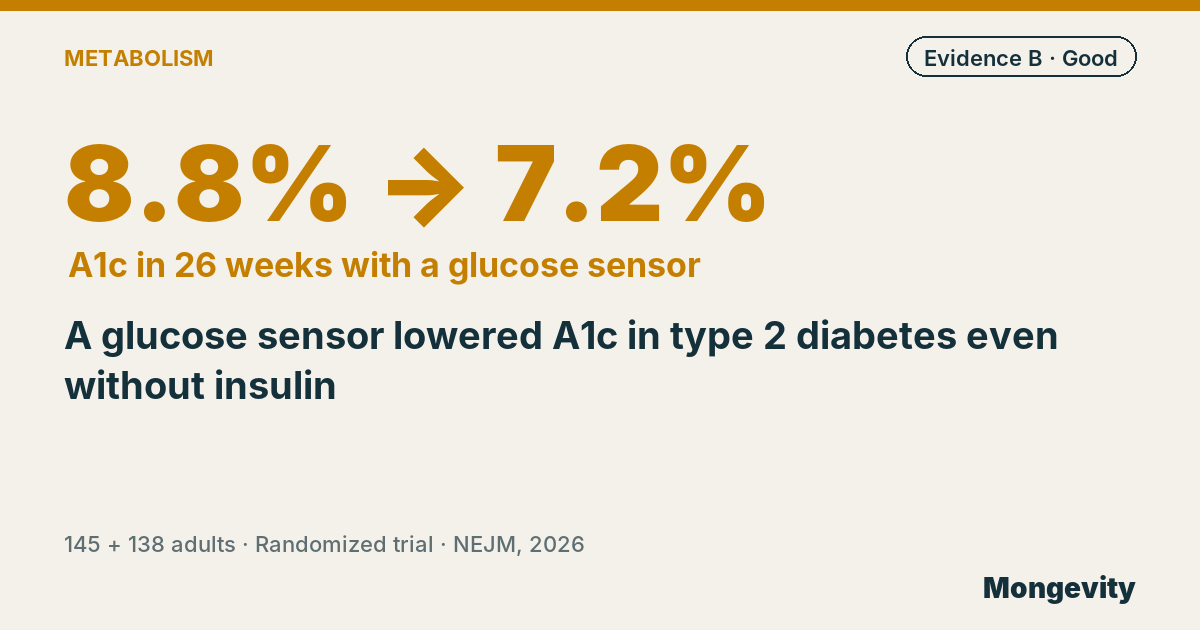
Adults with type 2 diabetes not using insulin who wore a continuous glucose monitor lowered their A1c from 8.8% to 7.2% in 26 weeks, vs. 8.7% to 8.0% with routine care, in a trial at US primary care practices published Oct. 14, 2026, in New England Journal of Medicine. It supports glucose sensors as a diabetes care tool beyond insulin users.
A continuous glucose monitor, or CGM, is a small sensor worn on the arm or belly that reads blood sugar around the clock and sends it to a phone. It’s standard for people who use insulin. But most people with type 2 diabetes don’t use insulin, and whether a CGM helps them has been less clear.
What did the trial test?
At 22 primary care practices in the United States, adults with type 2 diabetes who weren’t using insulin were assigned by chance to a CGM (145 people) or routine care (138 people) for 26 weeks. They ranged in age from 21 to 84 years. The main outcome was A1c, also called glycated hemoglobin, a measure of average blood sugar over the past few months.
What did the study find about diabetes care?
| A1c | CGM | Routine care |
|---|---|---|
| At the start | 8.8% | 8.7% |
| At 26 weeks | 7.2% | 8.0% |
The adjusted difference was 0.9 percentage points in favor of the CGM. Time spent in the target range of 70 to 180 mg per deciliter was 21 percentage points higher with the CGM. Time with low blood sugar was also slightly lower, and there were no severe low blood sugar events.
Why does this matter?
Seeing your glucose rise after a meal, or fall after a walk, in real time can change habits in a way a fingerstick a few times a week can’t. This trial suggests that, even without insulin, that feedback can bring A1c meaningfully closer to target in a primary care setting, where most people with type 2 diabetes get their care.
How solid is this evidence?
It’s good. Mongevity rates it B on our A-to-E scale: a randomized trial in real primary care practices with a clear result. Limits: people knew whether they had a sensor, it lasted 26 weeks, it was funded by a CGM maker, and it didn’t measure long-term complications.
What does this mean for you?
If you have type 2 diabetes and your A1c is above target, ask your doctor whether a CGM could help, even if you don’t use insulin. Coverage varies, so check with your insurer. A sensor works best when you use what it shows to adjust meals, activity and medicines with your care team.
How do I explain this at dinner?
People with type 2 diabetes who don’t take insulin wore a small sensor that shows their sugar levels on their phone all day. In 26 weeks, their average sugar dropped much more than in people with usual care. A good question for the table: would seeing your numbers in real time change what you eat?
In one sentence: in adults with type 2 diabetes not using insulin, a continuous glucose monitor lowered A1c more than routine care over 26 weeks in primary care.
Questions and answers
- What is a CGM?
- A small wearable sensor that measures glucose continuously and shows it on a phone or reader.
- Does it help if I don't use insulin?
- In this trial, A1c fell from 8.8% to 7.2% with a CGM vs. 8.7% to 8.0% with routine care.
- Is it safe?
- No severe low blood sugar events were reported, and time with low blood sugar was slightly lower.