A kidney transplant before dialysis didn’t improve survival, but helped the new kidney
Kidney transplantPart of a story we are following · 3 articles · See every update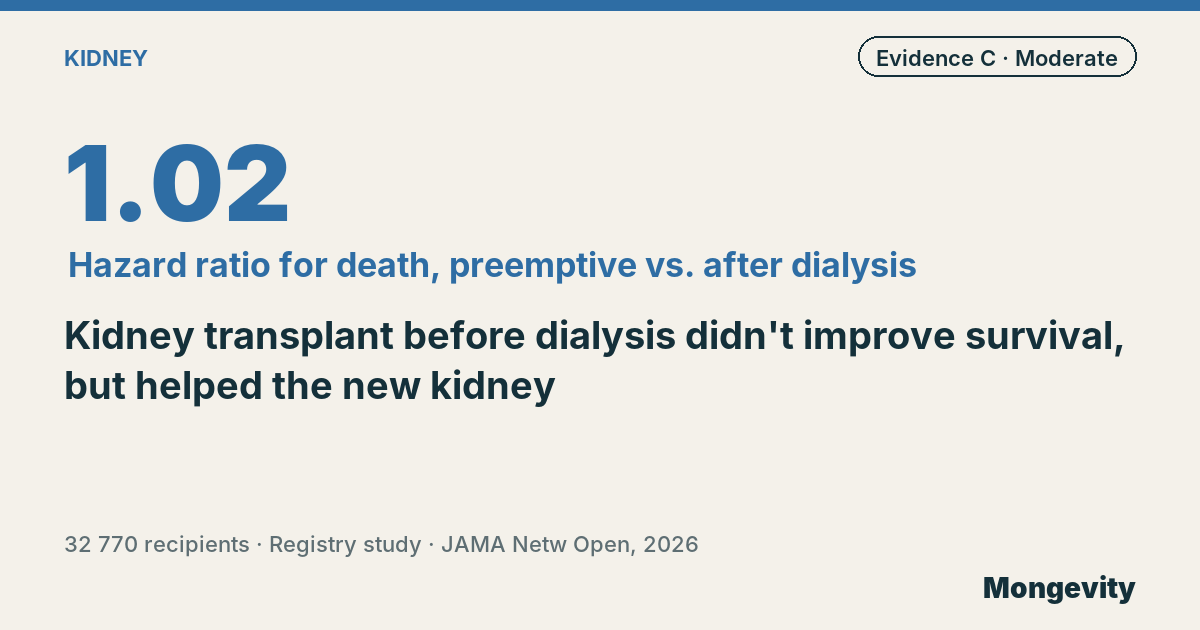
Transplantation before starting dialysis was not linked to longer survival, but was linked to a better start for the new kidney, in a US registry study of 32 770 kidney transplant recipients published Oct. 1, 2026, in JAMA Network Open. Timing still matters for kidney transplants.
When kidneys fail, the options are dialysis or a transplant. Getting a transplant before dialysis starts, called a preemptive transplant, is widely promoted as the best path. But earlier studies may have been biased, for example because people who get preemptive transplants tend to be healthier.
What did the study do?
Researchers used the US Scientific Registry of Transplant Recipients from 2005 to 2023. They included adults receiving a first kidney-only transplant who joined the waiting list with low kidney function. Using a method called target trial emulation, which mimics a randomized trial with registry data, they balanced the groups on health and social factors and accounted for the fact that preemptive recipients start the clock earlier.
What did the study find about kidney transplants?
Among 32 770 recipients, 15 894 had a preemptive transplant and 16 876 had dialysis first.
| Preemptive vs. after dialysis | Result |
|---|---|
| Death from any cause | No difference (hazard ratio 1.02) |
| Delayed function of the new kidney | Lower odds (odds ratio 0.68) |
| Failure of the new kidney, not counting deaths | Lower risk (hazard ratio 0.81) |
| Failure of the new kidney, including deaths | No clear difference (hazard ratio 0.96) |
The lower risk of graft failure was largely explained by the lower rate of delayed graft function.
Why does this matter?
The findings challenge the belief that preemptive transplantation saves lives on its own. Its main benefit may be a smoother start for the new kidney. That could shift the focus toward preventing early graft problems.
How solid is this evidence?
It’s moderate. Mongevity rates it C on our A-to-E scale: a large national registry with careful methods to reduce bias, but still observational, so unmeasured differences between groups may remain.
What are the open questions?
Researchers need to explore which patients gain most from a preemptive transplant and how to reduce delayed graft function for everyone.
What does this mean for you?
If you or someone close to you has advanced kidney disease, ask early about transplant evaluation and the waiting list, including living donation. A preemptive transplant still has real advantages, such as avoiding dialysis, even if survival may be similar.
How do I explain this at dinner?
People with failing kidneys are often told to get a transplant before starting dialysis. A large US study found survival was about the same either way, but the new kidney tended to start working better. A good question for the table: what counts as a benefit besides living longer?
In one sentence: kidney transplantation before dialysis was not linked to longer survival, but was linked to better early function of the new kidney.
Questions and answers
- What is a preemptive kidney transplant?
- A transplant done before the person starts dialysis.
- Does it improve survival?
- In this study, no: the hazard ratio for death was 1.02.
- What advantages did it show?
- Lower odds of delayed graft function (odds ratio 0.68) and lower death-censored graft failure.