People with kidney failure in Medicare Advantage got fewer kidney transplants
Kidney transplantPart of a story we are following · 3 articles · See every update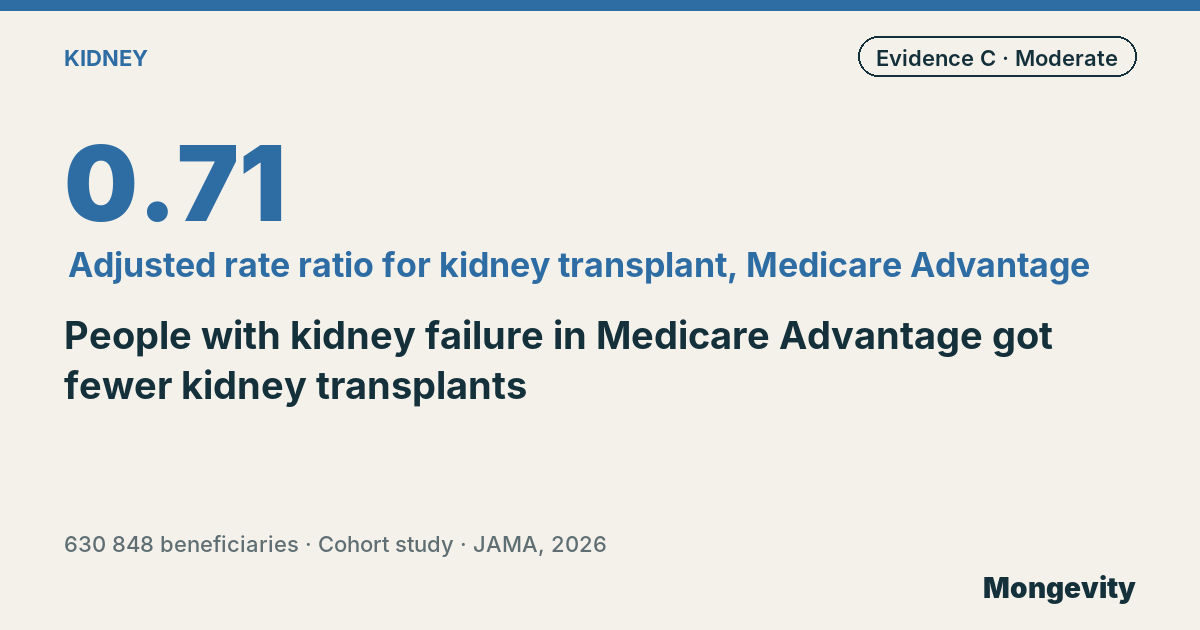
People with kidney failure in Medicare Advantage plans had lower kidney transplant rates than those in traditional Medicare (adjusted rate ratio 0.71), in a US study of 630 848 beneficiaries published Oct. 20, 2026, in JAMA. Insurance design may affect access to kidney transplants.
For people with kidney failure, a kidney transplant usually means longer survival and a better quality of life than dialysis. In 2021, a US law, the 21st Century Cures Act, allowed people with kidney failure to join Medicare Advantage, private plans that manage Medicare benefits, often with limited networks.
What did the study do?
Researchers studied 630 848 Medicare beneficiaries aged 18 to 74 with end-stage kidney disease from 2021 to 2023 who hadn’t had a transplant in the prior 3 years. They compared transplant and wait-listing rates between Medicare Advantage and traditional Medicare, adjusting for demographics, income, Medicaid eligibility, time with kidney failure and region.
What did the study find about kidney transplants?
| Per 1000 person-months | Medicare Advantage | Traditional Medicare | Adjusted rate ratio |
|---|---|---|---|
| Kidney transplant | 2.51 | 4.60 | 0.71 |
| New wait-listing | 3.05 | 4.64 | 0.77 |
| Transplant among wait-listed people | 16.59 | 20.85 | 0.91 |
The gap was stable across all three years and widest in the youngest beneficiaries, aged 18 to 44.
Why does this matter?
More people with kidney failure are joining Medicare Advantage. If these plans make it harder to get on a waiting list or receive a transplant, many patients could miss out on a treatment that extends life. The authors suggest policy oversight. The gap matters most for younger patients, who have the most years of life to gain from a transplant.
How solid is this evidence?
It’s moderate. Mongevity rates it C on our A-to-E scale: a very large national study with careful adjustment, but observational. People who choose Medicare Advantage may differ in ways the data can’t capture, and the study can’t show which plan features cause the gap.
What are the open questions?
Researchers need to identify what drives the gap, such as referral networks, prior authorization or transplant center contracts, and whether policy changes close it.
What does this mean for you?
If you or someone close to you has advanced kidney disease, ask early about transplant evaluation and getting on the waiting list. When choosing a health plan, check which transplant centers are in network and how referrals work.
How do I explain this at dinner?
In the US, people with kidney failure in private Medicare Advantage plans were less likely to get on transplant waiting lists or receive a kidney than those in traditional Medicare. A good question for the table: how much should insurance choices shape access to life-saving care?
In one sentence: Medicare Advantage beneficiaries with kidney failure had substantially lower transplant and wait-listing rates than those in traditional Medicare.
Questions and answers
- What is Medicare Advantage?
- Private health plans that manage Medicare benefits, often with limited provider networks.
- Did plan type affect transplants?
- Yes: Medicare Advantage beneficiaries had lower transplant rates (adjusted rate ratio 0.71).
- What can patients do?
- Ask early about transplant evaluation and check which transplant centers are in network.