A second trial confirms two pills beat chemo when EGFR lung cancer escapes through MET
Lung cancerPart of a story we are following · 9 articles · See every update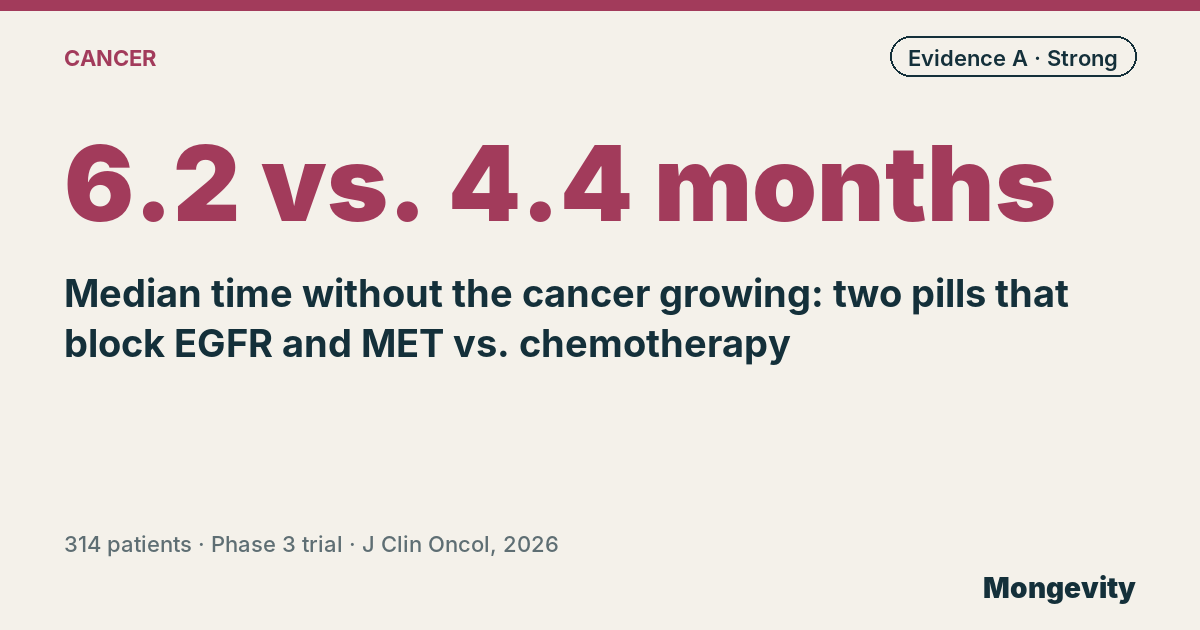
People with EGFR lung cancer that escaped EGFR pills through MET amplification went a median 6.2 months without progression on dalmelitinib plus aumolertinib, vs. 4.4 months on chemotherapy, in a phase 3 trial published Oct. 26, 2026, in Journal of Clinical Oncology. It is a second trial backing this pill-based approach in lung cancer.
When EGFR lung cancer stops responding to targeted pills, one common escape route is MET amplification: the tumor makes extra copies of the MET gene to keep growing. Up to 30% of resistance to EGFR pills involves this route. Earlier this month, Mongevity covered the SAFFRON trial, which tested osimertinib plus savolitinib in this situation.
It also beat chemotherapy.
What did the trial test?
314 people with advanced EGFR lung cancer and MET amplification, confirmed by a lab test on the tumor, whose disease had progressed on EGFR pills were assigned by chance to dalmelitinib plus aumolertinib or to platinum chemotherapy. Independent reviewers who didn’t know the treatment judged progression.
What did the study find about lung cancer?
| Two pills | Chemotherapy | |
|---|---|---|
| Median time without the cancer growing | 6.2 months | 4.4 months |
| Tumors that shrank (response rate) | 59.6% | 38.6% |
| Median duration of response | 9.7 months | 4.4 months |
| Grade 3+ side effects | 50.0% | 51.0% |
The hazard ratio was 0.60. Side effects differed: more liver test abnormalities with the pills, more blood count problems with chemotherapy. Overall survival data were not yet mature.
Why does this matter?
Two independent phase 3 trials now support the same strategy: test the tumor again when EGFR pills fail, and if MET is the escape route, block it while continuing to block EGFR. That consistency makes the approach more convincing.
How solid is this evidence?
It’s strong. Mongevity rates it A on our A-to-E scale: a randomized phase 3 trial with blinded review of progression. Limits: it was open-label, survival data aren’t available yet, and the benefit in time without progression was modest.
What does this mean for you?
If you or someone close to you has EGFR lung cancer that grew on targeted pills, ask the oncologist whether a new biopsy or a MET test makes sense. Which MET-blocking combination is available depends on the country.
How do I explain this at dinner?
When a cancer finds a back door to escape its medicine, doctors can find that door and lock it with a second pill. A second big study showed this works better than chemotherapy. A good question for the table: why does it help when two different teams get the same answer?
In one sentence: a second phase 3 trial showed that blocking both EGFR and MET beats chemotherapy when EGFR lung cancer escapes through MET amplification.
Questions and answers
- What is MET amplification?
- Extra copies of the MET gene that some EGFR lung cancers make to escape EGFR pills; it accounts for up to 30% of this resistance.
- How well did the two pills work?
- Median time without progression was 6.2 months vs. 4.4 months with chemotherapy, and 59.6% vs. 38.6% of tumors shrank.
- What side effects did they cause?
- Serious side effects were similar overall (50.0% vs. 51.0%), with more liver test changes on the pills and more blood count problems on chemotherapy.