A targeted drug plus immunotherapy held off a hard-to-treat lung cancer far longer
Lung cancerPart of a story we are following · 9 articles · See every update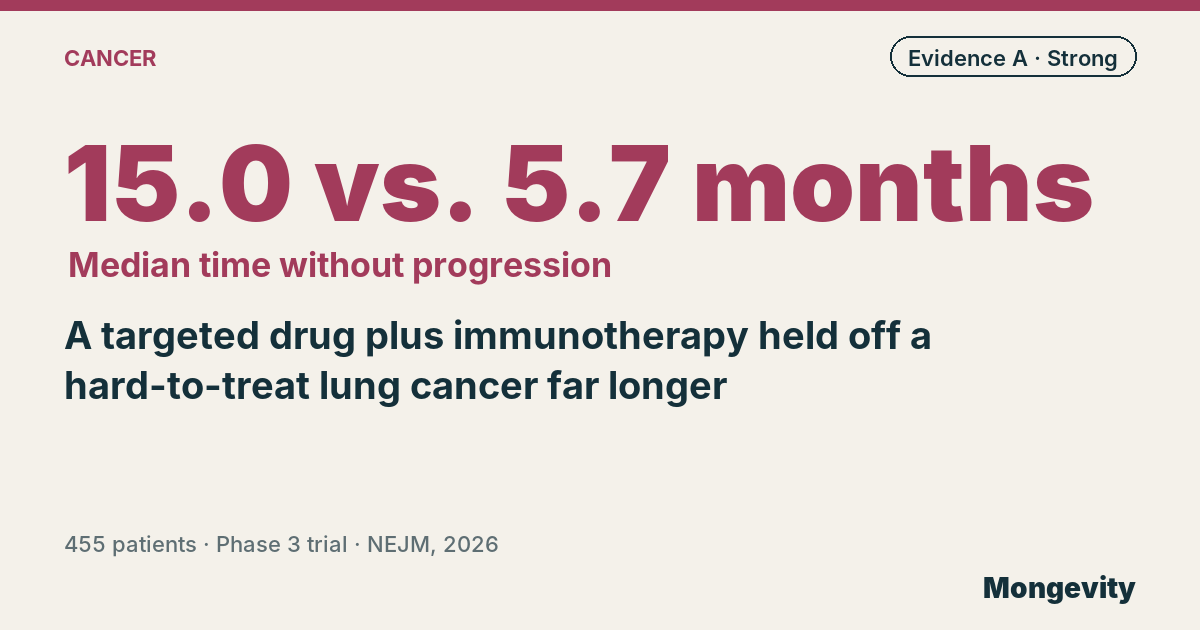
People with PD-L1-negative advanced lung cancer went a median 15.0 months without progression on sacituzumab tirumotecan plus pembrolizumab vs. 5.7 months on chemotherapy plus pembrolizumab, in a phase 3 trial published Oct. 25, 2026, in New England Journal of Medicine. It could change first treatment for this hard-to-treat lung cancer.
Immunotherapy works best in lung cancers that make a lot of a protein called PD-L1. When tumors make almost none, the standard first treatment combines immunotherapy with chemotherapy, but results are modest.
What did the trial test?
455 people with untreated advanced nonsquamous non-small cell lung cancer, without targetable mutations and with PD-L1 below 1%, were assigned by chance to sacituzumab tirumotecan plus pembrolizumab (229 patients) or chemotherapy plus pembrolizumab (226 patients). Reviewers who didn’t know the treatment judged progression.
What did the study find about lung cancer?
| Sacituzumab tirumotecan + pembrolizumab | Chemotherapy + pembrolizumab | |
|---|---|---|
| Median time without progression | 15.0 months | 5.7 months |
| Tumor shrinkage (response) | 50.2% | 47.3% |
| Median duration of response | 13.6 months | 6.8 months |
| Grade 3+ side effects | 47.6% | 60.6% |
The hazard ratio for progression or death was 0.49. Survival data were still immature, with a hazard ratio for death of 0.58. Mouth sores were common with the new combination, but mostly mild.
Why does this matter?
PD-L1-negative lung cancer has been one of the harder groups to treat with immunotherapy. A combination that keeps the cancer in check much longer, with fewer severe side effects than chemotherapy, could change the first treatment these patients receive.
What questions remain?
Doctors will want to see mature overall survival data, longer follow-up on side effects and results in more diverse populations. They will also want to know how this option fits with other new treatments, and which patients benefit most, before it changes routine care everywhere.
How solid is this evidence?
It’s strong. Mongevity rates it A on our A-to-E scale: a randomized phase 3 trial with blinded review. Limits: it was open-label, this is an interim analysis, survival data aren’t mature yet and the trial was funded by the drugmaker.
What does this mean for you?
If you or someone close to you has advanced lung cancer, ask whether the tumor was tested for PD-L1 and for targetable mutations, and whether trials or new combinations are options. Not smoking remains the most important step to prevent lung cancer.
How do I explain this at dinner?
Some lung cancers hide from immunotherapy. Doctors paired immunotherapy with a drug that carries chemo straight to cancer cells, and the cancer stayed in check for a median of 15.0 months instead of 5.7. A good question for the table: why might a “smart” chemo be gentler than the usual one?
In one sentence: in PD-L1-negative advanced lung cancer, sacituzumab tirumotecan plus pembrolizumab kept the cancer from growing far longer than chemotherapy plus pembrolizumab.
Questions and answers
- What is sacituzumab tirumotecan?
- An antibody-drug conjugate that targets the TROP2 protein and delivers chemotherapy directly to cancer cells.
- How well did it work?
- Median time without progression was 15.0 months vs. 5.7 months with chemotherapy plus pembrolizumab.
- Was it harder to tolerate?
- No: grade 3+ side effects were 47.6% vs. 60.6%, though mouth sores were common.