A two-pronged HER2 antibody beat the standard first treatment in HER2+ breast cancer
Breast, ovarian and uterine cancerPart of a story we are following · 8 articles · See every update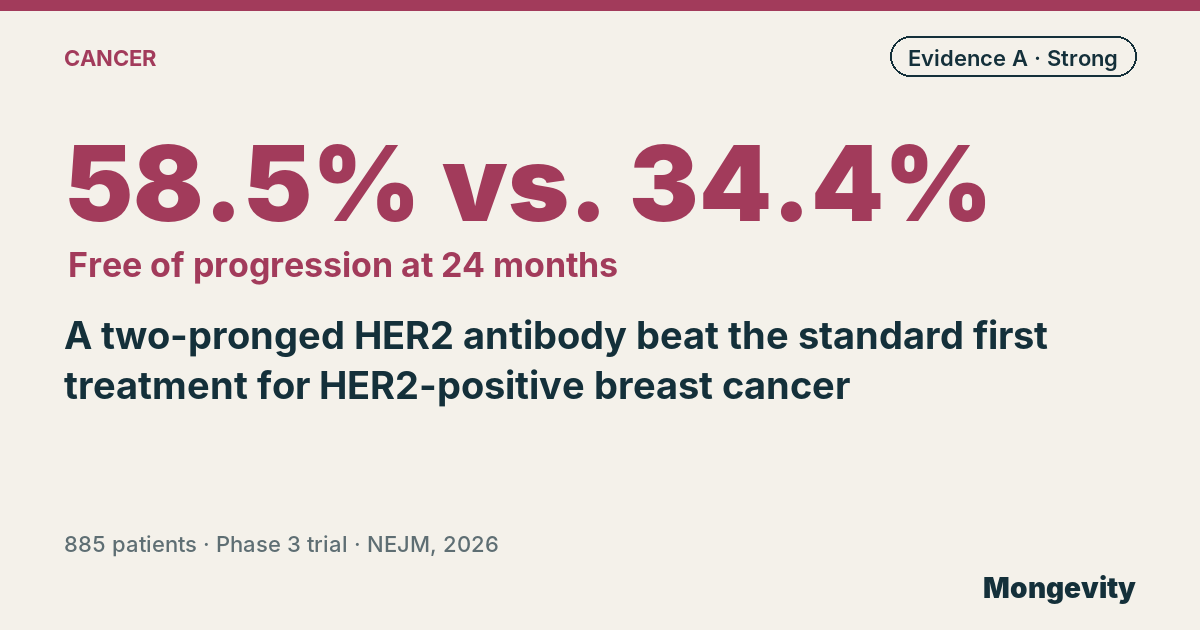
Anbenitamab plus a docetaxel formulation kept 58.5% of women with HER2-positive advanced breast cancer free of progression at 24 months, vs. 34.4% with the standard combination, in a phase 3 trial in China published Oct. 24, 2026, in New England Journal of Medicine. It is a potential new first treatment for one of the most common women’s cancers.
For HER2-positive advanced breast cancer, the usual first treatment combines the chemotherapy docetaxel with two HER2 antibodies, trastuzumab and pertuzumab, known as THP. Anbenitamab is a bispecific antibody: a single molecule that grabs HER2 at two different spots.
What did the trial test?
At multiple centers in China, 885 people with HER2-positive advanced breast cancer were assigned by chance to anbenitamab plus HB1801 (445) or THP (440). Reviewers who didn’t know the treatment judged progression. Median follow-up was 21.0 months.
What did the study find about women’s cancers?
| Anbenitamab + HB1801 | THP | |
|---|---|---|
| Free of progression at 24 months | 58.5% | 34.4% |
| Tumor shrinkage (response) | 87.6% | 73.4% |
| Grade 3+ side effects | 45.9% | 34.4% |
| Severe low neutrophils | 13.1% | 8.4% |
The hazard ratio for progression or death was 0.46. Side effects leading to death occurred in 2 patients in each group.
Why does this matter?
THP is the established first-line standard. A treatment that keeps the cancer in check notably longer could become a new option, especially if survival benefits are confirmed.
What questions remain?
Doctors will want to see mature overall survival data, longer follow-up on side effects and results in more diverse populations. They will also want to know how this option fits with other new treatments, and which patients benefit most, before it changes routine care everywhere.
How solid is this evidence?
It’s strong. Mongevity rates it A on our A-to-E scale: a large randomized phase 3 trial with blinded review. Limits: it was open-label, done only in China, this is an interim analysis without survival data, side effects were more frequent and it was funded by the drugmaker.
What does this mean for you?
If you or someone close to you has HER2-positive advanced breast cancer, ask about first-line options, including clinical trials of newer HER2 drugs. Anbenitamab may not be available in your country yet. Ask, too, how heart function and blood counts would be monitored during treatment.
How do I explain this at dinner?
Some breast cancers have a lot of a protein called HER2. Standard treatment uses two antibodies to block it; a new antibody grabs it in two places at once. Paired with chemo, it kept the cancer in check longer than the standard. A good question for the table: why might grabbing a target in two places work better?
In one sentence: anbenitamab plus HB1801 kept HER2-positive advanced breast cancer from progressing longer than standard THP, with more side effects.
Questions and answers
- What is anbenitamab?
- A bispecific antibody that binds HER2 at two different sites.
- How well did it work?
- 58.5% were free of progression at 24 months vs. 34.4% with THP.
- Is it harder to tolerate?
- Grade 3+ side effects were 45.9% vs. 34.4%, most often low neutrophils.