Bank records showed money struggles long before a mental health disclosure
Stress and the mindPart of a story we are following · 4 articles · See every update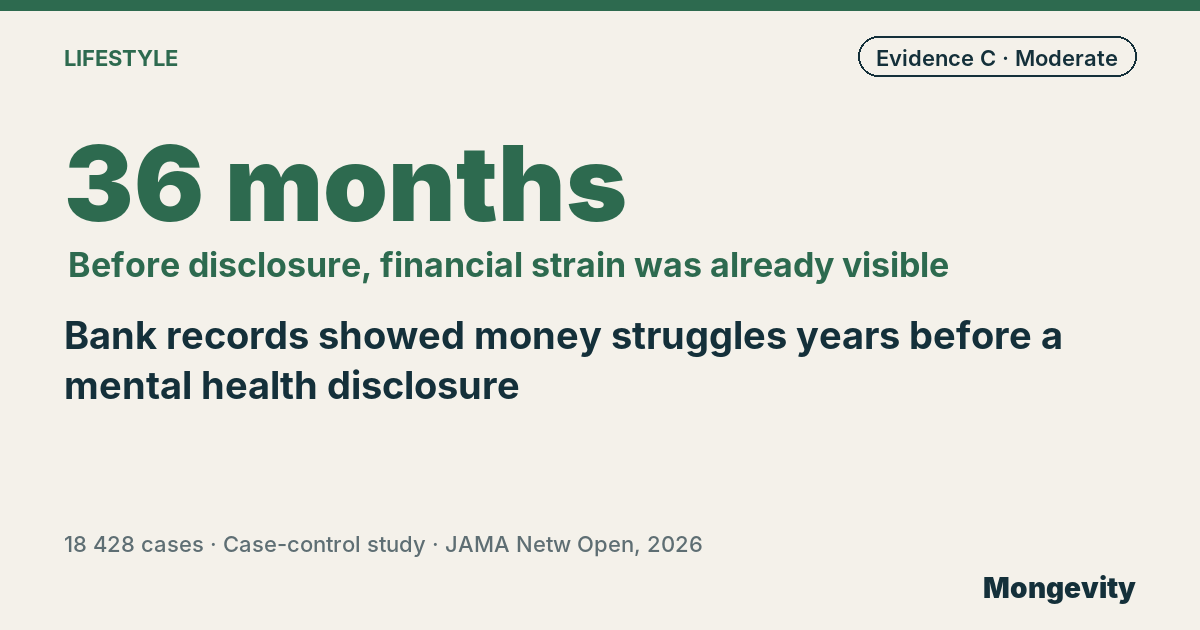
People in the UK who told their bank about a mental health condition showed signs of financial strain up to 36 months earlier, such as lower credit scores and more overdraft use, in a study of bank records published Oct. 1, 2026, in JAMA Network Open. Money trouble may be an early signal linking stress and mental health.
Mental health conditions affect more than mood. They can make it harder to manage money: paying bills on time, planning spending or resisting impulse purchases. Many banks now let customers tell them about a mental health condition so they can get extra support.
What did the study do?
Researchers compared 18 428 customers of a major UK bank who disclosed a mental health condition between 2019 and 2025 with 64 229 matched customers who didn’t. They looked at 331 monthly financial indicators, including income, spending, credit scores and how customers contacted the bank.
What did the study find about stress and mental health?
Differences in financial functioning appeared up to 36 months before disclosure. Compared with controls, people who later disclosed had:
| Indicator | Difference (standardized) |
|---|---|
| Disability benefits income | Higher, 0.80 |
| Credit scores | Lower, 0.52 |
| Overdraft use | Higher, 0.49 |
| Telephone banking use | Higher, 0.56 |
They also used more cash and spent less on self-care and leisure. The patterns were broadly similar across different mental health conditions.
Why does this matter?
Money problems and mental health problems often feed each other. Seeing early signs in financial data could help banks offer support sooner, such as payment holidays, budgeting help or links to mental health services, and might help clinicians understand how a condition is affecting daily life.
How solid is this evidence?
It’s moderate. Mongevity rates it C on our A-to-E scale: a very large study with objective financial data, but observational, and limited to people who chose to tell their bank, who may differ from others with mental health conditions. Using financial data in this way also raises important privacy questions.
What are the open questions?
It’s not yet clear whether offering support based on financial signals actually helps people, or how to do it ethically and with consent.
What does this mean for you?
If you’re struggling with your mental health, money worries are common and nothing to be ashamed of. Many banks offer support if you tell them; ask what’s available. If you notice a friend or relative suddenly struggling with bills or spending, it may be a sign to check in on how they’re doing.
How do I explain this at dinner?
A UK study found that people’s bank records showed signs of money trouble, such as lower credit scores and more overdrafts, up to 36 months before they told their bank about a mental health condition. A good question for the table: how does stress change the way you spend?
In one sentence: bank records showed financial strain up to 36 months before customers disclosed a mental health condition, a pattern that could help offer support earlier.
Questions and answers
- What did bank data show?
- Signs of financial strain, such as lower credit scores and more overdraft use, up to 36 months before disclosure.
- Was it the same for all conditions?
- Patterns were broadly similar across different mental health conditions.
- Can banks help?
- Many banks offer extra support to customers who disclose a mental health condition.