For IVF after 35, a non-invasive embryo genetic test didn’t raise pregnancy rates
Fertility and agePart of a story we are following · 5 articles · See every update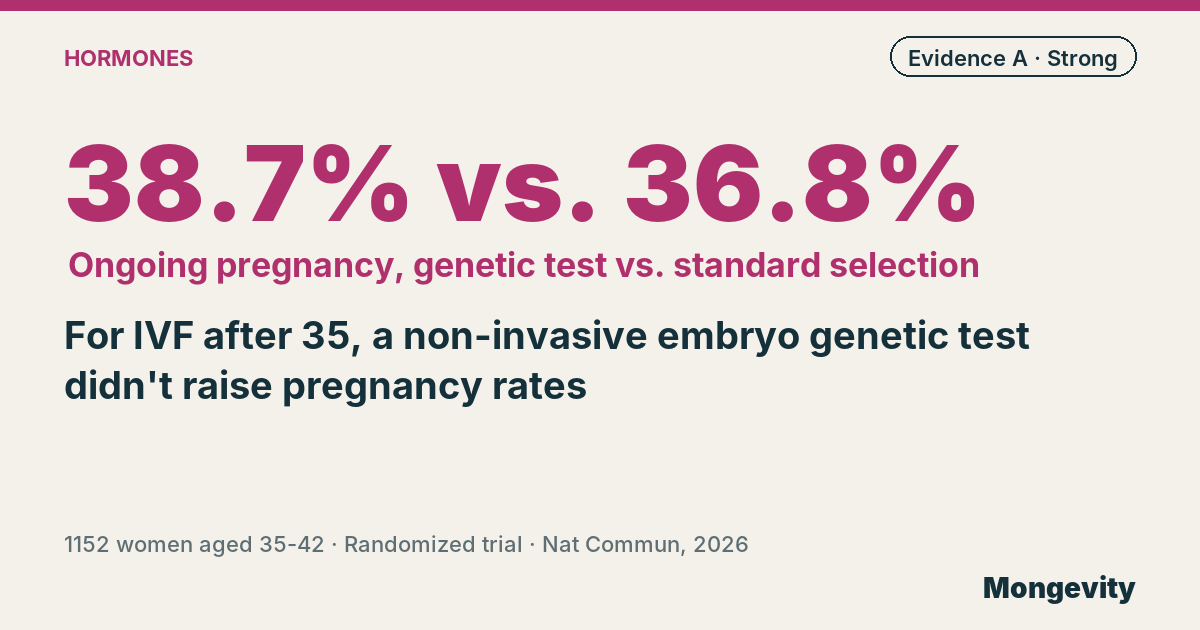
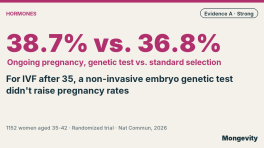
Choosing embryos with a non-invasive genetic test of the culture fluid gave an ongoing pregnancy rate of 38.7%, similar to 36.8% with standard selection, in a randomized trial of 1152 women aged 35 to 42 at 13 fertility centers in China, published Sept. 8, 2026, in Nature Communications. The test didn’t improve fertility treatment results for this group.
As women age, more of their eggs carry the wrong number of chromosomes, which leads to embryos that don’t implant or end in miscarriage. Genetic testing of embryos before transfer aims to pick the healthy ones. A newer, non-invasive version analyzes DNA that embryos release into the fluid they grow in, without taking cells from the embryo.
What did the trial test?
Women aged 35 to 42 at 13 fertility centers in China, who had at least two embryos at the blastocyst stage and agreed to transfer a single frozen-thawed embryo, were assigned by chance to embryo selection by the non-invasive test (594) or by standard appearance criteria (595). Neither patients nor assessors knew the group. The main outcome was an ongoing pregnancy beyond 12 weeks. The analysis included 1152 couples.
What did the study find about fertility?
- Ongoing pregnancy was 38.7% with the genetic test and 36.8% with standard selection, not a significant difference.
- Clinical pregnancy (47.6% vs. 49.9%), miscarriage (21.0% vs. 27.6%) and live birth (37.0% vs. 35.5%) did not differ significantly.
- Early miscarriage, before 12 weeks, was lower with the test: 18.0% vs. 25.2%.
- Outcomes for mothers and babies were similar, and no serious adverse events were reported.
Why does this matter?
Embryo genetic tests add cost and are often offered to women over 35. This well-designed trial found that, in women with a good prognosis, the non-invasive test didn’t increase the chance of a baby. The lower early miscarriage rate may matter to some patients, but it didn’t translate into more births.
How solid is this evidence?
It’s strong. Mongevity rates it A on our A-to-E scale: a large multicenter, double-blind randomized trial with a clear main outcome. Limits: it included women with at least two blastocysts, a relatively good-prognosis group, it looked at the first transfer only, and it was done in China.
What are the open questions?
It’s unclear whether the test helps women with fewer embryos, older women or those with repeated miscarriages, and whether it reduces time to pregnancy over several transfers.
What does this mean for you?
If you’re doing IVF after 35, ask your clinic what evidence supports any add-on test they offer, how much it costs and whether it increases the chance of a live birth in your situation. Age remains the strongest factor in fertility, so planning ahead matters.
How do I explain this at dinner?
In fertility treatment, some clinics test the fluid around embryos to choose the ones with normal chromosomes. In a big trial with women 35 to 42, it didn’t lead to more pregnancies or babies than choosing embryos by how they look, though early miscarriages were fewer. A good question for the table: how do you decide whether an extra test is worth paying for?
In one sentence: in women aged 35 to 42 with a good prognosis, embryo selection by non-invasive preimplantation genetic testing did not improve ongoing pregnancy rates compared with standard morphology.
Questions and answers
- What is non-invasive embryo genetic testing?
- A test of DNA released by the embryo into its culture fluid, to estimate whether it has the right number of chromosomes.
- Did it increase pregnancies?
- No: 38.7% ongoing pregnancies vs. 36.8% with standard selection.
- Did it reduce miscarriage?
- Early miscarriage was lower (18.0% vs. 25.2%), but overall miscarriage and live birth did not differ significantly.
- Who was studied?
- Women aged 35 to 42 with at least two blastocysts, at 13 centers in China.