Oral estrogen, including menopause pills, was linked to a rare blistering skin disease
MenopausePart of a story we are following · 11 articles · See every update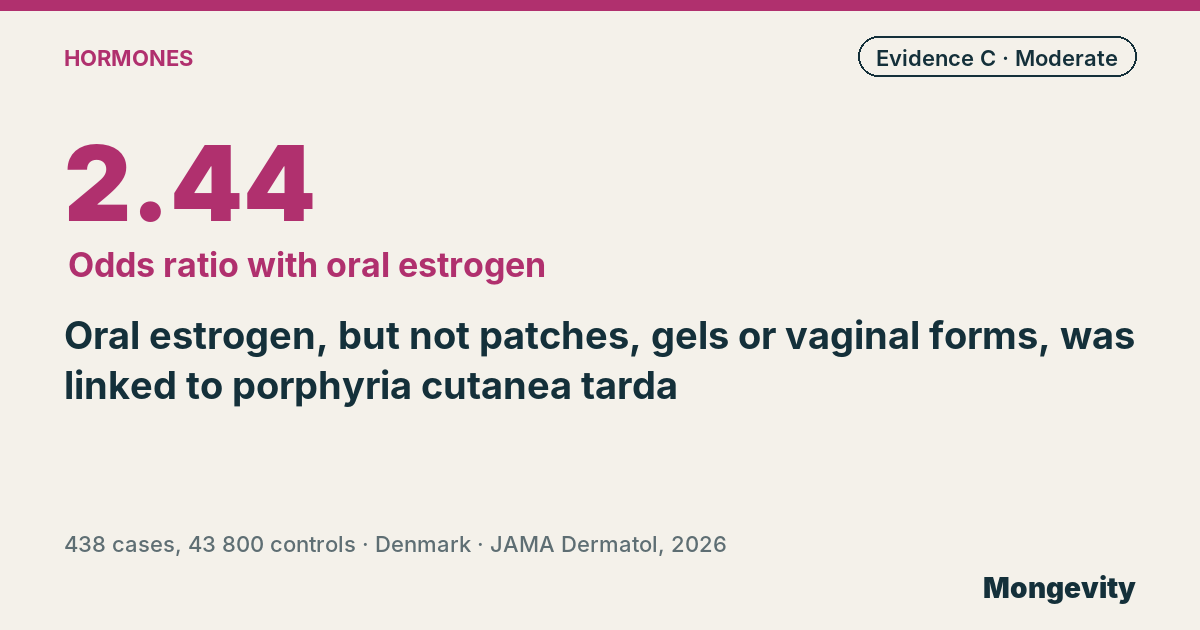
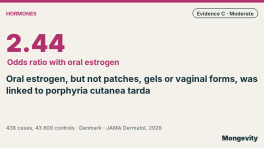
Women who used estrogen-containing therapy had higher odds of porphyria cutanea tarda, a rare blistering skin disease (adjusted odds ratio 2.03), in a nationwide study in Denmark published Oct. 28, 2026, in JAMA Dermatology. Oral therapy, including for menopause, was linked to the disease; non-oral routes were not.
Porphyria cutanea tarda is a rare condition in which a problem in making heme, part of hemoglobin, causes fragile skin and blisters on sun-exposed areas like the hands. Estrogen has long been suspected as a trigger, but the evidence came mostly from case reports.
What did the study look at?
Using Danish national registries from 1995 through 2024, researchers compared 438 women with a first diagnosis of porphyria cutanea tarda with 43 800 women of the same age without it. They looked at estrogen prescriptions filled in the year before, adjusting for other known risk factors such as liver disease, hepatitis, iron overload, HIV, smoking and alcohol.
What did the study find about menopause?
| Exposure | Adjusted odds ratio |
|---|---|
| Any estrogen-containing therapy | 2.03 |
| Estrogen-containing contraceptives | 2.52 |
| Estrogen-only therapy | 1.58 |
| Combined estrogen and progestogen therapy | 2.18 |
| Oral therapy | 2.44 |
Non-oral routes, such as patches, gels or vaginal estrogen, were not linked to the disease.
Why does this matter?
Estrogen is widely used for contraception and menopause symptoms. Knowing that the risk seems tied to oral forms can help doctors choose a route for women with other risk factors, and helps explain why some women develop this disease. Oral estrogen passes through the liver first, where heme is made, which may be one reason the route matters, though this study didn’t test that mechanism.
How solid is this evidence?
It’s moderate. Mongevity rates it C on our A-to-E scale. A nationwide case-control study is strong for a rare disease, but it’s observational, based on prescriptions filled rather than taken, and can’t prove estrogen causes the disease. The absolute risk remains very low because the disease is rare.
What does this mean for you?
Porphyria cutanea tarda is rare, so this isn’t a reason for most women to avoid estrogen. If you’ve had liver disease, hepatitis C, iron overload or skin blisters on sun-exposed areas, mention it when discussing hormonal contraception or menopause therapy; non-oral options may be worth considering.
How do I explain this at dinner?
A rare illness makes the skin on the hands blister in the sun. Scientists in Denmark found it was more common in women taking estrogen pills, but not patches or gels. A good question for the table: why might the same medicine act differently as a pill or a patch?
In one sentence: estrogen therapy taken by mouth, but not through the skin or vagina, was linked to a rare blistering skin disease in a nationwide Danish study.
Questions and answers
- What is porphyria cutanea tarda?
- A rare disorder of heme production that causes fragile skin and blisters on sun-exposed areas.
- Does estrogen raise the risk?
- In this study, estrogen-containing therapy was linked to higher odds (adjusted odds ratio 2.03).
- Are patches or gels safer for this?
- Only oral therapy was linked to the disease (odds ratio 2.44); non-oral routes were not.