Cochrane update: mifepristone may ease endometriosis period pain, with weak evidence
Menstrual healthPart of a story we are following · 6 articles · See every update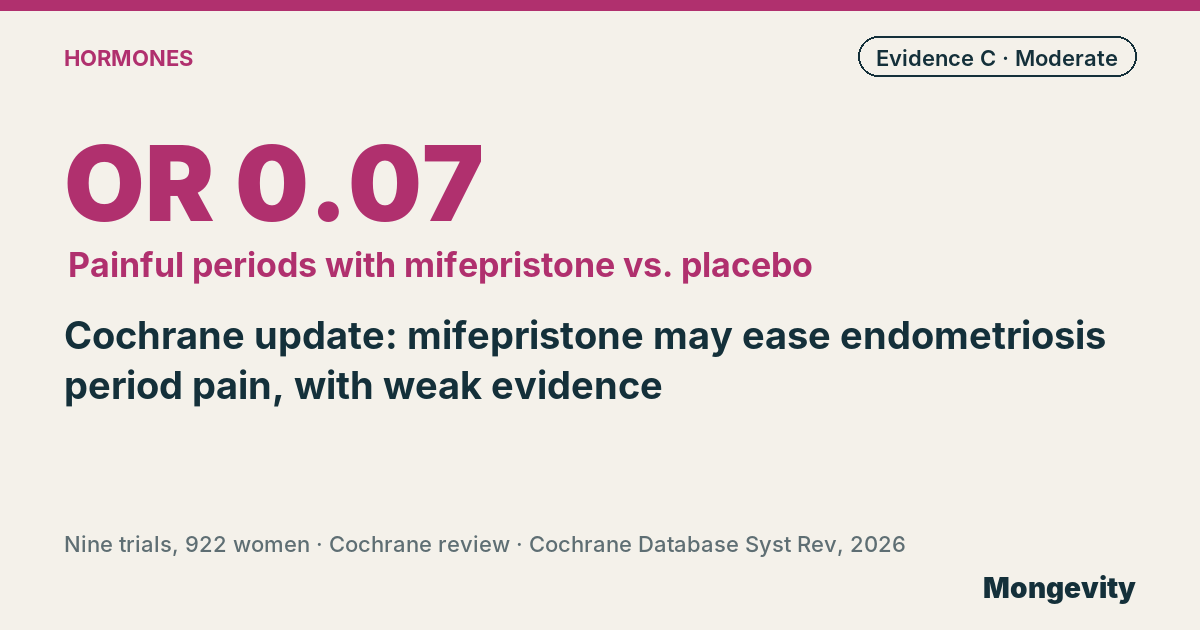
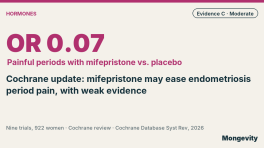
Mifepristone may reduce painful periods in endometriosis (odds ratio 0.07) but may cause hot flushes, according to a Cochrane review of nine trials with 922 women published Sept. 16, 2026, in Cochrane Database of Systematic Reviews. Evidence on these drugs for menstrual health remains weak.
Endometriosis is a condition in which tissue similar to the lining of the uterus grows outside it, causing pelvic pain, painful periods, pain during sex and sometimes infertility. Because it depends on estrogen, many treatments act on hormones. Progesterone receptor modulators, such as mifepristone and gestrinone, have been proposed. A Cochrane review updated in September 2026 in the Cochrane Database of Systematic Reviews summarized the evidence.
What did the study look at?
Reviewers searched for randomized trials comparing these drugs with placebo, no treatment or other medicines in women with symptomatic endometriosis, up to April 2026. No new trials were found since the 2017 version. The review included nine studies with 922 women. They rated certainty of the evidence with the GRADE system.
What did the study find about menstrual health?
- One study found that mifepristone may improve painful periods at three months (odds ratio 0.07, low certainty).
- In practice, if 40% of women on placebo had painful periods, between 3% and 10% would with mifepristone.
- Mifepristone may increase hot flushes (odds ratio 28.79).
- The effect on pain during sex was very uncertain.
- Compared with leuprorelin, gestrinone may be less effective for period pain but better for pain during sex, with fewer hot flushes.
- Comparisons of gestrinone with danazol were very uncertain.
Why does this matter?
Endometriosis often takes years to diagnose and treat, and many women don’t respond well to available options. This review shows that progesterone receptor modulators may help some symptoms, but the evidence is thin and dated, and no new trials have been done in years.
How solid is this evidence?
It’s limited. Mongevity rates it C on our A-to-E scale: a Cochrane review of randomized trials, but the certainty was low to very low. Limits: few, small and old studies, poor reporting, high or unclear dropout rates and wide uncertainty in results.
What are the open questions?
New, well-designed trials are needed to know whether these drugs have a role alongside current treatments, and to measure long-term safety and quality of life.
What does this mean for you?
If you have severe period pain, pain during sex or pelvic pain that disrupts your life, ask a gynecologist about endometriosis. Several hormonal and surgical treatments exist, and a specialist can help choose based on your symptoms and plans for pregnancy.
How do I explain this at dinner?
Endometriosis causes painful periods and pelvic pain in many women. Reviewers pooled the trials on a group of hormone-blocking drugs and found that one, mifepristone, may ease period pain but cause hot flushes, and that the studies are old and weak. A good question for the table: why does women’s pain get studied so little?
In one sentence: in women with endometriosis, mifepristone may improve painful periods but increase hot flushes, and evidence for other progesterone receptor modulators is low to very low certainty.
Questions and answers
- What is endometriosis?
- Tissue similar to the uterine lining growing outside the uterus, causing pain and sometimes infertility.
- Does mifepristone help?
- It may improve painful periods (odds ratio 0.07), with low certainty.
- What are the side effects?
- It may increase hot flushes (odds ratio 28.79).
- Is there new evidence?
- No new trials were found since the 2017 version of the review.