Unexplained infertility: one IVF cycle led to more births in 7 months than four IUI cycles
Fertility and agePart of a story we are following · 5 articles · See every update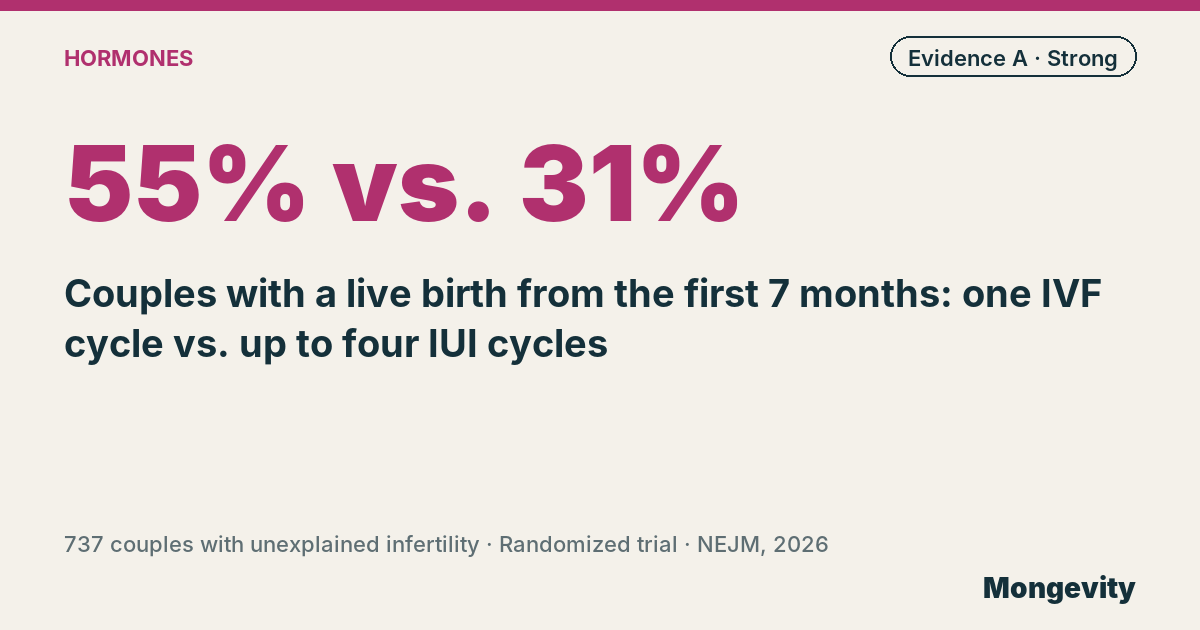
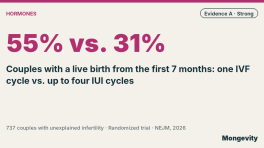
Couples with unexplained infertility had a 55% live-birth rate within 7 months after one complete IVF cycle, vs. 31% after up to four IUI cycles, in a randomized trial in Australia and New Zealand published Oct. 27, 2026, in New England Journal of Medicine. Over 20 months, fertility outcomes were similar: 70% vs. 71%.
Many couples who can’t conceive get a diagnosis of unexplained infertility: the tests come back normal, but pregnancy doesn’t happen. International guidelines recommend starting with intrauterine insemination (IUI) with ovarian stimulation, a simpler and cheaper treatment, before moving to in vitro fertilization (IVF).
One complete cycle of IVF led to many more births in the first 7 months than up to four cycles of IUI.
What are IUI and IVF?
In IUI, the woman takes medicine to stimulate her ovaries, and prepared sperm is placed directly in the uterus. In IVF, eggs are collected, fertilized in the lab, and embryos are transferred to the uterus. IVF is more complex and expensive but more effective per attempt.
What did the trial test?
737 couples with unexplained infertility were assigned by chance to start with IUI (up to four cycles) or with IVF (one complete cycle, including transfer of the frozen embryos). After 7 months, couples without a birth or ongoing pregnancy could move on: the IUI group to up to two IVF cycles, the IVF group to one more.
What did the study find about fertility?
IUI was not as good as IVF in the first stage. Over the full 20 months, the two strategies ended up with similar birth rates, because many IUI couples went on to IVF. Most serious adverse events were related to egg collection or ovarian overstimulation.
Why does this matter?
The order of treatments affects time, cost and stress. Starting with IVF got couples to a baby faster, while starting with IUI got them to the same place later. Which path is best can depend on age, costs and preferences.
How solid is this evidence?
It’s strong. Mongevity rates it A on our A-to-E scale: a large, multicenter randomized trial in a leading journal. Limits: couples who were in the first stage during COVID lockdowns were left out of the main analysis, and the results apply to unexplained infertility, not to other causes.
What does this mean for you?
If you have unexplained infertility, ask your fertility specialist to compare both paths for your situation: chances per month, total time, costs and risks. Age matters, because time is a bigger factor for older women.
How do I explain this at dinner?
Some couples who want a baby don’t know why it isn’t happening. Doctors compared a simpler treatment tried several times with a more complex one tried once: the complex one worked faster, but by the end both got about the same number of babies. A good question for the table: when is it worth taking the faster but harder road?
In one sentence: for unexplained infertility, starting with one IVF cycle led to more births in 7 months than up to four IUI cycles, though both strategies ended up similar after 20 months.
Questions and answers
- Is IVF better than IUI for unexplained infertility?
- Faster: 55% vs. 31% live births from the first 7 months. Over 20 months, both strategies reached similar rates (71% vs. 70%).
- Why did both strategies end up similar?
- Because many couples in the IUI group moved on to IVF in the second stage.
- Is IVF riskier?
- Serious adverse events occurred in 14 couples in the IVF group and 6 in the IUI group, mostly related to egg collection or ovarian overstimulation.