Adding tarlatamab to maintenance therapy extended survival in small-cell lung cancer
Lung cancerPart of a story we are following · 9 articles · See every update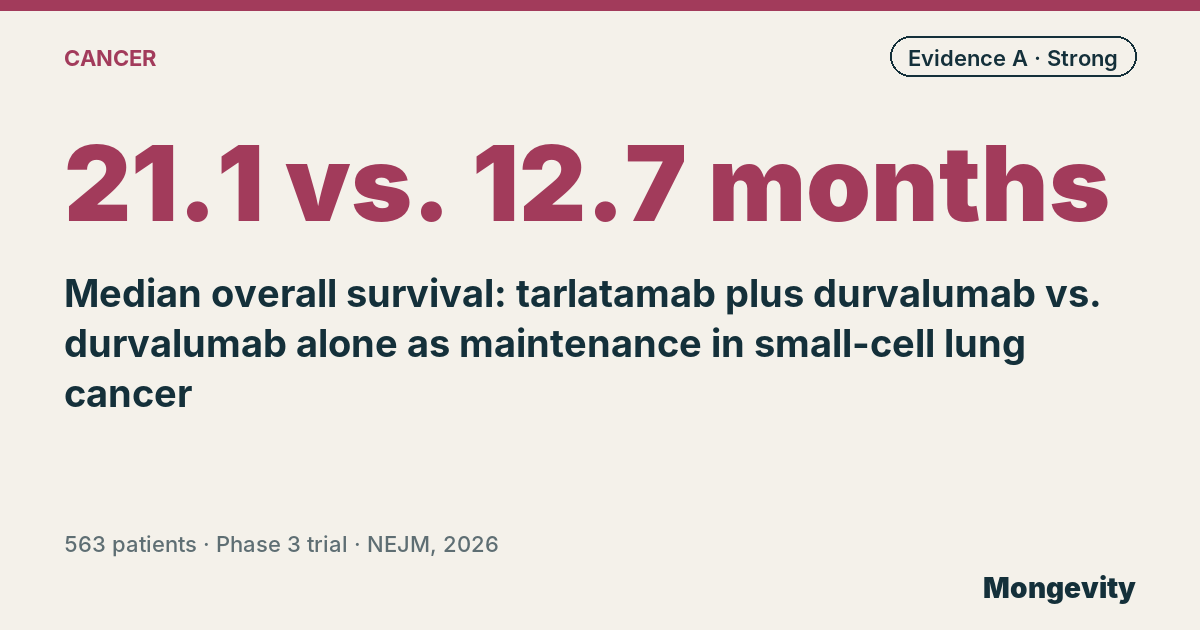
Adding tarlatamab to durvalumab maintenance extended median survival in extensive-stage small-cell lung cancer to 21.1 months vs. 12.7 months with durvalumab alone, in a phase 3 trial published Oct. 24, 2026, in New England Journal of Medicine. It is a major step for a hard-to-treat lung cancer.
Small-cell lung cancer is one of the most aggressive cancers. When it has spread (extensive stage), people typically live about 12 to 13 months, even with chemotherapy and immunotherapy.
Median survival rose from 12.7 to 21.1 months.
What is tarlatamab?
It’s a bispecific T-cell engager: a molecule with two arms, one that grabs DLL3, a protein on small-cell lung cancer cells, and one that grabs CD3 on immune T cells, bringing them together so the T cells attack the cancer. It had already improved survival as a second treatment.
What did the trial test?
563 people with extensive-stage small-cell lung cancer whose disease hadn’t progressed after initial chemotherapy plus immunotherapy were assigned by chance to maintenance with tarlatamab plus durvalumab or durvalumab alone.
What did the study find about lung cancer?
| Tarlatamab + durvalumab | Durvalumab alone | |
|---|---|---|
| Median overall survival | 21.1 months | 12.7 months |
| Median time without progression | 7.4 months | 1.9 months |
| Grade 3+ side effects | 46.8% | 40.6% |
The hazard ratio for death was 0.42. Cytokine release syndrome, an immune reaction causing fever and other symptoms, occurred in nearly half the patients on tarlatamab, mostly mild or moderate.
Why does this matter?
Progress in small-cell lung cancer has been slow for decades. An improvement of this size in survival, as an early maintenance treatment, is a major step.
How solid is this evidence?
It’s strong. Mongevity rates it A on our A-to-E scale: a large international randomized phase 3 trial with a large survival difference. Limits: it was open-label, the result comes from an interim analysis, and it was funded by Amgen and AstraZeneca. Cytokine release syndrome requires monitoring.
What does this mean for you?
If you or someone close to you has extensive-stage small-cell lung cancer and responded to initial treatment, ask the oncologist about tarlatamab maintenance and how side effects like cytokine release syndrome would be managed.
How do I explain this at dinner?
A new medicine works like a matchmaker: it grabs a cancer cell with one hand and a defense cell with the other, so the defense cell can attack. Added early, it helped people with a tough lung cancer live much longer. A good question for the table: why might it help to introduce two things that need to meet?
In one sentence: adding tarlatamab to durvalumab maintenance extended survival by months in extensive-stage small-cell lung cancer.
Questions and answers
- What is tarlatamab?
- A bispecific T-cell engager that links DLL3 on small-cell lung cancer cells to CD3 on T cells so they attack the cancer.
- How much did it extend survival?
- Median overall survival was 21.1 months with tarlatamab plus durvalumab vs. 12.7 months with durvalumab alone.
- What side effects does it cause?
- Cytokine release syndrome occurred in nearly half the patients, mostly grade 1 or 2; grade 3+ events were 46.8% vs. 40.6%.