For BRCA carriers, preventive breast removal was linked to lower mortality than screening
Breast, ovarian and uterine cancerPart of a story we are following · 8 articles · See every update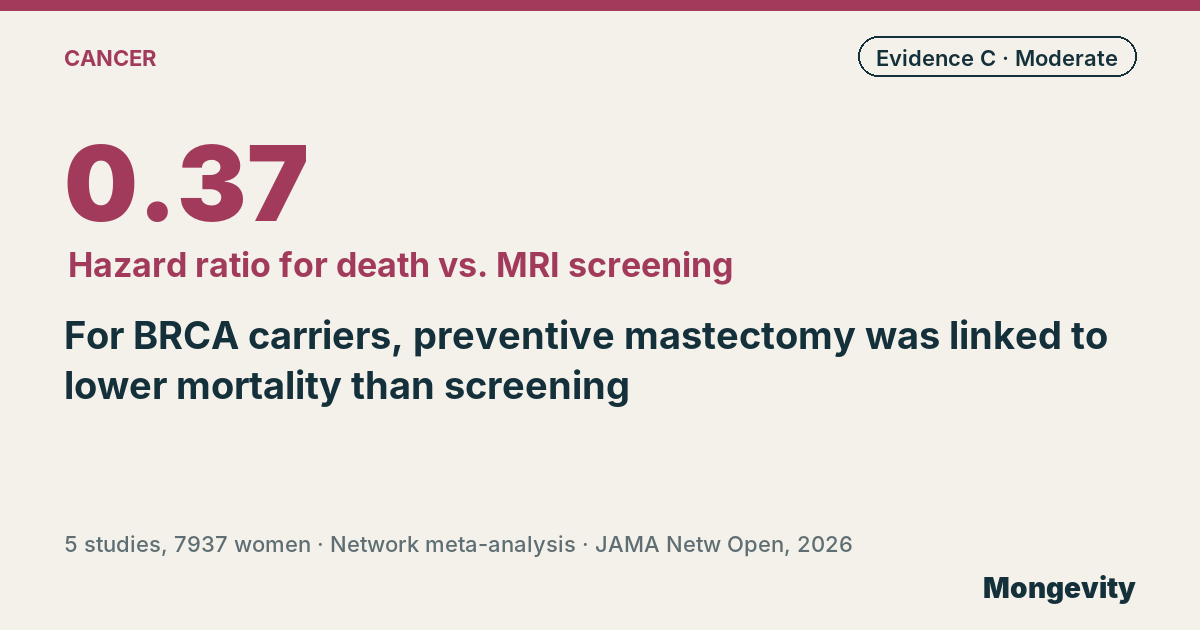
Risk-reducing mastectomy was linked to lower all-cause mortality than MRI-based screening (hazard ratio 0.37) in women with BRCA1 or BRCA2 variants, in a network meta-analysis published Oct. 1, 2026, in JAMA Network Open, though certainty was very low. For these breast cancer risks, prevention choices remain personal.
Women who carry harmful variants in the BRCA1 or BRCA2 genes have a high risk of breast and ovarian cancer. Options include intensive screening with MRI and mammography, removing the ovaries and fallopian tubes, or removing both breasts before cancer appears, called risk-reducing mastectomy. Because removing the ovaries also lowers risk and affects survival, it’s been hard to know how much mastectomy itself helps.
What did the study do?
Researchers searched three databases up to May 28, 2026, for studies in women carrying BRCA1 or BRCA2 variants, without prior breast or ovarian cancer, that compared mastectomy with screening and accounted for ovary removal. Five observational studies with 7937 women met the criteria.
What did the study find about women’s cancers?
| Risk-reducing mastectomy vs. | Hazard ratio, death from any cause |
|---|---|
| MRI-based screening | 0.37 |
| Mammography alone | 0.16 |
For breast cancer deaths, mastectomy was linked to lower mortality than mammography alone (hazard ratio 0.07), but not significantly lower than MRI-based screening (0.26). In BRCA1 carriers only, it was linked to lower breast cancer mortality than both forms of screening.
How solid is this evidence?
It’s limited, and that’s key. Mongevity rates it C on our A-to-E scale: a careful network meta-analysis, but of observational studies, with critical risk of bias in 4 of 5 studies and very low certainty overall. Women who choose surgery may differ from those who choose screening in ways the studies couldn’t fully measure.
Why does this matter?
It’s one of the clearest attempts to estimate the survival benefit of mastectomy itself. The authors say it can support shared decision-making, especially for BRCA1 carriers, but it doesn’t settle the question.
What does this mean for you?
If breast or ovarian cancer runs in your family, ask about genetic counseling. If you carry a BRCA variant, a team that includes a genetic counselor can explain the options, screening, ovary removal and mastectomy, and the trade-offs of each for your age and plans.
How do I explain this at dinner?
Women with BRCA gene changes face a high breast cancer risk. Combining several studies, removing the breasts before cancer appears was linked to lower death rates than screening, but the studies were weak. A good question for the table: how would you weigh a big decision with uncertain evidence?
In one sentence: in BRCA carriers, risk-reducing mastectomy was linked to lower mortality than screening, but the evidence is of very low certainty.
Questions and answers
- What is risk-reducing mastectomy?
- Removing both breasts before cancer appears to lower the risk in people with high genetic risk.
- Was it linked to longer survival?
- It was linked to lower all-cause mortality than MRI screening (hazard ratio 0.37) and mammography (0.16).
- How sure is this?
- Not very: certainty was very low, because the studies were observational with high risk of bias.