Iza-bren extended control of HR+ breast cancer after hormone therapy and chemo
Breast, ovarian and uterine cancerPart of a story we are following · 8 articles · See every update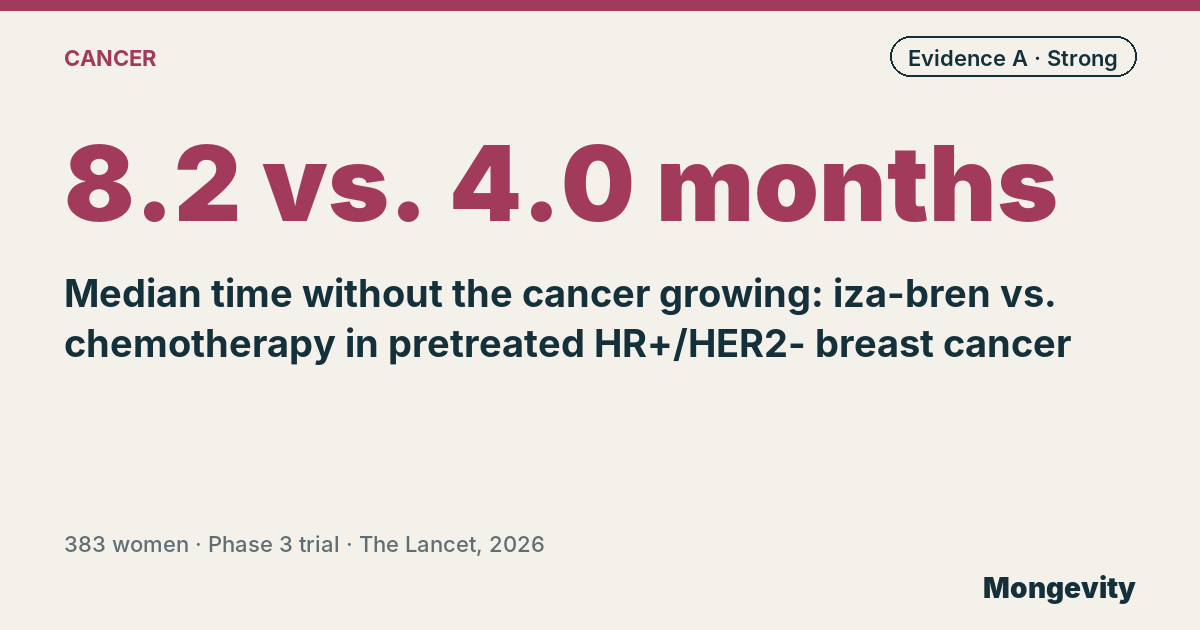
Women with HR-positive, HER2-negative breast cancer that had progressed after hormone therapy, CDK4/6 inhibitors and chemotherapy went a median 8.2 months without progression on iza-bren vs. 4.0 months on chemotherapy, in a phase 3 trial in China published Oct. 26, 2026, in The Lancet. It is a new option for one of the most common women’s cancers.
Hormone receptor-positive, HER2-negative (HR+/HER2-) breast cancer is the most common type. When it keeps growing after hormone therapy, CDK4/6 inhibitors and one or two rounds of chemotherapy, options become limited.
Women on iza-bren went a median of 8.2 months before the cancer grew, compared with 4.0 months on chemotherapy. Serious side effects, mostly blood-related, were more frequent.
What is iza-bren?
Izalontamab brengitecan is an antibody-drug conjugate that targets two proteins at once, EGFR and HER3, and delivers a potent chemotherapy payload to cancer cells.
What did the trial test?
At 72 hospitals in China, 383 women with pretreated HR+/HER2- breast cancer were assigned by chance to iza-bren or to the doctor’s choice of chemotherapy. Reviewers who didn’t know the treatment judged progression.
What did the study find about women’s cancers?
| Iza-bren | Chemotherapy | |
|---|---|---|
| Median time without the cancer growing | 8.2 months | 4.0 months |
| Serious (grade 3+) treatment side effects | 85% | 66% |
| Received platelet-raising drugs (iza-bren group) | 73% |
The hazard ratio was 0.41. Two women in the iza-bren group died from treatment-related side effects. Survival data were immature, so a survival benefit hasn’t been shown.
Why does this matter?
For women whose cancer has outlasted several treatments, a drug that keeps it in check longer is meaningful. But the high rate of serious blood problems means careful monitoring and support are needed, and the authors call for testing in other populations.
How solid is this evidence?
It’s strong for what it measured. Mongevity rates it A on our A-to-E scale: a randomized phase 3 trial with blinded review. Limits: it was open-label, all participants were Chinese, side effects were frequent and survival data aren’t mature.
What does this mean for you?
If you or someone close to you has HR+/HER2- breast cancer that has grown after several treatments, ask the oncologist about antibody-drug conjugates and clinical trials available where you live, and how side effects would be monitored.
How do I explain this at dinner?
Some medicines act like guided missiles that find cancer cells and drop chemotherapy right on them. This one looks for two targets at once and kept a common breast cancer in check longer, though it was tough on the blood. A good question for the table: when is a stronger treatment worth more side effects?
In one sentence: a two-target antibody-drug conjugate kept pretreated HR+/HER2- breast cancer in check longer than chemotherapy, with more serious side effects.
Questions and answers
- What is iza-bren?
- An antibody-drug conjugate that targets EGFR and HER3 and delivers chemotherapy directly to cancer cells.
- How well did it work in breast cancer?
- Median time without progression was 8.2 months vs. 4.0 months with chemotherapy (hazard ratio 0.41).
- Is it harder to tolerate?
- Yes: serious treatment-related side effects occurred in 85% vs. 66%, mostly blood-related.