A phone app for dementia caregivers improved their quality of life in 8 weeks
Caring for someone with dementiaPart of a story we are following · 3 articles · See every update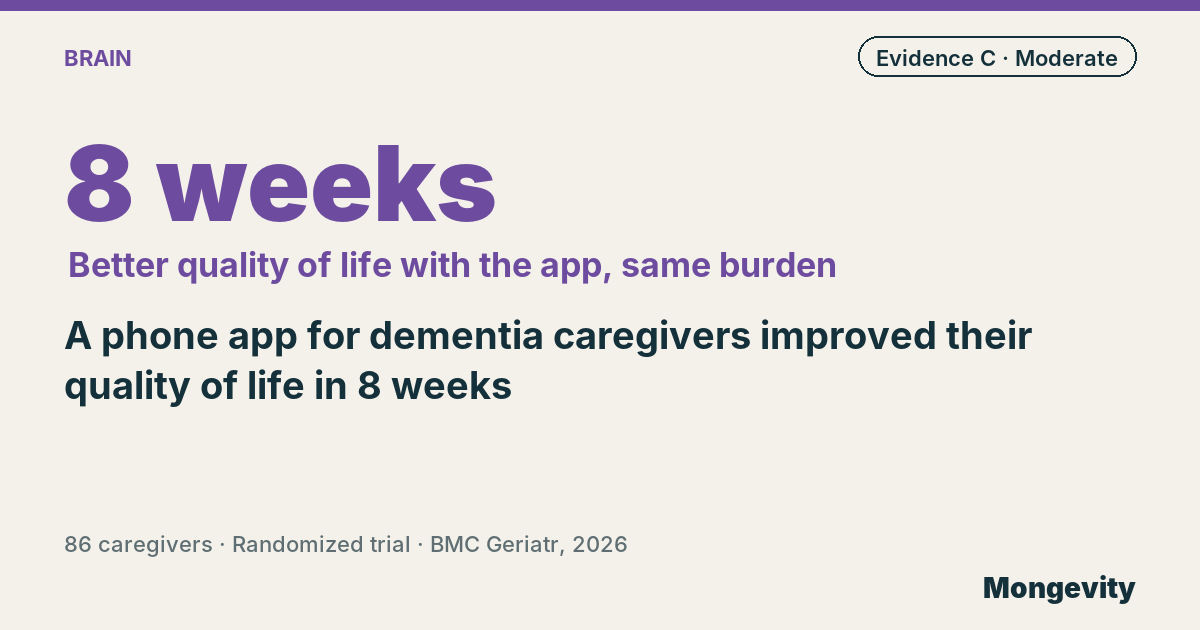
A mobile app designed with caregivers’ input improved quality of life at 8 weeks for 86 family caregivers of people with dementia, but did not reduce caregiver burden, in a randomized trial published Sept. 4, 2026, in BMC Geriatrics. Digital tools can support dementia caregivers, though they don’t replace human help.
Family caregivers of people with dementia need information and support that change as the disease progresses. Apps can deliver it anytime, but many are not designed around what caregivers actually need.
What did the trial test?
The app offered dementia education, guidance on communication and daily care adapted to each stage, advice for behavioral symptoms, self-care and stress-management resources, information on support services and customizable reminders. 86 caregivers were assigned by chance to usual care plus the app for 8 weeks, or usual care alone. 75 were included in the analysis: 37 with the app and 38 without.
What did the study find about dementia caregivers?
- Caregivers using the app improved more in overall quality of life and in the psychological domain than those in the control group.
- There were no significant differences in caregiver burden.
- There were no differences in the severity of the patient’s behavioral symptoms or in the distress they caused the caregiver.
- Users rated the app as easy to use.
Why does this matter?
Many caregivers can’t attend in-person programs because they can’t leave their relative alone. An app designed with their input can be a practical complement, and improving how caregivers feel is valuable in itself, even if the workload doesn’t change.
How solid is this evidence?
It’s moderate. Mongevity rates it C on our A-to-E scale: a randomized trial, but small and short. Limits: only 75 caregivers were analyzed, follow-up lasted 8 weeks, caregivers knew whether they were using the app, outcomes were self-reported and the app was tested in a single setting.
What are the open questions?
Larger, longer trials are needed to see whether the quality-of-life gains last, whether they eventually reduce burden, and which parts of the app caregivers use most.
What does this mean for you?
If you care for someone with dementia, digital tools can help you find information and reminders at any time of day. Look for apps from reliable sources such as health services or Alzheimer’s associations, and combine them with human support whenever possible.
How do I explain this at dinner?
Researchers built a phone app with the help of people caring for a relative with dementia. After two months, those who used it felt better about their own lives than those who didn’t, even if the caregiving load stayed the same. A good question for the table: what would you put in an app to help a caregiver?
In one sentence: a user-centered mobile app improved overall and psychological quality of life in dementia caregivers at 8 weeks, without changing caregiver burden.
Questions and answers
- What did the app offer?
- Dementia education, daily-care guidance by stage, advice for behavioral symptoms, self-care resources, support services and reminders.
- Did it help caregivers?
- It improved overall and psychological quality of life at 8 weeks.
- Did it reduce burden?
- No significant change in caregiver burden was found.
- Did it change the patient's symptoms?
- No differences in behavioral symptoms or related distress were seen.