For dementia caregivers, combining several kinds of support eased burden best
Caring for someone with dementiaPart of a story we are following · 3 articles · See every update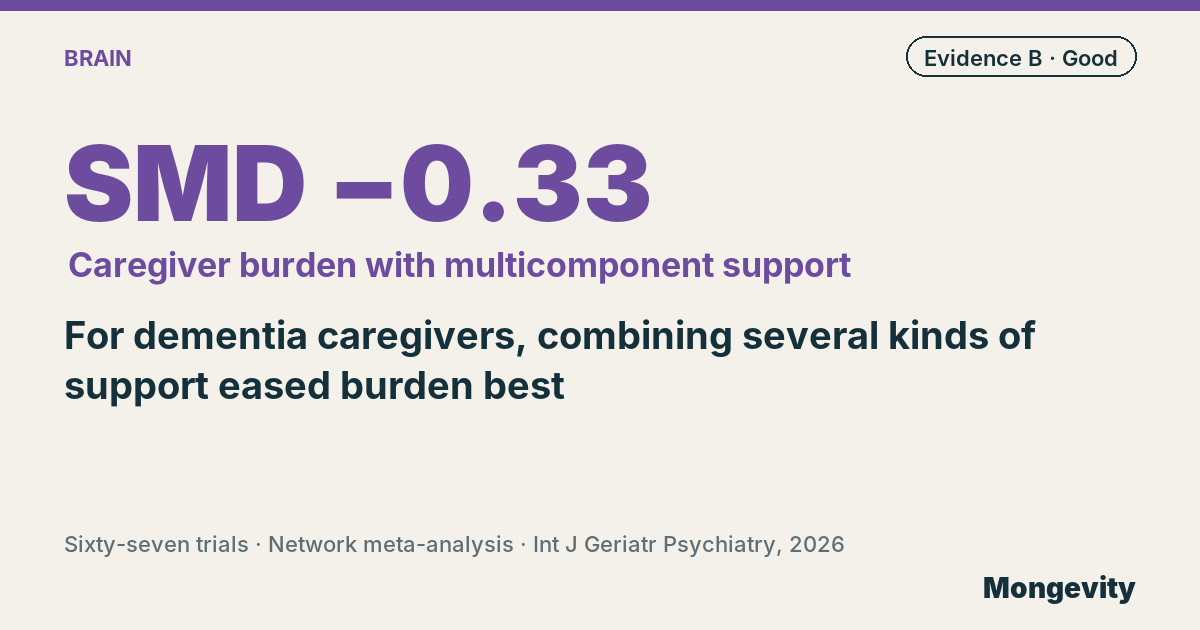
Multicomponent interventions, which combine several types of support, were the only approach that significantly reduced burden (standardized mean difference −0.33) in family caregivers of people with dementia, in a network meta-analysis of randomized trials published in October 2026 in International Journal of Geriatric Psychiatry. Help for dementia caregivers works best when it covers several needs.
Caring for a relative with dementia is demanding, and many family caregivers end up exhausted, stressed or isolated. Dozens of programs have been tested to help them.
What did the study look at?
Researchers searched six databases for randomized trials of non-drug interventions for unpaid caregivers of people with dementia. Sixty-seven trials met the criteria. They used a network meta-analysis, a method that compares many interventions at once even when they weren’t tested head to head. The outcomes were caregiver burden and positive aspects of caregiving, such as feeling useful or growing as a person.
What did the study find about dementia caregivers?
- 43 trials were included in the caregiver burden analysis.
- Multicomponent interventions, which combine several types of support, significantly reduced burden compared with control (standardized mean difference −0.33).
- Other interventions did not show statistically significant effects.
- Seven studies reported positive aspects of caregiving; the evidence was too sparse to identify an effective approach.
Why does this matter?
Caregivers’ health affects both them and the person they care for. This review suggests that a single type of help, such as only education or only emotional support, is often not enough. Programs that combine, for example, information, practical skills, emotional support and respite seem to work best.
How solid is this evidence?
It’s good. Mongevity rates it B on our A-to-E scale: a network meta-analysis of randomized trials with a sensitivity analysis and formal confidence grading. Limits: the effect was modest, trials differed in design and measures, and evidence on positive aspects of caregiving was scarce.
What are the open questions?
It’s unclear which components of multicomponent programs matter most, and how to strengthen the positive side of caregiving. The authors call for programs built on theory and for standard ways of measuring outcomes.
What does this mean for you?
If you care for someone with dementia, look for help that covers several needs at once: information about the disease, practical tips for daily care, emotional support and time for yourself. Local Alzheimer’s associations, support groups and health services often offer these programs.
How do I explain this at dinner?
Scientists compared dozens of programs for people caring for a relative with dementia. The ones that mixed several kinds of help, like information, practical skills and emotional support, eased the load best. A good question for the table: who in our circle is caring for someone, and how could we help?
In one sentence: across randomized trials, multicomponent interventions were the only approach that significantly reduced burden in family caregivers of people with dementia.
Questions and answers
- What is a multicomponent intervention?
- A program that combines several types of support, such as education, skills training and emotional support.
- How much did it reduce burden?
- A standardized mean difference of −0.33 vs. control, a modest effect.
- Did other approaches work?
- Other interventions did not show statistically significant effects on burden.
- What about positive aspects of caregiving?
- Only seven studies measured them; the evidence was too sparse to draw conclusions.