After weight-loss surgery, the heart’s AI-estimated age slowly drew closer to real age
Biological age testsPart of a story we are following · 3 articles · See every update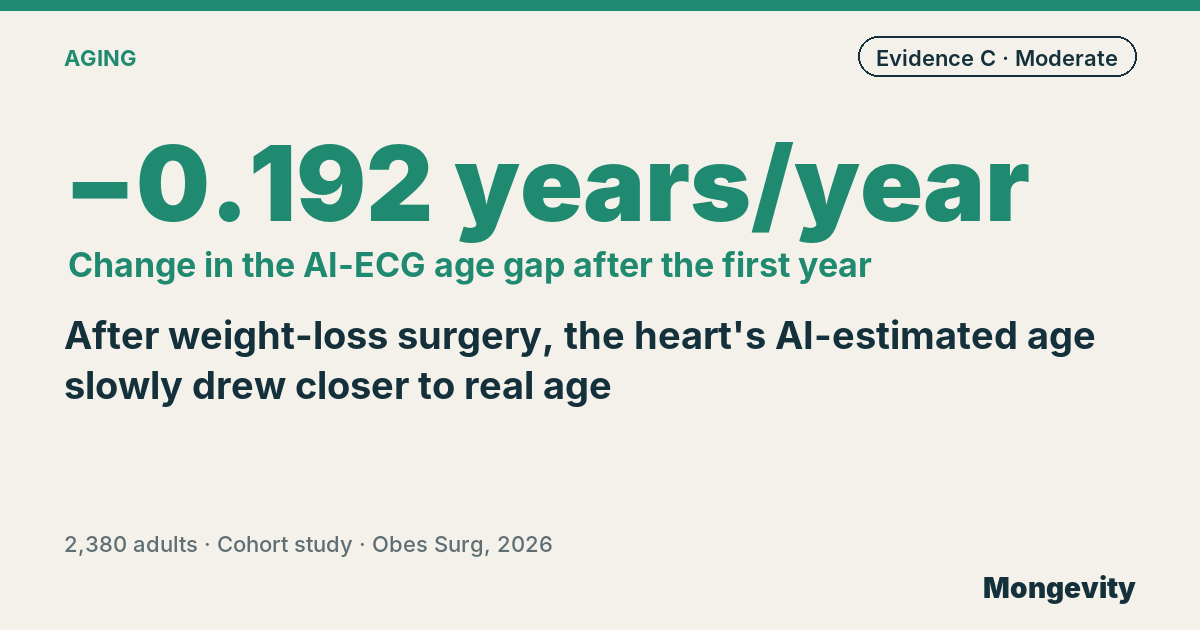
Before weight-loss surgery, an AI reading of the electrocardiogram put the heart’s age a median of 3.86 years above real age in 2,380 adults, and the gap shrank by 0.192 years per year after the first year, in a study published Sept. 15, 2026, in Obesity Surgery. It is a new way to track biological age after surgery.
An electrocardiogram, the quick test that records the heart’s electrical activity, can be read by artificial intelligence to estimate a person’s age. When the estimated age is higher than the real one, it suggests the body may be aging faster.
What did the study look at?
Researchers reviewed records of 2,380 adults who had a first metabolic and bariatric surgery between 2008 and 2023. Together they contributed 6,149 electrocardiograms over time. For each one, the team calculated the gap between the AI-estimated age and the real age, and followed how it changed after surgery.
What did the study find about biological age?
- Before surgery, the median gap was 3.86 years, and 69.6% of patients had a heart age older than their real age.
- During the first year after surgery, the gap did not change significantly.
- After the first year, it fell by 0.192 years for each year of follow-up.
- People with higher average weight had a larger gap (0.548 years more per 10 kg), but weight lost by each person was not clearly linked to the change.
- Of 1,657 patients who started with an older heart age, 335 (20.2%) reached a heart age equal to or below their real age during follow-up.
Why does this matter?
Obesity is linked to faster aging of the body. This study suggests that the effect of surgery on this biological age marker is real but slow and modest, and that years spent at a high weight leave a mark that doesn’t disappear quickly.
How solid is this evidence?
It’s moderate. Mongevity rates it C on our A-to-E scale: a large cohort with repeated measurements over many years. Limits: it was retrospective, there was no comparison group without surgery, electrocardiograms were done for clinical reasons rather than on a fixed schedule, and AI-ECG age is a new marker whose meaning is still being studied.
What are the open questions?
It’s unclear whether narrowing the AI-ECG age gap translates into longer life or fewer heart problems, and whether other ways of losing weight, such as medicines, have similar effects.
What does this mean for you?
If you are considering weight-loss surgery, its main benefits are well known: better blood sugar, blood pressure and quality of life. This study adds that some signs of biological aging may slowly improve, but patience and long-term follow-up matter.
How do I explain this at dinner?
Doctors used artificial intelligence to estimate the “age” of the heart from a simple electrocardiogram. People with obesity had hearts that looked almost four years older than they were. After weight-loss surgery, that gap shrank slowly, year after year. A good question for the table: what else might a simple heart test reveal in the future?
In one sentence: after bariatric surgery, the AI-ECG heart age gap showed a modest late decline, and long-term weight was more strongly linked to it than weight lost.
Questions and answers
- What is AI-ECG age?
- An age estimated by artificial intelligence from an electrocardiogram; a higher age than the real one suggests faster aging.
- Did surgery reduce the gap?
- Modestly: by 0.192 years per year after the first year.
- Did weight lost matter?
- Not clearly; long-term average weight was more strongly linked to the gap.
- Does it mean living longer?
- Unknown; the study did not show that.