A blood-test biological age added little beyond how well older adults function
Biological age testsPart of a story we are following · 3 articles · See every update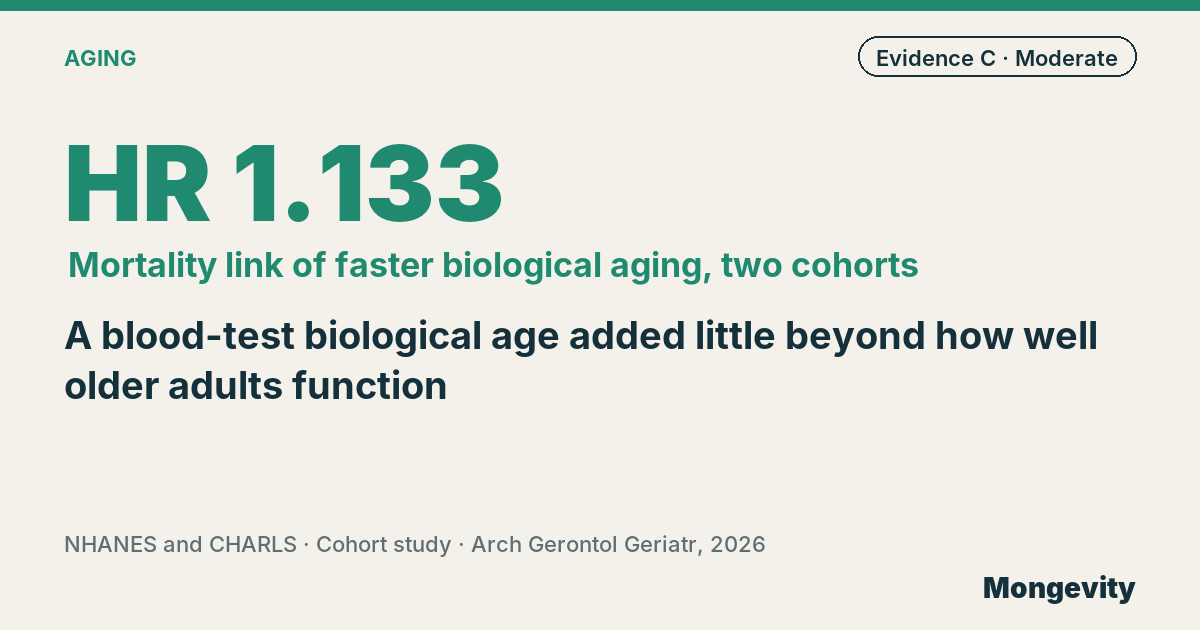
A 12-marker blood-test biological age was modestly linked to death in adults aged 60 or older in the US and China (combined hazard ratio 1.133), but added little beyond simple measures of function, in a study published Sept. 9, 2026, in Archives of Gerontology and Geriatrics. How you walk, think and feel may say more than a biological age score.
Biological age tests promise to tell you how old your body really is.
What did the study look at?
Researchers analyzed adults aged 60 or older in two large surveys: the US National Health and Nutrition Examination Survey (NHANES 2011-2014) and the China Health and Retirement Longitudinal Study (CHARLS 2011-2020). In both, they calculated biological age acceleration with the same 12-biomarker panel. They compared it with a functional impairment score covering four areas: walking and moving, vitality, psychological capacity and cognition.
What did the study find about biological age?
- In NHANES (2348 people, 406 deaths), faster biological aging was linked to higher mortality (hazard ratio 1.206), but functional impairment showed a stronger link (hazard ratio 1.798).
- In CHARLS, biological age acceleration was not linked to new limitations in daily activities (odds ratio 1.012 in 3791 people), while functional impairment was.
- In CHARLS (4570 people, 397 deaths), biological age was linked to mortality (hazard ratio 1.109), but the link weakened and lost significance after more adjustments.
- Combining both cohorts gave a hazard ratio of 1.133.
- Adding biological age to functional measures did not consistently improve prediction.
Why does this matter?
Many companies sell biological age tests to the public. This study suggests that, at least for this type of blood-based score, the signal is real but small, and that simple questions and tests about how a person walks, feels and thinks capture most of the useful information.
How solid is this evidence?
It’s moderate. Mongevity rates it C on our A-to-E scale: two large observational cohorts on two continents, with consistent methods. Limits: it tested one biological age method, so newer epigenetic clocks may behave differently; and observational data can’t show cause and effect.
What are the open questions?
It remains unclear whether other biological age tests, such as DNA methylation clocks, add more than functional measures, and whether lowering any biological age score changes how long or how well people live.
What does this mean for you?
Before paying for a biological age test, consider that how well you walk, your energy, your mood and your memory already say a lot about your health. Keeping those strong through activity, sleep and social contact is likely worth more than a single number.
How do I explain this at dinner?
Scientists compared a “biological age” calculated from blood tests with simple checks of how well older people move, think and feel. The biological age was a little linked to dying sooner, but the simple checks told doctors more. A good question for the table: would you rather know a number or how strong your legs are?
In one sentence: in two cohorts of older adults, a 12-biomarker biological age score was modestly linked to mortality but added little prediction beyond multidomain functional impairment.
Questions and answers
- What is biological age acceleration?
- The gap between the age estimated from blood and body markers and your actual age, here with the 12-biomarker Klemera-Doubal method.
- Did it predict death?
- Modestly: a hazard ratio of 1.133 combining both cohorts.
- Was it better than functional measures?
- No. Adding it to functional impairment did not consistently improve prediction.
- Does this apply to epigenetic clocks?
- Not necessarily; the study tested one blood-based method.