After a sleepless night, people made more mistakes and noticed fewer of them
Sleep healthPart of a story we are following · 13 articles · See every update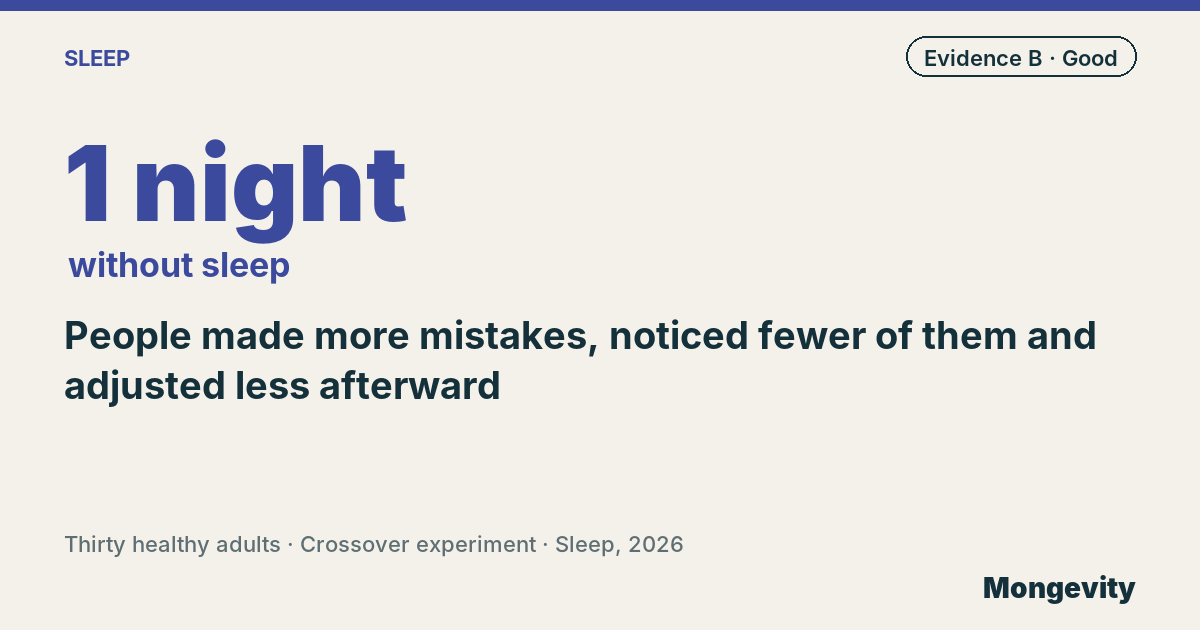
Thirty healthy adults made more mistakes and consciously noticed fewer of their own errors after a night without sleep, in an experiment published Oct. 24, 2026, in Sleep. Sleep loss hurts both performance and self-awareness.
Everyone knows that a sleepless night makes us slower and more error-prone.
What did the study test?
Thirty healthy adults played a game-like computer task, once well rested and once after a full night without sleep. On each round, they gave an answer and then said whether they thought it was right or wrong. That let researchers separate actual errors from errors people noticed.
What did the study find about sleep?
- Without sleep, people responded more slowly, made more mistakes and missed more responses.
- They consciously noticed a smaller share of their errors.
- These problems got worse the longer the task went on.
- Normally, people slow down after a mistake to be more careful. When rested, this slowing was stronger after errors they noticed than after actual errors. Sleep deprivation weakened that difference.
- In particular, when people wrongly thought they had made a mistake, they usually slowed down; after a sleepless night, they slowed down less.
Why does this matter?
Noticing our own mistakes is how we correct course. If sleep loss makes us both more error-prone and less aware of it, that’s a dangerous mix for drivers, health workers, pilots and anyone doing precise work after a night shift or a sleepless night.
How solid is this evidence?
It’s good for a lab result. Mongevity rates it B on our A-to-E scale. Each person was compared with themselves, which is a strong design, and the effects were clear. Limits: only thirty people, a single night of total sleep loss and a computer task, which may not reflect real-world situations.
What does this mean for you?
After a night with little or no sleep, assume you’ll make more mistakes than you realize. Avoid driving if you can, double-check important work, and ask a colleague to review critical tasks. Protecting regular sleep is the best prevention.
How do I explain this at dinner?
Scientists kept people awake all night and had them play a game. Tired players made more mistakes and also didn’t notice many of them. A good question for the table: what’s something you always double-check when you’re tired?
In one sentence: a sleepless night made people more error-prone and less aware of their own mistakes, weakening how they adjusted afterward.
Questions and answers
- Does lack of sleep affect noticing mistakes?
- Yes: after a night without sleep, people consciously noticed a smaller share of their errors.
- What else changed?
- Responses were slower, less accurate and more often missed, and these problems grew over time on the task.
- What should I do after a sleepless night?
- Avoid driving if possible and double-check important work, because you may not notice your own errors.