Short sleep was linked to more brain vessel damage when other vascular injury was present
How the brain cleans itself during sleepPart of a story we are following · 3 articles · See every update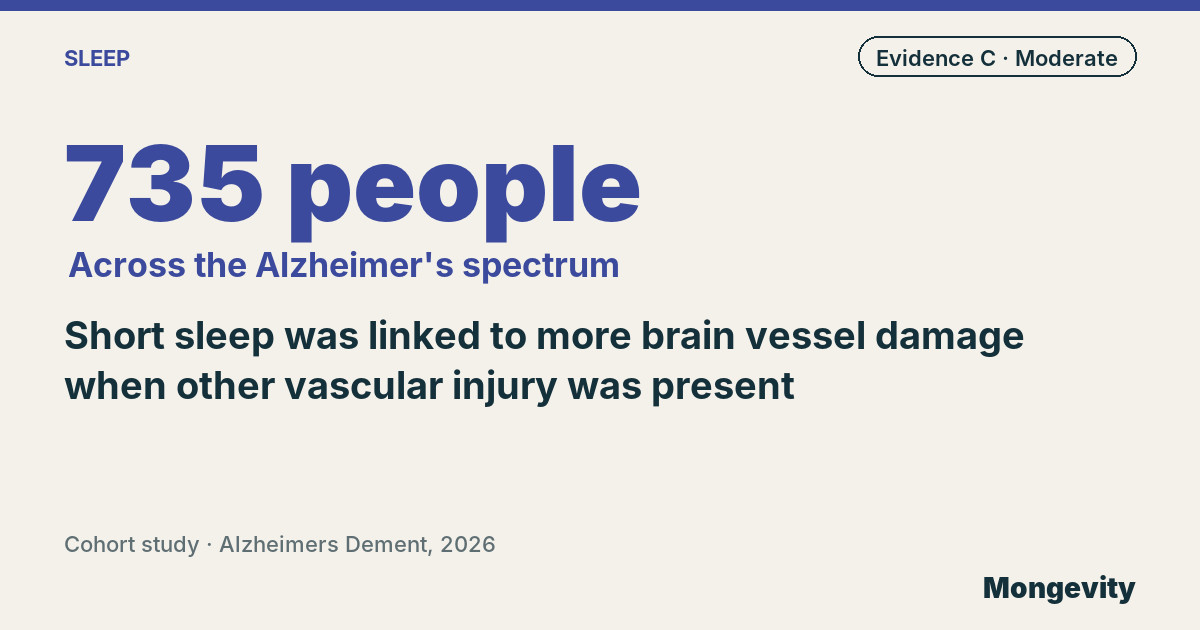
Shorter sleep was linked to more white matter damage, especially when people also had other signs of blood vessel injury in the brain, in a study of 735 people across the Alzheimer’s spectrum published in October 2026 in Alzheimer’s & Dementia. Sleep and the brain’s blood vessels seem connected.
White matter hyperintensities are bright spots seen on brain MRI. They usually reflect damage to small blood vessels and are linked to memory problems, stroke and dementia. Sleep duration has been linked to both dementia risk and these spots.
What did the study do?
Researchers studied a deeply characterized group of 735 people: healthy volunteers and people along the Alzheimer’s spectrum, from subjective memory complaints to mild cognitive impairment and dementia, including groups with a high burden of vascular disease. Sleep was assessed with a standard questionnaire, the Pittsburgh Sleep Quality Index. People were classified as having white matter spots only, or white matter spots plus other vascular injury, such as microbleeds, small strokes or amyloid in blood vessel walls.
What did the study find about sleep and the brain?
- In people with mild cognitive impairment and high vascular burden, and in people with Alzheimer’s dementia, having additional vascular injury strengthened the link between shorter sleep and more white matter damage.
- In exploratory analyses of people with Alzheimer’s, longer sleep was linked to better thinking in those with additional vascular injury, but to worse thinking in those with white matter spots only.
Why does this matter?
The findings suggest that the brain’s vascular health changes how sleep relates to brain damage and thinking. Looking only at white matter spots may miss part of the picture. For people with vascular brain disease, sleep may be especially important.
How solid is this evidence?
It’s limited. Mongevity rates it C on our A-to-E scale: a well-characterized cohort with detailed brain imaging, but cross-sectional, with self-reported sleep and complex subgroup analyses, some exploratory. The abstract doesn’t report effect sizes.
What are the open questions?
Long-term studies with objective sleep measures are needed to clarify the direction of these links, and trials to test whether improving sleep slows vascular brain damage.
What does this mean for you?
Protect both your sleep and your blood vessels. Aim for regular, sufficient sleep, and control blood pressure, cholesterol and blood sugar, don’t smoke and stay active, since these protect the small vessels of the brain. If you snore loudly or wake up gasping, ask about sleep apnea.
How do I explain this at dinner?
Damage to tiny blood vessels shows up as bright spots on brain scans. In people with memory problems, short sleep went along with more of these spots, especially when the brain had other vessel damage too. A good question for the table: how many hours do you really sleep?
In one sentence: shorter sleep was more strongly linked to white matter damage in people with additional vascular brain injury, suggesting brain vessel health shapes how sleep affects the brain.
Questions and answers
- What are white matter hyperintensities?
- Bright spots on brain MRI that usually reflect damage to small blood vessels.
- How was sleep linked to them?
- Shorter sleep was more strongly linked to white matter damage in people with additional vascular injury.
- What can protect brain vessels?
- Controlling blood pressure, cholesterol and blood sugar, not smoking, staying active and sleeping well.