Less REM sleep was linked to faster amyloid buildup in older adults without symptoms
How the brain cleans itself during sleepPart of a story we are following · 3 articles · See every update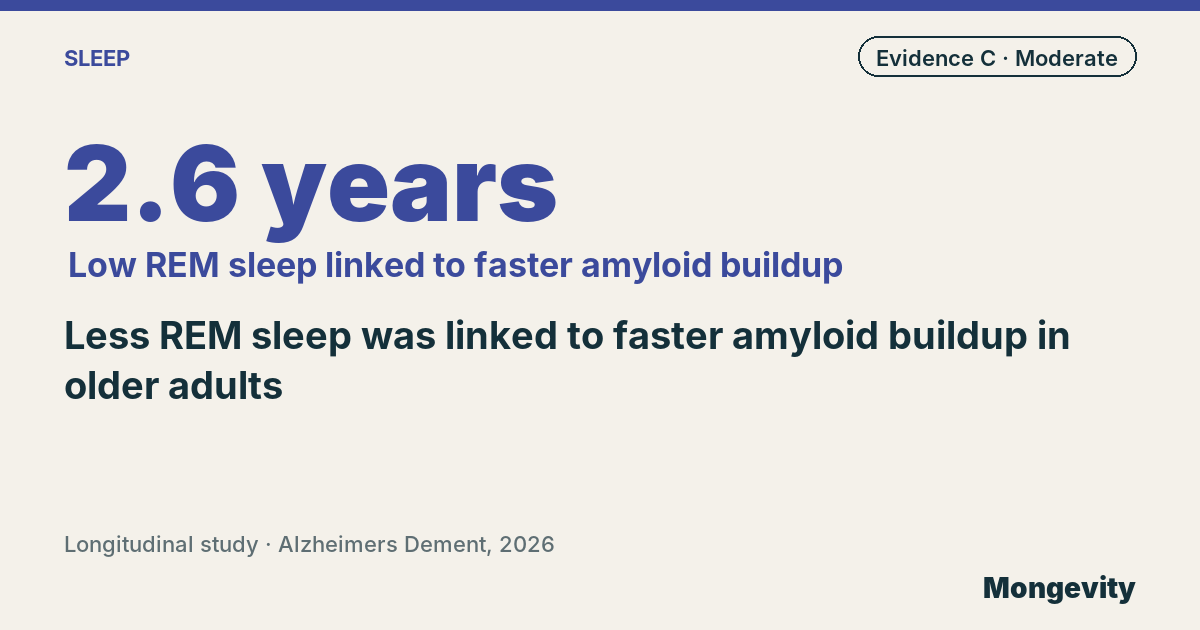
A low share of REM sleep was linked to a faster drop in a blood marker that signals amyloid buildup over about 2.6 years in sixty-four cognitively healthy older adults, in a study published in October 2026 in Alzheimer’s & Dementia. It adds to evidence on sleep and the brain.
Sleep has stages. Deep, slow-wave sleep is when brain waves are slow and large; REM sleep is when most vivid dreaming happens. Both are thought to matter for brain health, and deep sleep is linked to clearing waste proteins, including amyloid, which builds up in Alzheimer’s disease.
What did the study do?
Sixty-four older adults, aged 55 to 90 and without memory problems, had an overnight sleep study and gave blood samples twice, 2.6 years apart. Researchers measured the ratio of two forms of amyloid in the blood, Aβ42/40. A falling ratio suggests more amyloid is building up in the brain.
What did the study find about sleep and the brain?
- More frontal slow-wave activity, a sign of deep sleep, was linked to the amyloid blood ratio at the first visit.
- A low percentage of REM sleep was linked to a large decline over time in the blood amyloid ratio, a sign of faster amyloid buildup.
- In exploratory analyses, this link between low REM sleep and faster decline was stronger in people who already had amyloid in the brain.
Why does this matter?
The findings suggest that different sleep stages may carry different signals: deep sleep may reflect current amyloid, while REM sleep may predict how fast it accumulates in the earliest, symptom-free stage. If confirmed, sleep measurements could become early, noninvasive markers, and sleep itself a target for prevention.
How solid is this evidence?
It’s limited. Mongevity rates it C on our A-to-E scale: an interesting study that combines detailed sleep recordings with repeated blood tests, but small, with sleep measured on a single night and some exploratory analyses. It shows links, not cause.
What are the open questions?
Larger studies are needed to confirm the findings, and trials to test whether improving REM or deep sleep slows amyloid buildup.
What does this mean for you?
Protecting your sleep is a reasonable step for brain health: aim for regular sleep and wake times, limit alcohol, which suppresses REM sleep, especially in the evening, and get treatment for sleep apnea if you snore loudly or stop breathing at night.
How do I explain this at dinner?
The dreaming stage of sleep, REM, may matter for Alzheimer’s. In older adults without memory problems, those with less REM sleep showed signs of faster buildup of a sticky brain protein over the next 2.6 years. A good question for the table: do you remember your dreams?
In one sentence: in cognitively healthy older adults, low REM sleep was linked to faster amyloid accumulation, a small study’s finding that needs confirmation.
Questions and answers
- What is REM sleep?
- The sleep stage when most vivid dreaming happens, with rapid eye movements.
- What was REM sleep linked to?
- Low REM sleep was linked to a faster decline in the blood amyloid ratio, suggesting faster buildup.
- Does better sleep prevent Alzheimer's?
- Not proven: trials are needed to test whether improving sleep slows amyloid buildup.