A drug raised a missing brain protein, but didn’t slow a genetic form of dementia
Other dementiasPart of a story we are following · 3 articles · See every update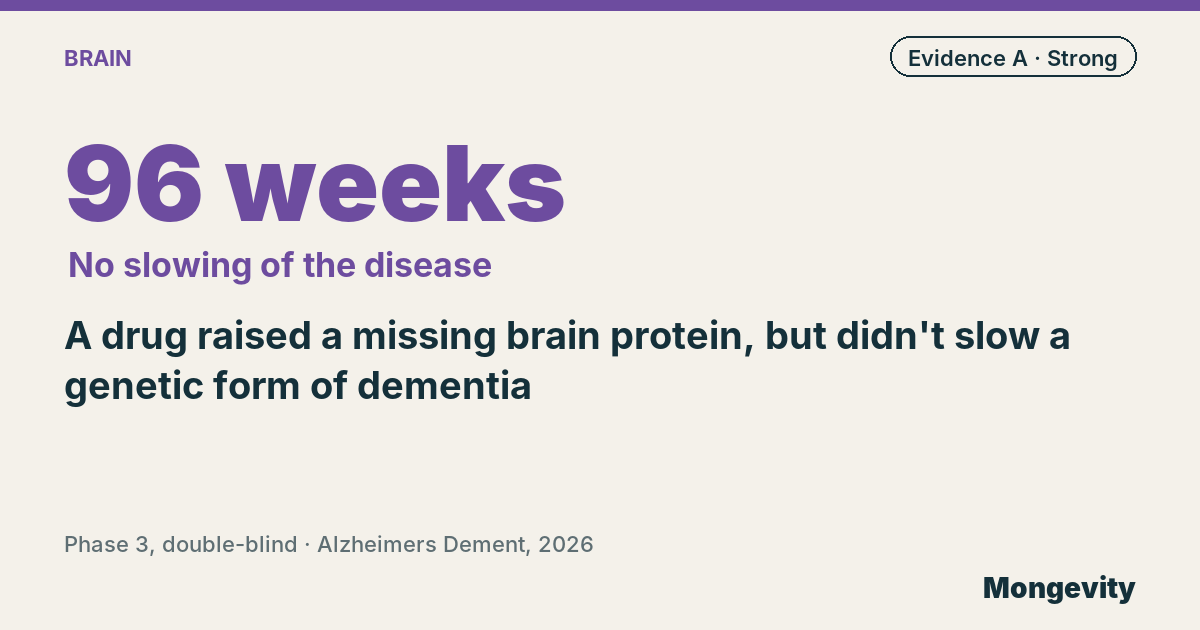
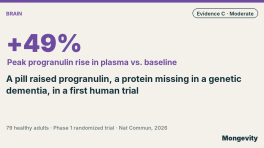
Latozinemab raised progranulin levels in people with frontotemporal dementia from GRN mutations, but didn’t slow the disease over 96 weeks, in the INFRONT-3 phase 3 trial published in October 2026 in Alzheimer’s & Dementia. Raising a missing protein wasn’t enough in this genetic dementia.
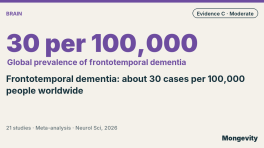
Frontotemporal dementia, or FTD, affects the front and side parts of the brain. It often begins earlier than Alzheimer’s, changing personality, behavior or language. In some families, it’s caused by a mutation in a gene called GRN, which leaves people with too little of a protein called progranulin. Latozinemab is an antibody designed to raise progranulin levels.
What did the trial test?
People who had FTD due to a GRN mutation, or who carried the mutation and were at risk, received 60 mg/kg of latozinemab or placebo by IV every 4 weeks for 96 weeks. Neither they nor their doctors knew which. Those who finished could join a 96-week open-label safety extension.
What did the study find about dementia?
- Latozinemab raised progranulin levels in the blood and in the fluid around the brain and spine, and kept them up, in people with symptoms.
- There was no slowing of the disease, by clinical scores or by biomarkers.
- No safety concerns were identified.
Why does this matter?
The idea behind the drug made sense: if the problem is too little progranulin, raise it. The trial shows that raising the protein in blood and spinal fluid isn’t enough, at least at this stage of the disease and in this way. That’s a hard result for families, but it guides the next steps: researchers may need to act earlier, deliver the protein differently or target other parts of the disease.
How solid is this evidence?
It’s strong. Mongevity rates it A on our A-to-E scale: a pivotal double-blind, placebo-controlled phase 3 trial, the first in this form of FTD. Limits: the abstract doesn’t give the number of participants or the detailed scores, and results in people without symptoms aren’t described.
What does this mean for you?
If FTD runs in your family, a genetic counselor can explain what testing means and what research studies are open. Negative trials like this one are still valuable: taking part in research is how better treatments are found. Support groups for FTD families can also help with day-to-day challenges.
How do I explain this at dinner?
Some families have a gene change that leaves the brain short of a protective protein, leading to a kind of dementia. A new drug brought that protein back up, but the disease kept moving at the same pace. A good question for the table: why might fixing a shortage not be enough to stop a disease?
In one sentence: latozinemab raised progranulin in genetic frontotemporal dementia but didn’t slow the disease in a 96-week phase 3 trial.
Questions and answers
- What is frontotemporal dementia?
- A dementia that affects the front and side of the brain, often changing behavior, personality or language.
- What does latozinemab do?
- It's an antibody designed to raise progranulin, a protein that is low in people with GRN mutations.
- Did it work?
- It raised progranulin, but it didn't slow the disease over 96 weeks.