Frontotemporal dementia: about 30 cases per 100,000 people worldwide, with wide variation
Other dementiasPart of a story we are following · 3 articles · See every update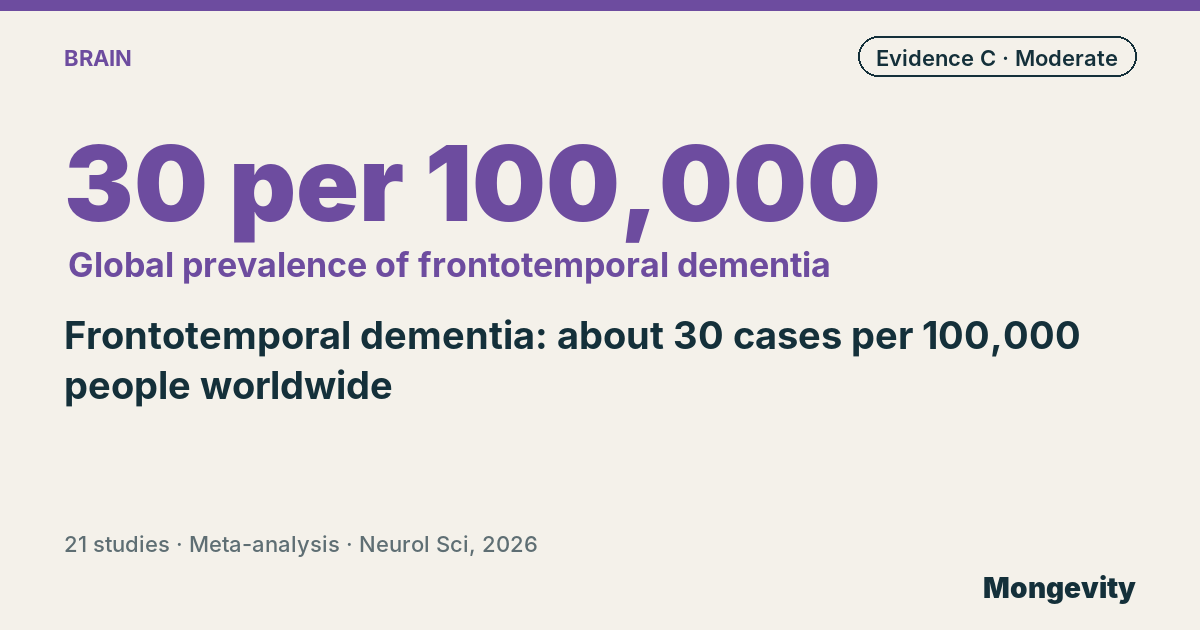
Frontotemporal dementia affects about 30 people per 100,000 worldwide, according to a meta-analysis of 21 studies published Sept. 2, 2026, in Neurological Sciences, though estimates varied widely and data from Asia, Africa and Latin America are scarce. It is a leading cause of dementia before age 65.
Frontotemporal dementia (FTD) damages the front and side parts of the brain. Instead of memory loss, it often starts with changes in behavior, personality or language, and it is one of the leading causes of dementia before age 65.
What did the study look at?
Researchers searched several databases for studies on how many people have FTD, published up to October 31, 2025. They found 21 studies and combined them with a random-effects model. They also compared results by region, age range and the period of the diagnostic criteria used.
What did the study find about dementia?
- The pooled global prevalence was 30 cases per 100,000 people (0.03%).
- The uncertainty was large, from 0.01% to 0.12%, with extreme differences between studies.
- Prevalence varied with the age range studied, but not significantly by region or by diagnostic criteria era.
- There was no clear sign of small-study bias.
Why does this matter?
Knowing how common a disease is helps plan diagnosis, care and research. FTD is rare compared with Alzheimer’s disease, but it strikes people in midlife, often while they work and raise families, and is frequently mistaken for a psychiatric problem. A benchmark figure helps make it visible.
How solid is this evidence?
It’s moderate. Mongevity rates it C on our A-to-E scale: a systematic review and meta-analysis of observational studies. Limits: studies used different methods and populations, heterogeneity was extreme, and many regions, including large parts of Asia, Africa and Latin America, have little or no data.
What are the open questions?
Better population-based studies are needed, particularly in underrepresented regions, to know the real burden and plan services.
What does this mean for you?
If someone in midlife, before 65, shows marked changes in personality, judgment, social behavior or language, it’s worth seeing a neurologist, not just a psychiatrist. An early, correct diagnosis helps the family plan and access support.
How do I explain this at dinner?
Frontotemporal dementia is a type of dementia that often hits people before 65 and starts with changes in behavior or speech, not memory. Pooling studies from around the world, scientists estimated it affects about 30 in every 100,000 people, though the numbers varied a lot. A good question for the table: would you recognize dementia if it didn’t start with forgetfulness?
In one sentence: a meta-analysis of 21 studies estimated the global prevalence of frontotemporal dementia at 30 cases per 100,000 people, with very wide variation between studies.
Questions and answers
- What is frontotemporal dementia?
- A dementia that damages the front and side parts of the brain, often starting with behavior or language changes.
- How common is it?
- About 30 cases per 100,000 people worldwide, according to this meta-analysis.
- Is the estimate precise?
- No. Studies differed greatly, and the range went from 0.01% to 0.12%.
- Who does it affect?
- It is a leading cause of dementia before age 65.