Not all whole grain is equal: intact grains lowered blood sugar a bit in type 2 diabetes
Food and blood sugarPart of a story we are following · 3 articles · See every update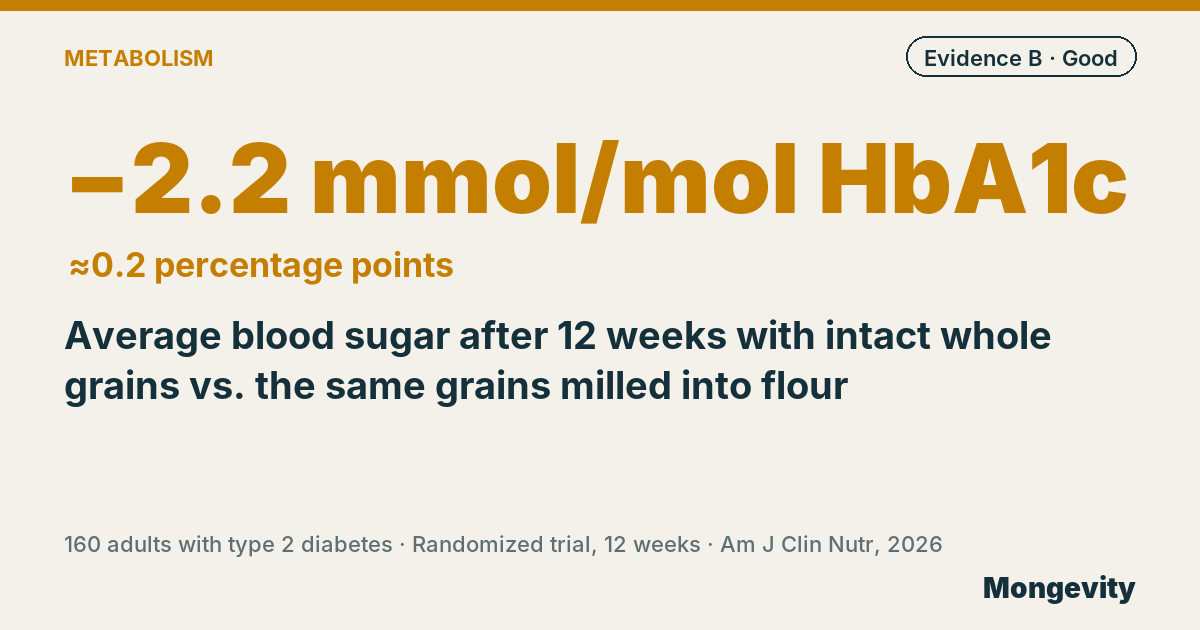
Adults with type 2 diabetes who ate intact whole grains for 12 weeks ended with an HbA1c 2.2 mmol/mol lower than those who ate the same grains milled into flour, in a randomized trial of 160 adults at a US center published Oct. 26, 2026, in American Journal of Clinical Nutrition. How grain is processed matters for blood sugar.
“Choose whole grains” is one of the most repeated pieces of nutrition advice. People who ate intact grains ended the trial with slightly lower average blood sugar than people who ate the same grains milled into flour.
The difference was small, but it pokes a hole in the idea that “whole grain” is a single thing.
What is HbA1c?
HbA1c is a blood test that shows your average blood sugar over roughly the past three months. Sugar in the blood sticks to hemoglobin, the protein that carries oxygen inside red blood cells, and those cells live for a few months. So the test works like a report card for the whole term instead of a single exam.
For people with type 2 diabetes, it’s one of the main numbers doctors watch. In the US it’s usually reported as a percentage; this trial used another common unit, millimoles per mole (mmol/mol). Lower is better.
Isn’t whole-grain flour still whole grain?
Yes, on the label. Whole-grain flour keeps all the parts of the grain: the bran, the germ and the starchy center. What changes is the structure. Milling grinds the grain into fine particles, so digestive enzymes reach the starch faster and it turns into sugar in the blood sooner.
Think of a whole apple and applesauce. Same fruit, same ingredients, but your body handles them differently. An intact grain, like brown rice, rolled oats or wheat berries, is closer to the whole apple.
What did the trial test?
The researchers enrolled 160 adults with type 2 diabetes. On average they were 58.5 years old, with a BMI of 33.7 and an HbA1c of 56.4 mmol/mol.
Chance decided which kind of whole grain each person got, for 12 weeks:
- Less processed: intact or barely processed whole-grain foods from wheat, rice and oats.
- More processed: the same grains, milled, in products like whole-grain flour and bread.
The foods were free and delivered home, in amounts of 4.5 to 9 kg every two weeks, enough for the whole family. People were asked to replace the grain foods they usually ate with the ones provided. Those foods ended up supplying about 20% of their daily energy.
What did the trial find about blood sugar?
After 12 weeks, HbA1c was 2.2 mmol/mol lower in the intact-grain group than in the milled-grain group. On the percentage scale used in the US, that’s ≈0.2 percentage points.
Two other details make that result easier to trust. Body weight didn’t change differently between the groups, so the lower blood sugar wasn’t simply weight loss. And both groups ate about the same amount of whole grains, refined grains and nutrients. The main thing that differed was how processed the grain was.
Among the other outcomes, the only improvement was one people reported themselves: better bowel habits with the less processed grains.
How solid is this evidence?
Good, not definitive. Mongevity rates it B on our A-to-E scale.
It’s a randomized trial, and 143 of the 160 participants (89%) gave a final blood sample. It measured HbA1c, a lab marker doctors use to manage diabetes, not complications like heart attacks or kidney disease.
The effect is modest. The estimate of the difference ran from 4.2 down to just 0.1 mmol/mol, so the true benefit could be close to zero. It was one trial, it lasted 12 weeks, and the summary doesn’t say who funded it. And it compared two kinds of whole grain with each other; it didn’t compare them with refined grains.
What can I do with this?
This is a low-risk swap, not a treatment. When you already eat whole grains, picking the intact version is an easy change: brown rice instead of whole-wheat bread, rolled or steel-cut oats instead of instant oat flakes, barley or wheat berries in a salad.
If you have diabetes, keep your medicines and your care plan as they are, and talk to your doctor or dietitian before changing how you eat.
The authors also make a point for food labels: a package that says “whole grain” can mean an intact grain or a fine flour, and for blood sugar those may not be the same food.
How do I explain this at dinner?
Some cereals are made from crushed grains and some from whole grains, a bit like applesauce and a whole apple. Whole things take longer for the body to break down, so sugar reaches the blood more slowly. A good question for the table: which do you think keeps you full longer, a whole apple or a glass of apple juice?
In one sentence: in type 2 diabetes, swapping whole-grain flour for intact grains lowered average blood sugar a little, without any weight change.
Questions and answers
- Are intact whole grains better than whole-wheat flour for blood sugar?
- In this trial of people with type 2 diabetes, yes, a little. After 12 weeks, HbA1c was 2.2 mmol/mol lower with intact grains than with milled whole grains.
- Did people lose weight eating intact grains?
- No. Body weight didn't change differently between the groups, so the lower blood sugar wasn't explained by weight loss.
- Which foods count as intact whole grains?
- Grains that keep their shape, such as brown rice, rolled or steel-cut oats, barley and wheat berries. Whole-grain flour, bread and most crackers are milled.
- Can this replace diabetes medicine?
- No. It's a small, low-risk food swap. Keep your treatment and talk to your doctor or dietitian before changing your diet.