An experimental pill aimed at cell stress did not slow ALS in a placebo-controlled trial
ALSPart of a story we are following · 3 articles · See every update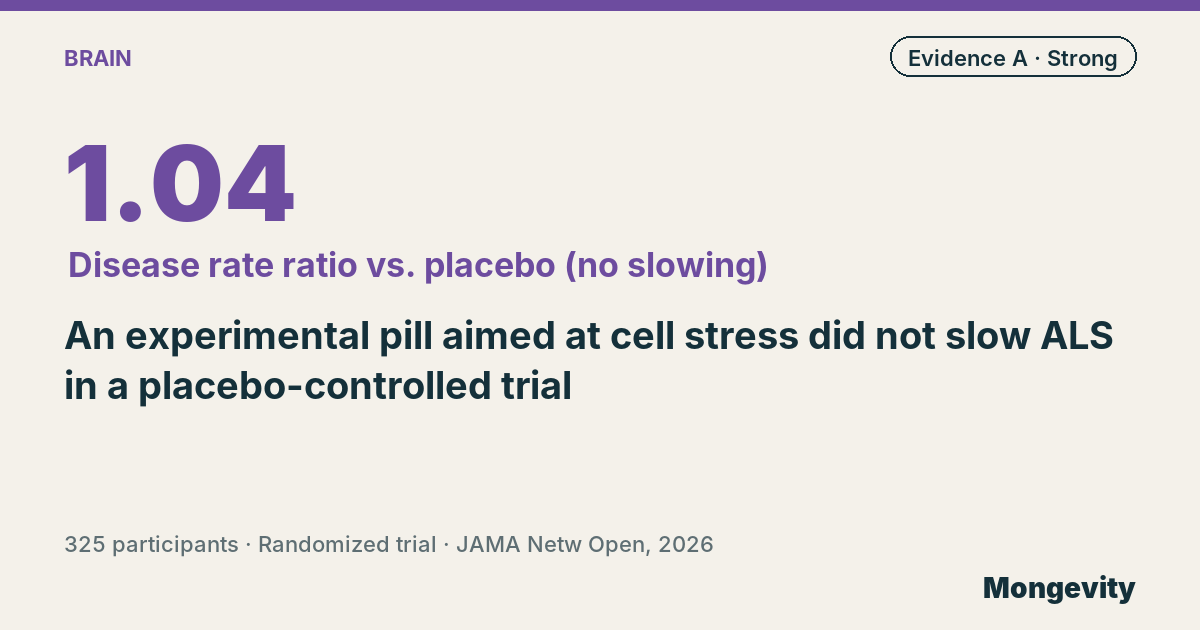
DNL343 did not slow loss of function or improve survival in 325 people with ALS over 24 weeks, in the HEALEY ALS Platform Trial at 74 US centers, published in September 2026 in JAMA Network Open. The negative result steers ALS research toward other targets.
Amyotrophic lateral sclerosis (ALS) is a disease that gradually destroys the nerve cells controlling muscles. Treatments only modestly slow it. One theory is that a cell alarm system called the integrated stress response stays switched on and harms these neurons. DNL343 is a pill designed to calm it.
What did the trial test?
DNL343 was tested as one arm of the HEALEY ALS Platform Trial, which runs several drugs in parallel and shares a placebo group, across 74 centers in the US. Participants were assigned by chance, 3 to 1, to 200 mg of DNL343 once daily or placebo for 24 weeks. 186 received DNL343, and the placebo group combined 63 people from this arm with 76 from another, for 325 participants in total. The main outcome combined loss of function, measured with the ALS Functional Rating Scale, and survival.
What did the study find about ALS?
- The disease rate ratio was 1.04, meaning no evidence that DNL343 slowed progression compared with placebo.
- Secondary outcomes did not differ between groups.
- Adverse events were similar with DNL343 and placebo.
Why does this matter?
An earlier, smaller trial had shown that the drug reached the brain and acted on its target. This result shows that hitting a biological target doesn’t guarantee a clinical benefit. Negative trials also save patients from taking drugs that don’t help and point researchers toward other approaches.
How solid is this evidence?
It’s strong. Mongevity rates it A on our A-to-E scale: a double-blind, placebo-controlled randomized trial across many centers, with a shared placebo group that makes the platform efficient. Limits: it lasted 24 weeks and tested one dose; a small effect over a longer time can’t be ruled out.
What are the open questions?
Whether other ways of targeting the stress response, or treating specific subgroups of people with ALS, could work remains open.
What does this mean for you?
If you or someone close lives with ALS, platform trials like HEALEY test several drugs faster and give more participants access to active treatment. Ask your ALS clinic about ongoing trials. Multidisciplinary care, nutrition and breathing support remain central.
How do I explain this at dinner?
Scientists tested a pill meant to calm a cellular alarm that may damage the nerves in ALS. It reached its target, but after six months people who took it declined at the same pace as those on placebo. A good question for the table: why might a drug that hits its target still fail?
In one sentence: in a placebo-controlled platform trial, 200 mg daily of DNL343 for 24 weeks did not slow disease progression in ALS.
Questions and answers
- What is DNL343?
- An experimental pill that activates eIF2b to calm the integrated stress response, a cell alarm system linked to ALS.
- Did it slow ALS?
- No. The disease rate ratio was 1.04 vs. placebo.
- Was it safe?
- Adverse events were similar with DNL343 and placebo.
- What is a platform trial?
- A trial that tests several drugs in parallel and shares a placebo group.