AI reading the heart tracing from a sleep study predicted heart problems years later
Sleep healthPart of a story we are following · 13 articles · See every update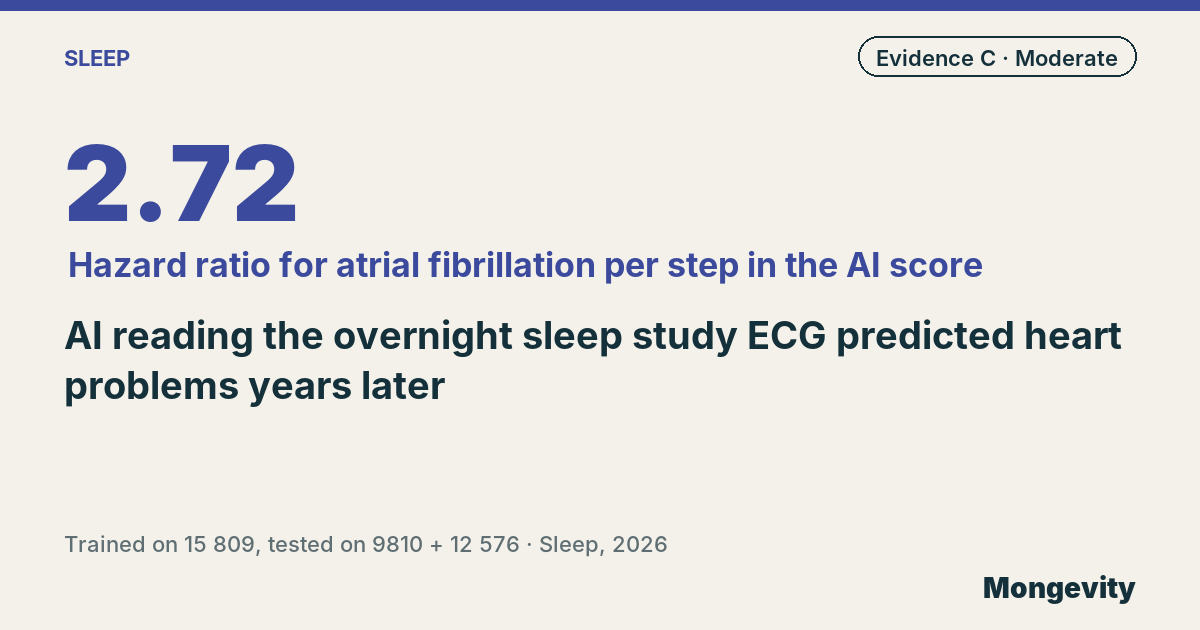
A neural network reading the heart tracing recorded during overnight sleep studies predicted 10-year risk of atrial fibrillation, heart failure, stroke and death in a hospital study in Israel, published Oct. 9, 2026, in Sleep. A routine sleep test could help flag heart risk.
When people do an overnight sleep study, a simple heart tracing (a single-lead ECG) is recorded the whole night. It’s rarely analyzed beyond checking for obvious problems.
What did the study do?
Researchers took a deep neural network trained to detect heart rhythm problems, fine-tuned it on overnight ECGs and sleep stage data from 15 809 patients at Massachusetts General Hospital, and tested it in two other hospitals: Emory University Hospital (9810 patients) and Beth Israel Deaconess Medical Center (12 576 patients). They looked at heart events over 10 years from medical records.
What did the study find about sleep?
The AI score was strongly linked to future heart problems, even after accounting for age, sex, weight, smoking, high blood pressure, diabetes and sleep measures. For each step up in the score:
| Outcome | Hazard ratio (Emory) | Hazard ratio (Beth Israel) |
|---|---|---|
| Atrial fibrillation | 2.03 | 2.72 |
| Heart failure | 1.69 | 2.33 |
| Death from any cause | 1.82 | 1.65 |
| Stroke | 1.19 | 1.40 |
The link with heart attack was significant in one hospital but not the other.
Why does this matter?
Millions of sleep studies are done every year, and the ECG data are already there. If AI can turn them into an early warning of heart risk, people could get preventive care sooner without any extra test. Atrial fibrillation, in particular, often goes unnoticed until it causes a stroke.
How solid is this evidence?
It’s moderate. Mongevity rates it C on our A-to-E scale. Testing in two outside hospitals is a strength, but the outcomes came from billing codes in health records, everyone had been referred for a sleep study, and the tool hasn’t been tested to see whether using it actually improves care.
What does this mean for you?
This tool isn’t in routine use yet. If you’ve had a sleep study, ask whether anything was noted about your heart rhythm. Regardless, controlling blood pressure, weight and blood sugar, and treating sleep apnea if you have it, protects the heart.
How do I explain this at dinner?
During a sleep test, a wire records your heartbeat all night. A computer program learned to spot tiny hints in that recording that predicted heart trouble years later. A good question for the table: what other information might we already have but never look at?
In one sentence: an AI reading the overnight heart tracing from sleep studies predicted atrial fibrillation, heart failure and death years later, beyond standard risk factors.
Questions and answers
- What did the AI analyze?
- The single-lead ECG recorded during overnight sleep studies, combined with sleep stage data.
- What did it predict?
- 10-year risk of atrial fibrillation, heart failure, stroke and death, beyond standard risk factors.
- Can I get this test?
- Not yet in routine care; it still needs to show that using it improves outcomes.