Dupilumab for eczema wasn’t linked to more psoriasis than other treatments
PsoriasisPart of a story we are following · 3 articles · See every update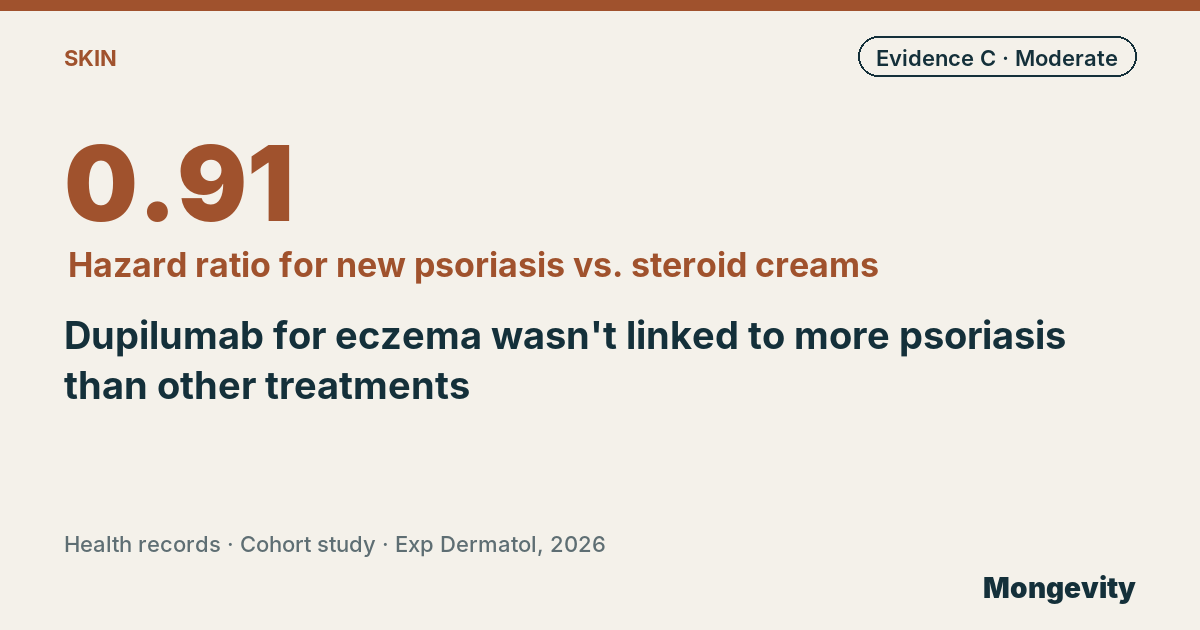
People with eczema treated with dupilumab didn’t have a higher two-year risk of psoriasis than those on steroid creams, other biologics or JAK inhibitors, in a large records study published in October 2026 in Experimental Dermatology. It eases a worry about this eczema drug.
Dupilumab is one of the most used treatments for moderate to severe atopic dermatitis, the most common form of eczema. Doctors have reported cases of people developing psoriasis, a different inflammatory skin disease, after starting it. One idea is that blocking one branch of the immune system may tip the balance toward another. But is the risk really higher than with other eczema treatments?
What did the study do?
Researchers used two large health record networks, TriNetX and Epic Cosmos. In TriNetX, they matched people with eczema who started dupilumab with similar people who used steroid creams, other biologics that target the same immune branch (nemolizumab, lebrikizumab and tralokinumab) or JAK inhibitor pills (abrocitinib and upadacitinib). They then compared new psoriasis diagnoses over two years. In Cosmos, they did an exploratory analysis over a 17-month span.
What did the study find about psoriasis?
| Dupilumab vs. | Hazard ratio for new psoriasis |
|---|---|
| Steroid creams | 0.91 |
| Other biologics | 1.03 |
| JAK inhibitors | 0.86 |
None of these differences was statistically significant. In Cosmos, psoriasis was as common or less common with dupilumab than with the alternatives.
So why are cases reported?
The authors suggest two explanations: some cases may reflect uncertainty in the original diagnosis, since eczema and psoriasis can look alike, and some people may have a genetic tendency toward immune shifts. Both ideas still need testing in studies that follow patients with clinical, biopsy and genetic data.
How solid is this evidence?
It’s moderate. Mongevity rates it C on our A-to-E scale: a large observational study with matching and two separate databases that point the same way. Limits: it relies on diagnosis codes in records, not on examinations, and it cannot rule out all differences between people who received each treatment.
What does this mean for you?
If you use dupilumab for eczema and notice new patches that look different, with thick, scaly, well-defined plaques, show them to your dermatologist. This study suggests the drug isn’t uniquely to blame, but new rashes always deserve a look. Don’t stop treatment on your own.
How do I explain this at dinner?
A popular eczema drug was suspected of triggering psoriasis, another skin disease. A study of two large health record networks found that people on it didn’t get psoriasis more often than people on other eczema treatments. A good question for the table: why might two skin diseases be easy to confuse?
In one sentence: in a large records study, dupilumab for eczema wasn’t linked to a higher two-year psoriasis risk than other eczema treatments.
Questions and answers
- What is dupilumab?
- An injected biologic drug used for moderate to severe atopic dermatitis and other allergic conditions.
- Does it cause psoriasis?
- In this study it wasn't linked to more psoriasis than steroid creams, other biologics or JAK inhibitors.
- What should I do if I see a new rash?
- Show it to your dermatologist and don't stop the treatment on your own.