Eczema flares on psoriasis biologics: how often, and which drugs carry more risk
PsoriasisPart of a story we are following · 3 articles · See every update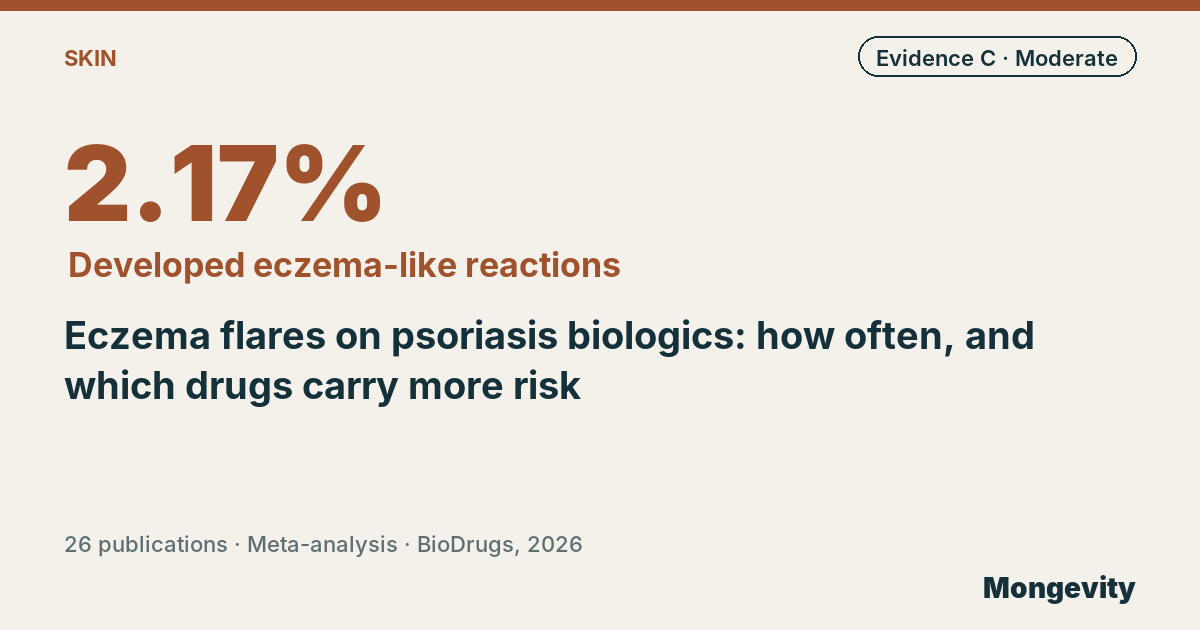
Eczema-like reactions developed in 2.17% of people treated with biologics for psoriasis, most often with IL-17 inhibitors and least with IL-23 inhibitors, in a meta-analysis published Oct. 16, 2026, in BioDrugs. The choice of psoriasis drug may matter for skin side effects.
Biologic drugs have transformed psoriasis treatment. But doctors have noticed that some patients develop a different rash while on them: patches that look like eczema, also called atopic dermatitis.
What did the study do?
Researchers searched three databases up to January 2026 for studies reporting new or worsening eczema in people with psoriasis treated with biologics that block TNF, IL-17, IL-12/23 or IL-23. They pooled 26 publications covering 34,511 treatment exposures.
What did the study find about psoriasis?
Overall, 2.17% developed an eczema-like reaction. The risk depended on the drug class:
Within the IL-17 class, rates were higher with secukinumab (5.3%) than ixekizumab (1.51%). High doses were linked to more reactions than low doses (7.65% vs. 3.36%). Studies in East Asian populations reported rates around 6%, vs. around 1% in Western populations. A personal history of atopic dermatitis was the strongest risk factor, with a hazard ratio of 12.40.
Why does this matter?
The immune pathways behind psoriasis and eczema are partly opposite. Blocking one can sometimes tip the balance toward the other. Knowing which drugs and which patients carry more risk helps dermatologists choose and monitor treatment.
How solid is this evidence?
It’s moderate. Mongevity rates it C on our A-to-E scale: a systematic review with meta-analysis, but of studies with varied designs and definitions of eczema reactions. Comparisons between drug classes come from different studies, not head-to-head trials.
What are the open questions?
It’s still unclear why some people react and others don’t, and how best to manage the rash: switching drug class, adding creams or continuing treatment.
What does this mean for you?
If you take a biologic for psoriasis and notice itchy, dry, poorly defined patches that look different from your psoriasis, show them to your dermatologist. Mention it before starting treatment if you’ve ever had eczema, since that raises the risk.
How do I explain this at dinner?
Some psoriasis drugs can, in a small number of people, trigger an eczema-like rash, because the two diseases use opposite immune pathways. It happens most with one drug family and rarely with another. A good question for the table: why might calming one immune signal wake up another?
In one sentence: eczema-like reactions occurred in 2.17% of people on psoriasis biologics, most often with IL-17 inhibitors and in those with a history of eczema.
Questions and answers
- How common are eczema reactions on psoriasis biologics?
- 2.17% overall in this meta-analysis.
- Which drugs carry more risk?
- IL-17 inhibitors (3.47%), especially secukinumab; IL-23 inhibitors had the lowest rate (0.09%).
- Who is at higher risk?
- People with a history of atopic dermatitis, with a hazard ratio of 12.40.